
CALL US 850-385-3774
When you’re comparing a 14 SEER vs 16 SEER air conditioner, the difference can seem small at first. Both numbers sound close. Both systems are designed to cool a home. Both may be offered by familiar HVAC brands like Goodman, Trane, Rheem, and others. But in Florida, where air conditioners often run through long, humid cooling seasons, that small number can make a noticeable difference in energy use, comfort, humidity control, and long-term value.
The simple answer is that a 16 SEER air conditioner is more efficient than a 14 SEER air conditioner. In a basic efficiency comparison, 16 SEER is about 14% more efficient than 14 SEER under similar conditions. That does not mean every Florida homeowner will see exactly 14% lower total electric bills, because your actual savings depend on ductwork, insulation, thermostat settings, system size, installation quality, and how often your AC runs.
There is also one major Florida-specific detail: older 14 SEER ratings are now part of a changing efficiency conversation because today’s systems are rated under SEER2. That means homeowners comparing 14 vs 16 SEER AC systems should make sure they are comparing the same rating standard before making a decision.
SEER stands for Seasonal Energy Efficiency Ratio. It measures how efficiently an air conditioner or heat pump converts electricity into cooling over a typical cooling season. A higher SEER rating means the system can provide more cooling output for the same amount of electrical energy.
For homeowners, SEER is most useful as a comparison tool. A 16 SEER air conditioner uses less energy than a 14 SEER air conditioner to deliver the same amount of cooling, assuming both systems are properly sized, installed, and maintained. That makes SEER especially important in Florida, where the cooling season is longer than it is in many other parts of the country.
SEER is not the only factor that matters, though. A higher rating does not automatically mean better comfort if the system is oversized, connected to leaky ducts, or installed without proper airflow setup. For a broader look at efficiency options, Tony Kelly’s article on energy-efficient air conditioners for Florida homes explains how system design, equipment type, and local climate all affect performance.
SEER2 is the updated efficiency rating standard used for newer HVAC equipment. It was introduced to better reflect how systems perform in real homes, especially homes with duct resistance and real-world airflow conditions. Because the newer SEER2 test is more demanding, SEER2 numbers usually look slightly lower than older SEER ratings even when the physical equipment is similar.
That is why homeowners may see numbers that look confusing during the buying process. A system that would have been described as roughly 16 SEER under the older rating system may now appear closer to 15.2 SEER2. A 14 SEER system may translate closer to about 13.4 SEER2.
This matters because Florida falls under the Southeast efficiency region. For many new split-system central AC installations, the minimum standard is now higher than the old 14 SEER baseline. In practical terms, if someone is comparing an older-style 14 SEER vs 16 SEER air conditioner, the 16 SEER option is usually closer to what current Florida replacement conversations look like.
When reviewing quotes, ask whether the rating shown is SEER or SEER2. Comparing SEER to SEER2 directly can make one system look better or worse than it really is.
The efficiency difference between 14 SEER and 16 SEER is simple to estimate. Divide 16 by 14, and you get about 1.14. That means a 16 SEER system is roughly 14% more efficient than a 14 SEER system under similar operating conditions.
Another way to look at it is this: for the same amount of cooling, a 16 SEER system should use less electricity. If a 14 SEER air conditioner used a certain amount of energy to cool your home, a comparable 16 SEER air conditioner would typically use about 12% to 14% less energy for that same cooling load.
That savings matters more in Florida than in a mild climate because AC systems run more often. A homeowner in a cooler state might only rely on air conditioning for a short season. A homeowner in Tallahassee may use cooling for much of the year, especially during humid spring, summer, and early fall weather.
Still, 14 SEER vs 16 SEER energy savings are not guaranteed to show up perfectly on your utility bill. Your full electric bill includes appliances, lighting, water heating, electronics, and other household loads. The SEER rating only applies to cooling efficiency.
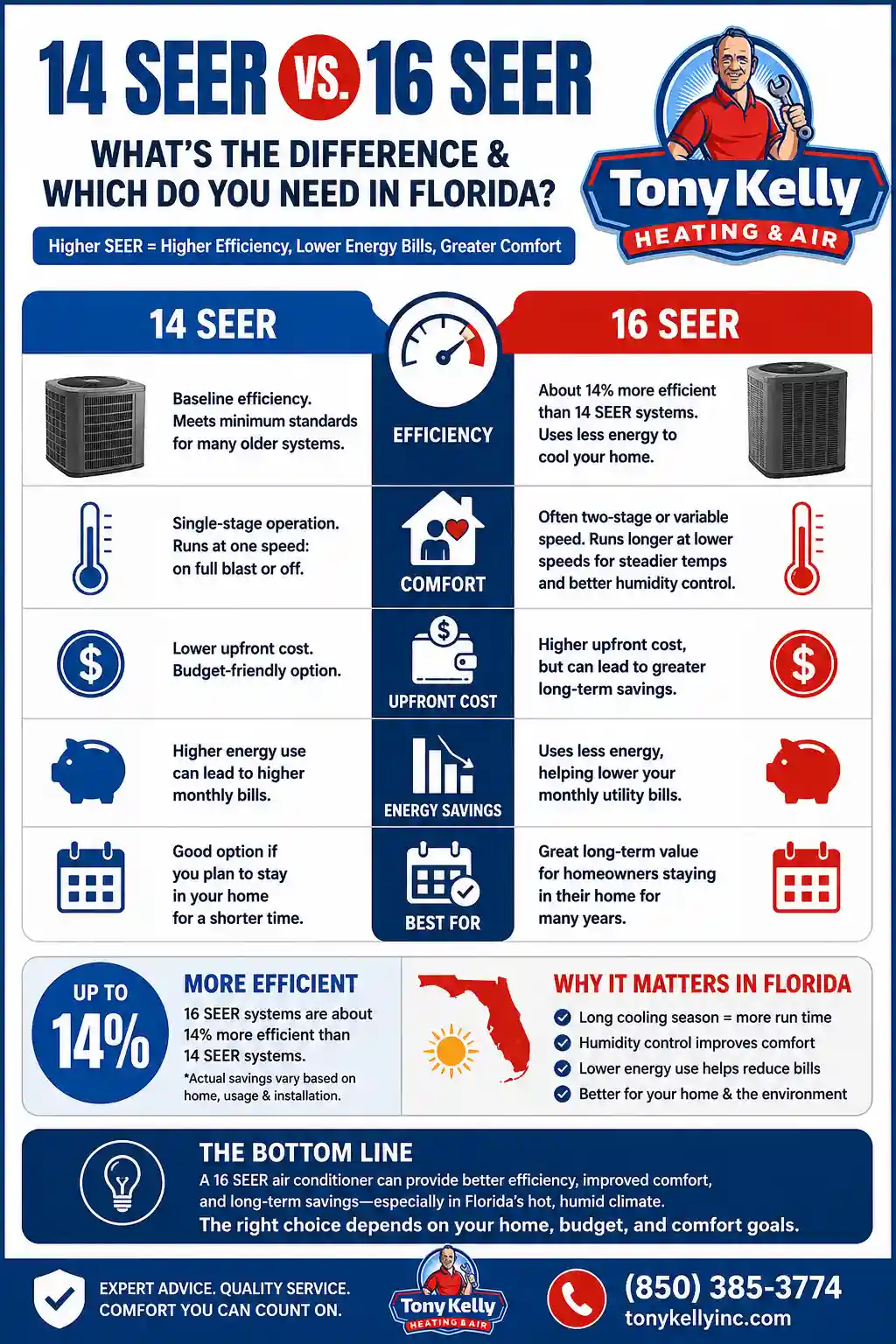
Many homeowners focus only on energy savings, but comfort is often the bigger day-to-day difference. A 14 SEER air conditioner is commonly a single-stage system. Single-stage equipment runs at full capacity when it is on and shuts off when the thermostat is satisfied.
That approach can cool the air, but it may not always provide the best humidity control in Florida. If the system cools the home quickly and shuts off too soon, it may not run long enough to remove as much moisture from the indoor air.
A 16 SEER air conditioner is more likely to include upgraded components, such as a two-stage compressor, variable-speed blower, or more refined airflow design. Not every 16 SEER model has the same features, but many mid-efficiency systems are designed to run longer at lower output. That can help keep temperatures steadier and remove more humidity.
In Florida homes, humidity control can affect comfort as much as temperature. A house set to 74 degrees can still feel sticky if the system is not removing enough moisture. That is why some homeowners find that a 16 SEER system feels more comfortable even when the thermostat setting stays the same.
The 14 SEER vs 16 SEER price difference depends on the brand, system size, indoor equipment match, compressor type, installation conditions, ductwork, thermostat setup, and whether additional work is needed. A 16 SEER system usually costs more upfront than a 14 SEER system because it often includes more efficient components.
That does not automatically mean the higher-efficiency option is always the better financial choice. The decision depends on how long you plan to stay in the home, how much your AC runs, and how large the price gap is between the systems being quoted.
If you plan to stay in the home for many years, the lower operating cost of a 16 SEER system may become more meaningful. If you plan to sell soon, your decision may depend more on upfront cost, code compliance, and basic reliability. Tony Kelly’s article on ways to save on a new AC unit can help you think through replacement timing, rebates, and quote comparisons without focusing only on the equipment sticker price.
Homeowners often search for Goodman 14 SEER vs 16 SEER, Trane 14 SEER vs 16 SEER cost, or Rheem 14 vs 16 SEER because they are comparing specific quotes. Brand matters, but the SEER rating alone does not tell the whole story.
Two systems with the same SEER rating can have different compressor designs, sound levels, cabinet construction, warranty terms, indoor coil matches, blower performance, and humidity control capabilities. A 16 SEER Goodman system, a 16 SEER Trane system, and a 16 SEER Rheem system may all meet similar efficiency targets, but they may not be identical in comfort features or installation requirements.
The most important thing is to compare full matched systems, not just outdoor units. The outdoor condenser, indoor coil, air handler or furnace, refrigerant charge, ductwork, and thermostat all influence how the system performs. Tony Kelly’s HVAC brands we service page is a helpful reference if you are trying to understand how different brands fit into repair, maintenance, and replacement conversations.
If you already have a Trane system and are weighing repair versus replacement, the information on Trane AC repair in Tallahassee may help you understand when brand-specific service history should be part of the decision.
The 14 vs 16 SEER heat pump comparison is similar on the cooling side because SEER and SEER2 measure cooling efficiency. A 16 SEER heat pump should be more efficient in cooling mode than a 14 SEER heat pump under similar conditions.
However, heat pumps also have heating efficiency ratings, including HSPF and HSPF2. In North Florida, heat pumps are common because they can provide both cooling and heating. That means homeowners should compare both cooling and heating efficiency when evaluating a heat pump replacement.
A higher-efficiency heat pump may be attractive if you want better year-round performance, but the right choice still depends on your home’s size, insulation, ductwork, and comfort goals. If heating performance is part of your decision, do not rely on SEER alone. Review the full equipment specifications and ask how the system will perform during both cooling and heating seasons.
A 16 SEER air conditioner often makes sense for Florida homeowners when:
In Florida, the longer cooling season gives higher-efficiency equipment more opportunity to save energy. That is why 16 SEER or comparable SEER2-rated systems are often a practical middle ground between basic equipment and premium high-efficiency systems.
While old 14 SEER split systems are generally not the standard for new Florida installations, the broader idea of choosing a lower-efficiency option may still come up when comparing code-compliant baseline systems against higher-efficiency upgrades.
A lower-cost, code-compliant system may be worth discussing if:
That is why the decision should not be made from the SEER rating alone. A well-sized, properly installed baseline system can perform better than a higher-rated system installed on poor ductwork or sized incorrectly.
A 16 SEER air conditioner only performs like a 16 SEER system when the installation supports it. If the system is oversized, undersized, poorly charged, or connected to restrictive ductwork, it may use more energy and deliver less comfort than expected.
Important installation factors include:
This is one reason homeowners comparing options should not only ask, “Is this 14 SEER or 16 SEER?” They should also ask how the system will be sized, installed, commissioned, and matched to the home.
Florida homes often have ductwork located in attics, crawl spaces, garages, or other hot and humid spaces. If ducts are leaking, disconnected, poorly insulated, or undersized, conditioned air may be lost before it reaches the rooms where it is needed.
In that situation, upgrading from 14 SEER to 16 SEER may still help, but the full benefit may be limited. The system may be more efficient on paper, but the home may still feel uncomfortable if air is not moving properly.
Humidity can also affect how efficient a home feels. A system that cools quickly but does not dehumidify well may cause homeowners to lower the thermostat to feel comfortable. That can increase energy use. A properly sized 16 SEER system with better staging may help the home feel comfortable at a slightly higher thermostat setting because it removes more moisture.
For homeowners looking for non-replacement ways to improve comfort, Tony Kelly’s HVAC energy-saving tips cover maintenance habits and home adjustments that can support better system performance.
If your current AC is still running, the 14 SEER vs 16 SEER question may come up during a repair decision. Older systems may have lower efficiency ratings, worn components, outdated refrigerant, or recurring repair needs. In that case, replacing the system with a higher-efficiency model may reduce operating costs and improve comfort.
That does not mean every repair issue should lead to replacement. A newer system with an isolated repair may still have useful life left. An older system with repeated failures, rising energy use, or poor humidity control may be a stronger replacement candidate.
The key is to compare total cost, not just the immediate repair bill. Tony Kelly’s article on AC repair vs AC replacement in Tallahassee can help homeowners think through age, repair frequency, comfort, and efficiency before making a decision.
The longer you plan to stay in your home, the more time you have to benefit from higher efficiency. If you expect to live in the house for the next 10 years, the energy savings, quieter operation, and humidity benefits of a 16 SEER system may be more valuable.
If you plan to sell soon, a code-compliant replacement may still be important, but the most expensive efficiency upgrade may not always provide the best return. Buyers may appreciate a newer system, but they may not pay a premium equal to the full upgrade cost.
Equipment age also matters. If your system is approaching the end of its expected lifespan in Florida, it may be wise to plan ahead rather than wait for a major breakdown during peak cooling season. Tony Kelly’s post on how long AC units last in Florida’s climate explains why heat, humidity, maintenance, and runtime all affect system life.
Before choosing between efficiency levels, ask these questions:
For homeowners who are already planning a replacement, Tony Kelly’s complete AC replacement guide for Tallahassee walks through additional factors that can affect the installation process and long-term performance.
For most Florida homeowners comparing 14 SEER vs 16 SEER, the practical answer is that 16 SEER or a comparable SEER2-rated system is usually the better fit for a new installation. It is more efficient, better aligned with current standards, and often offers improved comfort features.
A 14 SEER system may still be relevant if you are talking about older existing equipment, past system ratings, or packaged equipment categories, but it is generally not the right benchmark for a new split-system AC replacement in Florida today.
The best choice is not always the highest SEER rating available. Many homeowners do well with a mid-efficiency system that balances upfront cost, energy savings, humidity control, and reliability. The right answer depends on your home, your budget, your comfort goals, and the quality of the installation.
In many Florida homes, yes. A 16 SEER air conditioner is roughly 14% more efficient than a 14 SEER system under similar conditions. Because Florida has a long cooling season, that difference can matter more here than it would in a cooler climate. The final decision depends on the price difference, installation quality, ductwork, and how long you plan to stay in the home.
A 16 SEER system is about 14% more efficient than a 14 SEER system. Another way to estimate the savings is that a 16 SEER system may use about 12% to 14% less electricity for the same cooling output.
Not exactly. The SEER rating applies to cooling efficiency, not your entire electric bill. Your total bill includes lights, appliances, electronics, water heating, and other energy use. A 16 SEER system can reduce the cooling portion of your bill, but the total household reduction will depend on how much of your bill comes from air conditioning.
Yes. Existing systems that were properly installed before the updated standards can continue operating. The newer requirements apply to new installations and replacements, not to systems already in place.
For many new split-system central AC installations, older 14 SEER equipment no longer meets Florida’s current minimum efficiency requirements. Homeowners should confirm the SEER2 rating on any proposed system and make sure it meets current regional standards.
A 14 SEER system is roughly equivalent to about 13.3 to 13.4 SEER2, depending on the equipment. SEER2 numbers are lower because the updated test is more demanding and better reflects real-world duct conditions.
A 16 SEER system is commonly estimated at about 15.2 SEER2. That is one reason 16 SEER equipment is more relevant in today’s Florida replacement conversations than older 14 SEER equipment.
Yes, 16 SEER is generally a strong middle-ground efficiency level for many Florida homes. It is more efficient than older 14 SEER equipment and may include comfort upgrades such as two-stage operation, improved humidity control, and quieter performance.
Not always. Higher SEER systems can reduce energy use, but they usually cost more upfront. The best system is the one that fits your home, budget, ductwork, comfort needs, and expected length of ownership. Installation quality is just as important as the rating.
Brand matters, but it should not be the only factor. Goodman, Trane, Rheem, and other brands may offer systems at similar efficiency levels, but features, matched components, warranties, and installation requirements can vary. Compare the full system, not just the outdoor unit or brand name.
That depends on whether you want one system that provides both cooling and heating. Heat pumps are common in North Florida because winters are generally mild. When comparing heat pumps, look at both cooling efficiency and heating efficiency, including SEER2 and HSPF2 ratings.
Both matter. SEER tells you how efficient the equipment can be under proper conditions, but ductwork determines how well cooled air reaches the home. Leaky, undersized, or poorly insulated ducts can reduce the real-world benefit of a higher SEER system.
Start with your home’s size, insulation, duct condition, cooling usage, humidity concerns, budget, and how long you plan to stay in the home. Then compare SEER2-rated systems that meet current Florida requirements and ask for a proper load calculation before choosing.
When comparing 14 SEER vs 16 SEER in Florida, the 16 SEER option is usually the more practical and future-ready choice for new equipment. It offers better efficiency, stronger alignment with current SEER2 standards, and often better humidity control in a climate where moisture matters.
That said, the best air conditioner is not chosen by SEER rating alone. Proper sizing, ductwork, installation quality, thermostat setup, maintenance, and your long-term plans all shape the real value of the system. A 16 SEER air conditioner can be a smart choice for many Florida homes, but it should be selected as part of a complete comfort plan, not just because the number is higher.
Address:
870 Blountstown Hwy. Unit # 9
Tallahassee, FL 32303
Phone: 850-385-3774
License #: CMC1249702
Open Monday Through Friday
8:00 am to 8:00 pm

