
CALL US 850-385-3774
If you live in North Florida, dust can feel constant. You wipe down surfaces, clean your floors, and still notice a light layer returning within a day or two. It’s a common frustration—especially in homes that run air conditioning most of the year.
One question comes up often: does air duct cleaning actually reduce dust in Florida homes?
The short answer is that it can help in certain situations, but it is not a universal fix. Dust is created in many places throughout a home, and ductwork is only one part of the system that moves it around.
Understanding when duct cleaning makes a difference—and when it doesn’t—can help you make better decisions about your home’s comfort and maintenance.
For broader context on indoor air and HVAC systems in this region, you can explore the full blog library here: Tony Kelly HVAC blog.
Florida’s environment plays a major role in how dust behaves indoors. Unlike drier regions, homes here deal with high humidity for much of the year, along with extended cooling seasons and regular outdoor particle exposure.
Several factors make dust more noticeable:
These conditions don’t just increase dust—they change how it moves, settles, and recirculates.
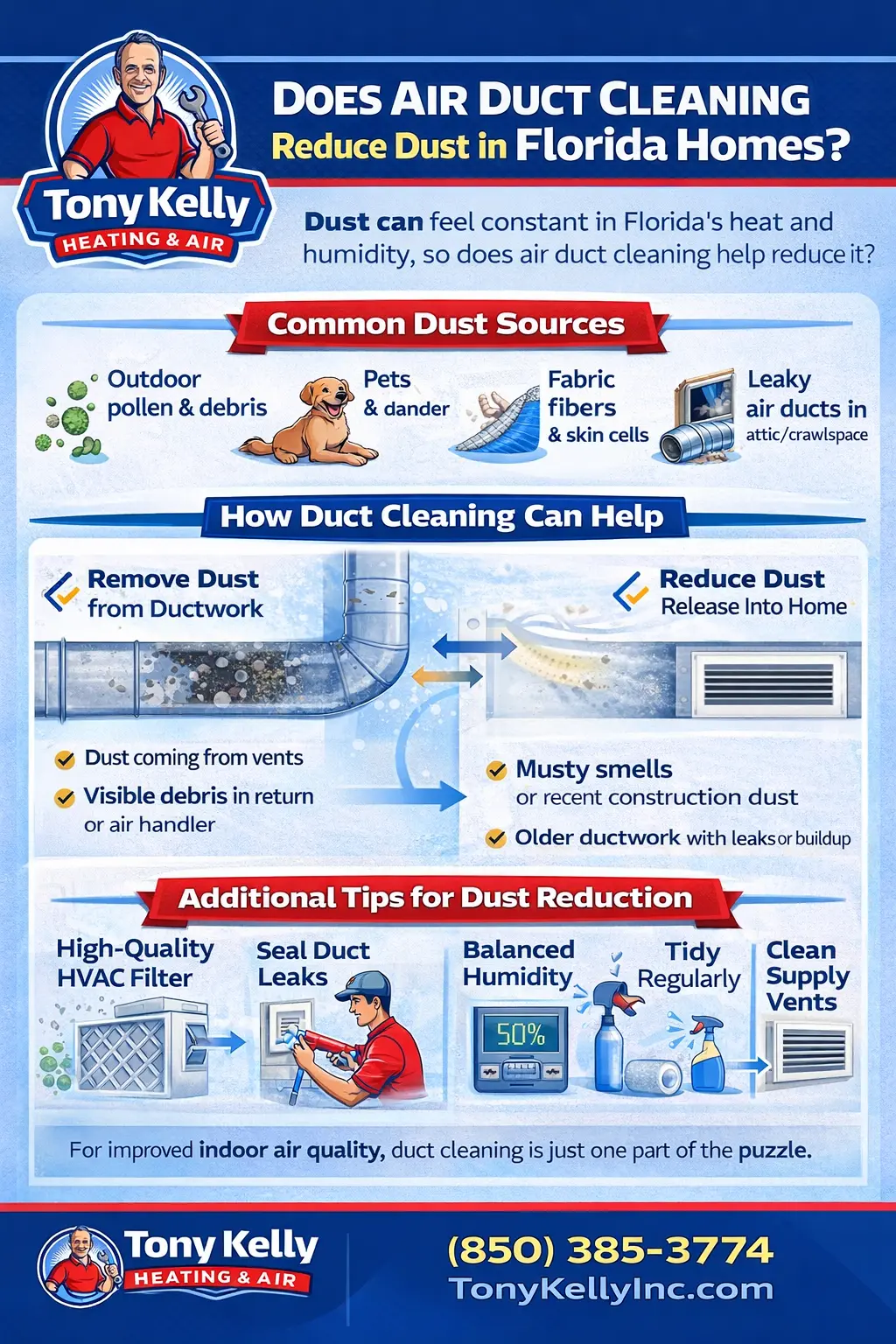
Before focusing on ductwork, it helps to understand where dust originates. In most homes, the majority of dust comes from everyday living rather than the HVAC system itself.
This means that even a perfectly clean duct system will not eliminate dust entirely. Instead, duct cleaning addresses one potential contributor: recirculated dust inside the HVAC system.
Click to Enlarge
Duct systems move air throughout your home. Over time, dust can collect inside those pathways—especially when filtration is not optimal or when outside air enters through leaks.
Dust accumulation in ducts can happen when:
When enough buildup exists, airflow can dislodge particles and push them back into living spaces.
For a deeper look at this relationship, see: how air duct cleaning impacts indoor air quality in Florida homes.
Duct cleaning is most effective when the duct system is clearly contributing to dust levels.
Situations where it may help include:
In these cases, cleaning can reduce the amount of dust being recirculated through the system.
For additional context, you can review: benefits of air duct cleaning.
In many homes, dust is generated primarily from surfaces, fabrics, and daily living activities. In these situations, duct cleaning alone may not produce a noticeable difference.
Common examples include:
In these cases, improving filtration and routine cleaning habits typically has a larger impact than duct cleaning alone.
This is one of the most important questions homeowners ask. The answer varies depending on the condition of your system.
After duct cleaning, some homeowners notice:
However, duct cleaning does not eliminate dust entirely. It works best when combined with other steps like filtration and humidity control.
Humidity affects how dust behaves indoors. In Florida, moisture in the air can cause particles to stick together and adhere to surfaces more easily.
This can make dust appear heavier or more visible—even if the total amount has not increased significantly.
Managing humidity can improve how dust behaves indoors. Learn more here: how whole-home dehumidifiers work in Florida’s humid climate.
If your goal is to reduce dust, it’s helpful to look at the full system:
These factors often have a greater overall impact than duct cleaning alone.
In Tallahassee, dust concerns often relate to older duct systems and long cooling seasons. If you suspect duct buildup or leaks, you can review local service context here: air duct cleaning in Tallahassee.
Nearby areas share similar conditions: air duct cleaning in Crawfordville.
The effectiveness of duct cleaning depends on how thoroughly it is performed and whether the entire system is addressed.
For a step-by-step explanation, visit: the process of professional air duct cleaning explained.
Dust is only one part of indoor air quality. A complete approach considers airflow, filtration, humidity, and system condition.
To explore these factors further, visit: indoor air quality services.
It can reduce dust when ductwork contains buildup or is pulling in debris from outside spaces. If dust mainly comes from daily living, results may be limited.
Results vary. Some homes see noticeable improvements near vents, while others experience only minor changes.
It may help if allergens are present in the duct system, but overall air quality depends on multiple factors.
This depends on system condition, usage, and environmental factors rather than a fixed schedule.
No. Dust is constantly generated inside homes, so cleaning ducts is only one part of reducing it.
Visible dust at vents, debris in registers, and rapid filter buildup can indicate duct issues.
In some cases, removing buildup can help airflow, especially if debris was restricting movement.
Humidity can influence dust behavior, but cleaning effectiveness still depends on system condition.
Filters should always be maintained first, as they play a primary role in dust control.
Duct cleaning removes buildup, while air purification focuses on filtering particles during operation.
Address:
870 Blountstown Hwy. Unit # 9
Tallahassee, FL 32303
Phone: 850-385-3774
License #: CMC1249702
Open Monday Through Friday
8:00 am to 8:00 pm

