Those questions matter in Tallahassee and throughout North Florida, where air conditioning systems spend much of the year cooling and removing moisture from indoor air. The right decision depends on much more than the age of the equipment. Warranty coverage, refrigerant type, leak location, compressor condition, previous repairs, coil compatibility, system performance, and the total repair cost should all be considered.
This guide explains how evaporator coil problems are diagnosed, what affects replacement cost, when a coil may be repairable, and how to compare evaporator coil replacement with a complete AC replacement.
Quick Answer: Replace the Coil or Replace the AC?
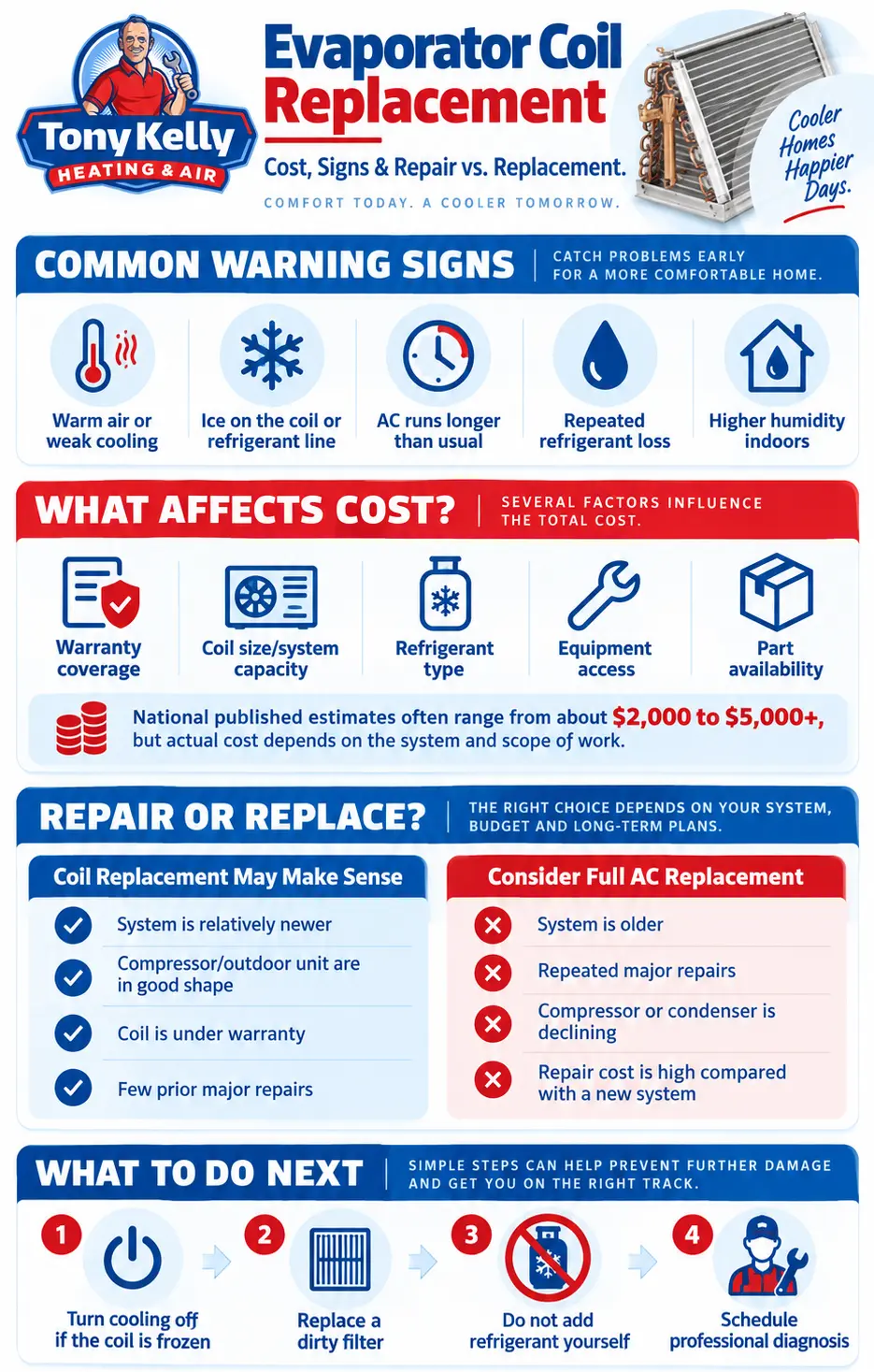
Evaporator coil replacement may make sense when the air conditioner is relatively young, the compressor and outdoor unit are in good condition, a properly matched replacement coil is available, and warranty coverage reduces the cost of the repair.
Full AC replacement deserves stronger consideration when the system is older, has required several expensive repairs, has a deteriorating compressor or condenser, has ongoing comfort problems, or needs an unusually expensive or difficult-to-source coil.
Before approving either option, ask the HVAC contractor to confirm the leak location, explain how it was found, determine whether the leak itself is repairable, verify warranty coverage and coil compatibility, and compare the complete coil-replacement price with the cost of replacing the system.
There is no universal age or dollar amount at which AC replacement automatically becomes the better decision. The condition of the entire system matters.
What Does an Evaporator Coil Do?
The evaporator coil is located in the indoor portion of a central air conditioner or heat pump, usually inside or near the air handler. Its main job is to absorb heat from the air inside your home.
Cold refrigerant moves through tubing inside the coil while the blower moves warm indoor air across its surface. Heat transfers from the indoor air into the refrigerant, allowing cooler air to move back through the ductwork. The refrigerant then carries the absorbed heat toward the outdoor unit, where that heat can be released.
The evaporator coil also plays an important role in humidity control.
Warm, humid air contains water vapor. As that air moves across the cold coil, moisture condenses on its surface and drains through the condensate system. This means the evaporator coil helps the AC system both cool and dehumidify the home.
A problem affecting the coil can therefore contribute to weak cooling, excessive run times, icing, poor humidity control, refrigerant loss, or eventually a complete loss of cooling.
Several other HVAC problems can create similar symptoms, however. Homeowners experiencing poor cooling should have the cause diagnosed before assuming the coil needs replacement. Tony Kelly provides professional AC repair in Tallahassee for refrigerant problems, frozen systems, poor cooling, and other air conditioning failures.
Signs Your Evaporator Coil May Be Failing
A bad evaporator coil does not always produce one unmistakable symptom. In many cases, homeowners first notice that the air conditioner simply is not performing as well as it used to.
Your AC Runs but the House Stays Warm
A leaking evaporator coil can gradually reduce the refrigerant charge. As refrigerant is lost, the AC may lose cooling capacity and run for increasingly long periods without reaching the thermostat setting.
Poor cooling does not automatically mean the coil is leaking. Dirty equipment, airflow restrictions, duct problems, compressor issues, electrical failures, and other conditions can also reduce cooling performance.
Ice Forms on the Coil or Refrigerant Line
Ice around the indoor coil or the larger refrigerant line near the air handler is another common warning sign.
An evaporator coil requires adequate airflow and correct refrigerant conditions to operate within its intended temperature range. Several problems can cause it to become cold enough for condensation on the coil to freeze, including:
- Low refrigerant
- A refrigerant leak
- A dirty air filter
- Restricted airflow
- A dirty evaporator coil
- Blower problems
- Duct restrictions
A frozen coil therefore does not automatically mean the evaporator coil itself needs replacement.
The System Keeps Needing Refrigerant
Air-conditioning refrigerant circulates through a sealed system. It is not normally consumed during everyday operation.
A system that repeatedly becomes low on refrigerant may have a leak that needs to be located. The evaporator coil is one possible source, but refrigerant can also escape from a line set, fitting, valve, outdoor coil, or another portion of the sealed system.
Repeatedly adding refrigerant without identifying why it is being lost can temporarily restore cooling without resolving the actual problem.
Cooling Performance Gradually Declines
Small refrigerant leaks may develop slowly. A homeowner might initially notice longer cooling cycles, higher indoor humidity, or rooms taking longer to reach the thermostat setting before the loss of performance becomes more obvious.
You Hear Hissing Near the Indoor Unit
Escaping refrigerant can sometimes produce a hissing sound near the coil or refrigerant connections. Small leaks may make no noticeable sound at all, so hissing is only one possible clue.
A Technician Finds Oily Residue
Refrigeration systems circulate oil with the refrigerant. Oily residue around damaged tubing or a fitting can sometimes help a technician identify an area that deserves further leak testing.
Important: Low Refrigerant Does Not Automatically Mean a Bad Evaporator Coil
A low refrigerant charge does not identify where refrigerant is being lost.
The source could be the evaporator coil, outdoor coil, line set, service valve, fitting, or another connection. An improperly charged system can also create refrigerant-related performance problems.
Before approving an expensive evaporator coil replacement, ask the technician how the leak location was confirmed.
“The system is low on refrigerant” and “the evaporator coil has a confirmed leak” are not the same diagnosis.
What to Do if You Suspect an Evaporator Coil Problem
A few homeowner-safe checks can help protect the equipment while you arrange a professional diagnosis.
1. Check the Air Filter
A severely dirty filter can restrict airflow enough to contribute to freezing and poor cooling. Replace a visibly dirty or overdue filter with the correct size and type for your system.
2. Look for Ice
Inspect accessible portions of the refrigerant line and indoor HVAC equipment. If you see significant ice, turn the thermostat from COOL to OFF.
Continuing to run the compressor while the indoor coil is frozen will not correct the problem.
3. Let the Coil Thaw
If the blower is operating normally, setting the thermostat fan to ON may help circulate room-temperature air and speed thawing.
Do not chip, scrape, or pry ice from the evaporator coil. The tubing and thin aluminum fins can be damaged easily.
4. Look for Water Around the Air Handler
Water near the indoor HVAC unit does not necessarily mean refrigerant is leaking. It could come from melting ice, a clogged condensate drain, a drain-pan problem, or another moisture issue.
5. Arrange Professional Diagnosis
Recurring icing, weak cooling, repeated refrigerant loss, or an AC that cannot maintain the thermostat setting needs testing before anyone can confidently recommend refrigerant, coil repair, or replacement.
How Does a Technician Confirm an Evaporator Coil Leak?
An evaporator coil replacement should begin with diagnosis rather than assumption.
The exact leak-detection process depends on the equipment and the nature of the problem, but technicians may use several methods.
Electronic Leak Detection
An electronic refrigerant leak detector can help locate refrigerant escaping from the coil, fittings, line set, or other components.
Leak-Detection Solution
A leak-detection solution can be applied to an accessible suspected area. Escaping gas may create bubbles at the leak location.
Ultraviolet Dye
Some diagnostic situations may involve approved UV dye that circulates with the refrigeration system and becomes visible at a leak location.
Pressure Testing and Component Isolation
Additional testing may be required when a leak is difficult to locate or when a technician needs to determine which portion of the sealed system is losing refrigerant.
The objective is not merely to determine that refrigerant is low. The useful question is:
Where is the refrigerant escaping?
That information helps determine whether an accessible connection may be repairable or whether deterioration inside the coil makes replacement more appropriate.
How Much Does Evaporator Coil Replacement Cost?
Evaporator coil replacement is often a significant HVAC repair, but there is no reliable one-price-fits-all figure.
For a useful national reference point, Trane’s 2026 evaporator coil replacement guide estimates that replacement can cost approximately $2,000 to $5,000 or more, depending on the system and circumstances.
That is a national manufacturer estimate, not a Tony Kelly quote or a Tallahassee-specific price range. Actual North Florida pricing can vary substantially based on the individual installation.
| Situation | What Can Affect Your Out-of-Pocket Cost |
|---|---|
| Coil covered by a parts warranty | Labor, refrigerant, diagnostics, access, materials, recovery, testing, and other items may still be the homeowner’s responsibility. |
| Out-of-warranty coil replacement | The estimate may include the coil itself plus labor, refrigerant, fittings, materials, testing, evacuation, and commissioning. |
| Repairable fitting or connection | Cost depends on leak location, accessibility, repair labor, testing, and how much refrigerant must be restored. |
| Full AC replacement | The cost reflects new indoor and outdoor equipment, installation, matched-system requirements, commissioning, warranty coverage, and any necessary system modifications. |
What Changes the Price of Evaporator Coil Replacement?
Warranty Coverage
A manufacturer’s parts warranty may cover the replacement coil itself without covering the complete repair.
Labor, refrigerant, diagnostics, materials, and related work may remain the homeowner’s responsibility. That is why a “warranty coil” can still result in a substantial bill.
Coil Size and System Capacity
Larger air-conditioning and heat-pump systems typically use larger coils. Capacity, design, and equipment configuration can affect component cost and labor requirements.
Accessibility
An air handler in an accessible mechanical closet may be significantly easier to work on than equipment located in a cramped attic or difficult horizontal installation.
Refrigerant Type and Charge
Evaporator coil replacement requires work on the sealed refrigerant circuit. The refrigerant must be handled appropriately, and the system must be evacuated and returned to the correct charge after the repair.
Manufacturer and Part Availability
Some replacement coils are readily available. Others may be expensive, backordered, obsolete, or limited to specific compatible models.
Additional Repairs or Modifications
Drain components, fittings, insulation, sheet metal, cabinet transitions, or other parts may also need attention during the repair.
What Should an Evaporator Coil Replacement Estimate Include?
Homeowners should compare more than the bottom-line price.
Depending on the system, a complete evaporator coil replacement may involve:
- Leak diagnosis and confirmation
- The replacement evaporator coil
- Refrigerant recovery
- Removal of the existing coil
- Refrigerant-line connections
- Brazing or other approved connection work
- Pressure testing
- System evacuation
- Refrigerant charging
- Condensate drain reconnection
- Insulation or cabinet adjustments when needed
- Startup and commissioning
- Final operating checks
Because coil replacement opens the sealed refrigerant circuit, technicians must follow applicable refrigerant-handling requirements. The EPA’s Section 608 service-practice requirements regulate refrigerant recovery and handling during stationary air-conditioning service.
A much lower quote does not necessarily represent the same scope of work. Ask what is included before comparing estimates solely by price.
Why Do Evaporator Coils Develop Leaks?
Evaporator coils can leak for several reasons, including corrosion, physical damage, vibration, weakened joints, manufacturing defects, and deterioration over time.
One type of corrosion worth understanding is formicary corrosion.
What Is Formicary Corrosion?
Formicary corrosion is a type of microscopic corrosion associated with copper tubing. Moisture on the evaporator coil can combine with contaminants and volatile organic compounds, or VOCs, in indoor air. Under the right conditions, chemical reactions can create acids that attack the copper surface and form tiny tunneling patterns within the metal.
Eventually, the affected copper can become thin enough for microscopic pinhole refrigerant leaks to develop.
Industry publications have documented formicary corrosion in residential evaporator coils for years. ACHR News has described how airborne contaminants can combine with condensation on indoor coils and contribute to this type of copper corrosion.
Household VOCs can come from many sources, including paints, flooring, building materials, cleaning products, adhesives, personal-care products, and other substances.
North Florida’s humidity should not be treated as the sole cause of coil corrosion. However, evaporator coils routinely operate with condensation on their surfaces, making moisture management, indoor air conditions, coil construction, installation quality, and system maintenance all relevant to long-term performance.
Copper vs. Aluminum Evaporator Coils
Older and newer HVAC systems may use different coil designs and materials.
Formicary corrosion is particularly associated with copper tubing. Some manufacturers have moved toward all-aluminum evaporator coil designs partly to reduce susceptibility to this specific form of copper corrosion.
That does not mean every aluminum coil is automatically superior or immune to every type of corrosion. Design quality, installation, environment, drainage, maintenance, system matching, and manufacturing all matter.
Homeowners concerned about humidity or other indoor comfort issues can also learn more about Tony Kelly’s indoor air quality services.
Can a Leaking Evaporator Coil Be Repaired?
Sometimes.
The answer depends heavily on what is leaking and where the leak is located.
| Leak Location or Coil Condition | Could Repair Be Possible? | Why It Matters |
|---|---|---|
| Accessible fitting or connection | Often, depending on the condition | The leak may be isolated to a connection rather than deterioration throughout the coil. |
| Accessible braze joint | Sometimes | Repair depends on access, tubing condition, system requirements, and the nature of the failure. |
| Single accessible tubing leak | Possibly | The technician must determine whether a durable repair is practical. |
| Corroded coil tubing | Often less practical | Repairing one weakened area may not prevent another location from leaking later. |
| Multiple pinhole leaks | Replacement becomes more likely | Multiple leaks may indicate broader deterioration rather than one isolated defect. |
| Leak not yet located | Too early to decide | The source should be confirmed before making a major repair recommendation. |
This distinction is important because “evaporator coil repair” can describe very different situations. Repairing an accessible connection is not the same as attempting to extend the life of a deteriorated coil with numerous weak points.
Evaporator Coil Replacement vs. Replacing the Entire AC
This is usually the most important financial decision in the process.
A coil replacement costs considerably less than a complete air-conditioning system in many situations. However, spending several thousand dollars on a major component in an aging system is not automatically a good investment.
Compare the entire HVAC system, not simply the failed coil.
| Factor | Coil Replacement May Make Sense | Full AC Replacement Deserves Stronger Consideration |
|---|---|---|
| System age | The equipment is relatively young. | The equipment is older and several components are showing wear. |
| Warranty | The coil still has parts coverage. | Parts coverage has expired and the repair is expensive. |
| Compressor | The compressor is operating normally. | The compressor has problems or signs of deterioration. |
| Outdoor unit | The condenser is otherwise reliable and in good condition. | The outdoor equipment has corrosion, electrical issues, or repeated problems. |
| Repair history | The system has required few major repairs. | Several costly repairs have already been made. |
| Coil availability | A correct replacement is readily available. | The coil is obsolete, difficult to obtain, or unusually expensive. |
| Comfort | The system cooled and dehumidified the home effectively before the failure. | Humidity, uneven cooling, noise, or other comfort problems already existed. |
| Efficiency | Operating costs remain reasonable. | The homeowner is already concerned about efficiency and operating costs. |
| Cost comparison | The repair is meaningfully less expensive than replacement. | The repair represents a substantial investment in equipment with limited expected remaining life. |
Example: A Newer AC With a Failed Coil
Consider a five-year-old system with a confirmed coil leak.
The compressor is healthy, the outdoor unit is in good condition, the system has had few previous problems, a properly matched replacement coil is available, and the coil itself still has manufacturer parts coverage.
Coil replacement may allow that homeowner to preserve many years of useful service without replacing equipment that otherwise operates properly.
Example: An Older AC With Multiple Problems
Now consider a 12-year-old air conditioner with a leaking evaporator coil.
The system has already required several significant repairs. Cooling performance and humidity control have declined, the coil is no longer covered by a parts warranty, and the outdoor equipment is also showing substantial age.
That homeowner should compare the complete coil-replacement estimate with the cost and benefits of AC replacement in Tallahassee before investing heavily in the existing equipment.
What About the “$5,000 Rule” or 50% Rule?
Homeowners may encounter HVAC rules of thumb that multiply the age of the system by the repair price or suggest replacing equipment once a repair reaches a certain percentage of the cost of a new system.
These formulas can be useful as conversation starters, but they should not make the decision by themselves.
A seven-year-old system with a warranty-covered coil and a healthy compressor is different from a seven-year-old system that has suffered repeated major failures.
Use repair-cost ratios as one factor alongside warranty coverage, repair history, component condition, compatibility, system performance, and expected remaining service life.
Does an R-410A Coil Leak Mean You Must Replace the Whole AC?
No—not automatically.
This has become an important source of confusion as newly manufactured residential HVAC equipment transitions toward lower-global-warming-potential refrigerants.
EPA guidance also explains that homeowners can replace a failed component such as an indoor coil with a similar R-410A component when servicing an existing system. R-410A evaporators and other specified components manufactured after January 1, 2025 can continue to be produced for this purpose, although they must be labeled for “servicing existing equipment only.”
Those components can continue to be sold for repairing legacy R-410A systems.
What has changed is the installation of new systems using higher-GWP refrigerants—not a homeowner’s ability to repair an existing R-410A system throughout its useful life.
What About R-32 and R-454B?
Many newer residential HVAC systems use lower-GWP refrigerants such as R-32 or R-454B. These refrigerants have different properties and equipment requirements from R-410A.
They should not simply be added to an existing R-410A system. EPA guidance notes that mildly flammable refrigerants such as R-32 and R-454B cannot be used in equipment that was not designed for them.
For an existing R-410A system with a leaking coil, the more useful questions are therefore:
- Is the correct R-410A replacement coil available?
- Is it properly matched with the existing outdoor equipment?
- How much will the complete repair cost?
- How old is the equipment?
- What condition are the compressor and condenser in?
- How reliable has the system been?
- Would investing more in the existing equipment make sense for the homeowner?
The refrigerant transition should be part of the discussion, but it does not automatically make every existing R-410A system unrepairable.
Why Replacement Coil Compatibility Matters
A replacement evaporator coil needs to do more than physically fit inside the air handler.
The indoor and outdoor components of a split HVAC system are designed to operate together. Capacity, refrigerant, airflow, metering equipment, coil construction, and the outdoor unit all affect overall performance.
The Air-Conditioning, Heating, and Refrigeration Institute explains that split-system indoor and outdoor equipment should operate as a coordinated matched system. AHRI certifies performance for specific indoor/outdoor combinations and assigns certified combinations a reference number.
A homeowner considering coil replacement can ask the contractor:
“What are the indoor and outdoor model numbers, and how do you know this replacement coil is an appropriate match for my existing system?”
That is especially useful when a proposed replacement coil differs from the original equipment.
An inappropriate match can potentially affect capacity, efficiency, humidity removal, or other aspects of system performance.
What Should Be Evaluated Before Recommending Coil Replacement?
A leaking evaporator coil should not be considered in isolation.
A thorough repair-versus-replacement discussion should consider:
- The confirmed leak location
- The condition of the coil
- System age
- Warranty status
- Refrigerant type
- Availability of an appropriate replacement coil
- Indoor/outdoor equipment compatibility
- Compressor condition
- Outdoor-unit condition
- Blower operation
- Previous repair history
- Cooling and humidity performance
- The cost difference between repair and replacement
Looking at the entire system helps avoid making a several-thousand-dollar decision based on one failed component alone.
What Happens During Evaporator Coil Replacement?
The exact repair process depends on the equipment, but a typical replacement involves several major stages.
1. Confirm the Diagnosis
The technician verifies the leak and determines that coil replacement is appropriate.
2. Recover Refrigerant
The sealed refrigerant system must be opened to remove and replace the coil. Refrigerant is recovered using appropriate equipment rather than intentionally released into the atmosphere.
3. Remove the Existing Coil
The existing coil is disconnected from the refrigerant piping and condensate system. Access panels or portions of the equipment cabinet may need to be removed.
4. Install the Replacement Coil
The new coil is positioned and connected to the refrigeration and drainage systems.
5. Pressure Test the System
The refrigeration circuit is tested for leaks before the AC is returned to normal operation.
6. Evacuate the Refrigerant Circuit
A vacuum is used to remove air and moisture introduced while the sealed system was open.
7. Restore the Correct Refrigerant Charge
The refrigerant charge is restored according to the equipment requirements.
8. Test AC Operation
The technician checks the system’s cooling operation and verifies relevant temperatures, pressures, airflow, drainage, and other operating conditions.
How Long Does Evaporator Coil Replacement Take?
Many straightforward evaporator coil replacements can be completed within a working day, but there is no universal timeline.
The amount of time depends on factors such as equipment access, attic conditions, coil configuration, refrigerant type, system design, additional repairs, and whether cabinet or drain modifications are required.
Part availability can sometimes create a longer delay than the repair itself.
How to Compare Evaporator Coil Replacement Estimates
A good estimate should provide enough information to compare more than price.
Before choosing between repair, coil replacement, and a new AC system, make sure you understand the following.
Diagnosis
- What exactly is leaking?
- How was the leak confirmed?
- Is the leak inside the coil or at an accessible connection?
- Is a repair realistically possible?
Equipment Compatibility
- What are the indoor and outdoor model numbers?
- Is the proposed replacement coil appropriate for the existing equipment?
- What refrigerant does the system use?
Warranty
- Is the coil covered by the manufacturer’s parts warranty?
- What expenses are not covered?
- What labor warranty applies to the replacement?
Price
- Is the replacement coil included?
- Is refrigerant included?
- Are diagnostics included?
- Does the estimate include pressure testing and evacuation?
- Could access or additional materials increase the final price?
Condition of the Existing System
- What condition is the compressor in?
- What condition is the outdoor equipment in?
- Are other expensive components showing signs of deterioration?
- How many significant repairs has the system needed?
The Replacement Alternative
- What would complete AC replacement cost?
- What warranty would come with replacement equipment?
- Would new equipment address existing humidity, comfort, efficiency, or reliability problems?
Homeowners comparing a major repair with replacement can also review available HVAC financing options if spreading the cost of a larger system project would affect the decision.
Evaporator Coil Problems in North Florida Homes
Air conditioners in Tallahassee and the surrounding North Florida area often operate for a substantial portion of the year.
The evaporator coil performs two important jobs during that operation: absorbing indoor heat and removing moisture from the air.
That makes correct airflow, drainage, refrigerant charge, and coil condition particularly important during long periods of hot, humid weather.
A dirty filter, blower problem, restricted airflow, drainage issue, or abnormal refrigerant condition can affect the coil even when the coil itself has not failed.
Regular AC maintenance in Tallahassee can help identify airflow, drainage, cleanliness, and operating issues before they develop into larger comfort problems. Maintenance cannot prevent every refrigerant leak or coil failure, but it helps keep the rest of the system operating under appropriate conditions.
Frequently Asked Questions About Evaporator Coil Replacement
How long does an evaporator coil last?
There is no exact evaporator coil lifespan. Many coils operate for much of the life of the HVAC system, while others fail earlier because of corrosion, manufacturing defects, installation conditions, physical damage, vibration, environmental conditions, or other factors.
Does a frozen evaporator coil need to be replaced?
Not necessarily. A coil can freeze because of restricted airflow, a dirty filter, blower problems, low refrigerant, or a refrigerant leak. The cause of the freezing should be diagnosed before deciding the coil has failed.
Can a leaking evaporator coil be repaired?
Sometimes. An accessible fitting, connection, braze joint, or isolated leak may be repairable depending on its location and the condition of the surrounding material. Multiple pinhole leaks or widespread deterioration can make replacement more practical.
Why is evaporator coil replacement expensive?
The job involves considerably more than purchasing the replacement coil. Labor may include refrigerant recovery, removal of the original coil, refrigerant-line work, installation, pressure testing, evacuation, recharging, drainage work, materials, and final system commissioning.
Is evaporator coil replacement covered by warranty?
It may be. Manufacturer parts warranties sometimes cover the coil itself during the applicable warranty period, while labor, refrigerant, diagnostics, materials, and other expenses may remain the homeowner’s responsibility. Check the terms associated with your specific equipment.
Can an R-410A evaporator coil still be replaced?
Yes, in many cases. EPA rules allow existing R-410A systems to continue to be serviced, and replacement components can continue to be manufactured and sold for repairing existing R-410A equipment. Availability and compatibility still need to be determined for the individual system.
Can R-454B or R-32 refrigerant be put into my existing R-410A AC?
No. Refrigerants are not interchangeable simply because they serve similar purposes. Newer mildly flammable A2L refrigerants require equipment specifically designed and approved for their use.
Should I replace the evaporator coil or buy a new AC?
Compare the system’s age, warranty coverage, compressor and outdoor-unit condition, repair history, coil availability, comfort, efficiency, and total repair price. A relatively young system with a warrantied coil may be a strong repair candidate, while an older system requiring an expensive coil and other repairs may justify full replacement.
Can I continue running the AC with a leaking coil?
Continuing to operate an AC with a confirmed refrigerant leak can lead to poor cooling and abnormal system operation. A visibly frozen system should generally be turned off and allowed to thaw before diagnosis. Recurring refrigerant loss should be investigated rather than repeatedly adding refrigerant without locating the source.
How long does evaporator coil replacement take?
Many straightforward replacements can be completed during a working day, although access, system configuration, additional repairs, and part availability can change the timeline considerably.
Get a Clear Diagnosis Before Replacing Your Coil or AC
A leaking evaporator coil does not automatically mean you need an entirely new air conditioning system. It also should not be diagnosed solely because the refrigerant charge is low.
The best decision starts with confirming where the problem is and evaluating the condition of the rest of the equipment.
Tony Kelly Heating & Air Conditioning provides professional air conditioning diagnosis and repair throughout Tallahassee and surrounding North Florida communities. Our team can evaluate cooling problems, refrigerant loss, frozen systems, and other AC concerns so you can understand the difference between repairing the problem, replacing the evaporator coil, or considering complete system replacement.
A clear diagnosis gives you the information you need to make a better HVAC decision for your home and your budget.
Call Tony Kelly Heating & Air Conditioning at (850) 385-3774 to schedule AC service.

