
 Good airflow plays an important role in keeping a Florida home comfortable, but more airflow is not always better. One of the most common thermostat questions homeowners have is whether they should leave the AC fan running all the time.For most homes with a conventional HVAC system, leaving the indoor blower fan on 24/7 is unnecessary. Continuous fan operation can increase electricity use, add unnecessary blower runtime, load the air filter more quickly, and make humidity control more difficult in some systems. In most cases, setting the thermostat fan to Auto is the better everyday choice.
There are exceptions. Modern variable-speed systems, advanced air filtration equipment, smart thermostat circulation modes, and homes with persistent temperature differences may benefit from different fan strategies.
The important part is understanding what your thermostat’s Auto, On, and Circulate settings actually do—and knowing the difference between a fan that is intentionally running and an HVAC blower that won’t shut off because something is wrong.
For most conventional HVAC systems in North Florida, use Auto for everyday operation. On runs the blower continuously, while Circulate runs it periodically between heating or cooling cycles. Continuous fan operation may help with temperature balance or filtration, but it can also increase energy use and interfere with humidity control.
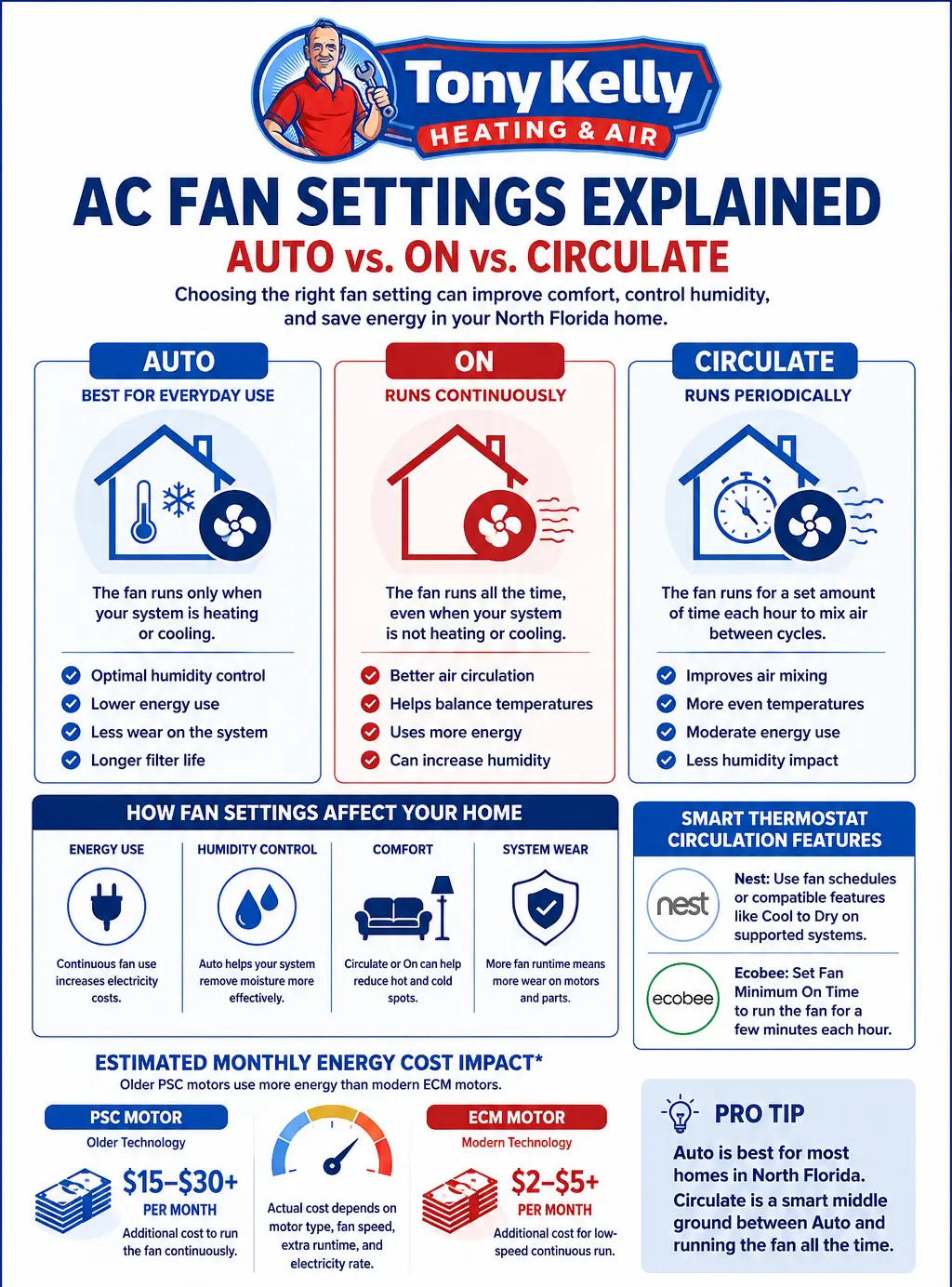
Table of Contents
- What Does the AC Fan Actually Do?
- AC Fan Auto vs. On vs. Circulate
- Should You Leave Your AC Fan On All the Time?
- What Happens When You Run the HVAC Fan 24/7?
- Does Running the AC Fan Use a Lot of Electricity?
- Can Leaving the AC Fan On Increase Humidity?
- Does Running the Fan Help Cool Your House?
- Does Continuous Fan Operation Improve Indoor Air Quality?
- When Does Continuous Fan Operation Make Sense?
- What About Variable-Speed HVAC Blowers?
- Why Is My AC Fan Running All the Time?
- How Long Should the Fan Run After the AC Turns Off?
- Should You Run the HVAC Fan Continuously by Season?
- What’s the Best AC Fan Setting for North Florida Homes?
- Quick Diagnostic Checklist
- Frequently Asked Questions
What Does the AC Fan Actually Do?
The “fan” controlled by your thermostat is the indoor blower located inside your furnace or air handler. Its job is to move conditioned air through the ductwork and distribute it throughout your home.
During a cooling cycle, several parts of the system work together:
- The outdoor unit and compressor support the refrigeration cycle.
- The indoor evaporator coil becomes cold.
- The blower pulls warm indoor air through the return system.
- That air passes across the evaporator coil.
- Heat is removed from the air while moisture can condense on the coil.
- Cooler air is distributed back through the supply ducts.
The blower is necessary for cooling, but the blower itself does not create cold air. Running the fan without active cooling primarily circulates the air already inside your home.
That distinction matters because homeowners sometimes switch the thermostat fan to On expecting it to cool the house more efficiently. The additional airflow may help mix temperatures between rooms, but it does not replace an active cooling cycle.
AC Fan Auto vs. On vs. Circulate: What’s the Difference?
The best thermostat fan setting depends on what you are trying to accomplish. Most systems offer Auto and On, while many newer smart thermostats provide additional circulation controls.
| Fan Setting | How It Works | Best Used For |
|---|---|---|
| Auto | Blower runs primarily when the HVAC system calls for heating or cooling | Normal everyday operation and cooling-season humidity control |
| On | Blower runs continuously, including between heating and cooling cycles | Specific airflow or filtration situations |
| Circulate / Scheduled Fan | Blower operates periodically according to thermostat controls | Additional air mixing without full-time fan operation |
What Does Auto Mean on a Thermostat?
With the fan set to Auto, the indoor blower operates as needed when your system heats or cools the home. Once the cycle ends, the blower normally stops after any programmed fan delay.
For many North Florida homes, Auto offers a practical balance between comfort, humidity control, energy use, blower runtime, and filtration.
What Does On Mean?
The On setting tells the indoor blower to run continuously regardless of whether the AC compressor or heating equipment is actively operating.
You may therefore continue feeling air from the vents after the cooling cycle ends. That air may be close to room temperature because the blower itself does not produce cooling.
This is normal if you intentionally selected On. It becomes a troubleshooting concern when the fan keeps running despite the thermostat being set to Auto.
What Does Circulate Mean on a Thermostat?
Circulation features provide a middle ground between Auto and continuous On operation. Instead of running 24/7, the thermostat can operate the blower periodically to mix air between heating and cooling cycles.
The exact terminology and behavior vary by thermostat. For example, ecobee thermostats can use a Fan Minimum On Time setting to establish a minimum amount of fan operation each hour. This can provide additional circulation when heating or cooling demand is low.
Google Nest thermostats also offer fan-control and scheduling capabilities on compatible HVAC systems. Features related to cooling and humidity management, such as Cool to Dry on supported configurations, should not be confused with simply setting the blower to run continuously.
Some thermostats and HVAC systems also use a short post-cooling blower period after the compressor shuts off. That is another reason homeowners may notice air continuing to come from their vents even though active cooling has stopped.
The takeaway: Auto, On, scheduled circulation, post-cycle fan operation, and system-controlled variable-speed airflow are not interchangeable. Modern thermostat settings should be matched to the HVAC equipment they control.
Should You Leave Your AC Fan On All the Time?
For most conventional residential HVAC systems, there is little reason to keep the blower running continuously under normal conditions.
The Auto setting already operates the fan whenever conditioned air needs to be distributed. Keeping the blower running between cycles may offer some airflow benefits, but those benefits come with tradeoffs.
Continuous operation can:
- Use additional electricity
- Increase annual blower runtime
- Move more air through the HVAC filter
- Require more frequent filter inspection
- Make indoor humidity harder to control in some systems
- Mask temperature-balance or ductwork problems instead of solving them
That does not mean leaving the fan On will immediately damage your HVAC system. HVAC blowers are designed to operate for long periods. The better question is whether continuous operation is providing a benefit that justifies the additional runtime.
For a homeowner who simply wants the house to stay comfortable, Auto is usually the better place to start.
What Happens When You Run the HVAC Fan 24/7?
A blower that runs continuously can accumulate thousands of additional operating hours over the course of a year compared with a blower controlled primarily by heating and cooling demand.
What that means for your home depends heavily on the type of blower motor, duct system, filter, thermostat, HVAC equipment, and fan speed.
You Use More Blower Electricity
The indoor fan requires electricity whenever it operates. An older blower using a traditional permanent split capacitor, or PSC motor, can consume substantially more electricity during extended operation than a modern electronically commutated motor, or ECM.
Modern ECM blowers can make low-speed circulation much more efficient, but they still consume electricity.
The Blower Accumulates More Runtime
Continuous fan mode naturally means the motor and related components operate for more hours.
More runtime does not automatically mean the motor will fail prematurely. Equipment quality, maintenance, operating temperature, airflow resistance, installation, and motor design all affect service life.
Still, there is little reason to accumulate unnecessary runtime if continuous airflow is not solving a specific comfort, filtration, or air-quality problem.
Your Filter Processes More Air
Continuous airflow means more total air passes through the HVAC filter.
That can be beneficial when filtration is the goal, but it can also mean the filter accumulates particles faster. Homeowners using continuous or high-runtime circulation should inspect their filters regularly rather than assuming the same replacement schedule works for every home.
Does Running the AC Fan Use a Lot of Electricity?
Running the indoor blower continuously uses more electricity than allowing the same blower to shut off between heating and cooling cycles. How much more depends heavily on motor technology, fan speed, local electricity rates, and how many additional hours the blower operates.
Older PSC Blower Motors
Many older furnaces and air handlers use a permanent split capacitor, or PSC blower motor. These motors generally consume considerably more electricity during continuous operation than modern electronically commutated motors.
As an illustrative example, the additional electricity required to keep some older PSC blowers running for extended periods can translate to roughly $15–$30 or more per month. The actual amount can be higher or lower depending on the blower’s wattage, normal cooling runtime, electricity rate, and how the system is configured.
Modern ECM and Variable-Speed Blowers
Newer HVAC systems frequently use ECM or variable-speed blower motors. At low circulation speeds, these motors can use substantially less electricity than older PSC designs.
Under favorable conditions, the incremental electricity cost of low-speed circulation with an efficient ECM blower may amount to only a few dollars per month. A rough example could fall around $2–$5 monthly, but that should not be treated as a universal operating cost.
There is a simple way to understand why two homes can have dramatically different fan costs:
Blower watts × operating hours ÷ 1,000 × electricity rate = estimated operating cost.
For example, a blower averaging 300 watts for an additional 12 hours per day would consume approximately:
0.3 kW × 12 hours × 30 days = 108 kWh per month.
A much more efficient blower averaging 50 watts under the same additional runtime would consume:
0.05 kW × 12 hours × 30 days = 18 kWh per month.
Multiplying those figures by your electricity rate provides a rough estimate of what that additional fan runtime costs.
This is why blanket statements about how much an AC fan costs to run can be misleading. The motor inside your air handler matters enormously.
Can Leaving the AC Fan On Increase Humidity?
Yes, continuous fan operation can make humidity control more difficult with some conventional HVAC systems.
During active cooling, moisture from indoor air condenses on the cold evaporator coil. After the compressor stops, some water remains on that coil while it drains away.
Keeping the blower running can move air across the damp coil and allow some of that moisture to evaporate back into the indoor air. This can partially reverse the dehumidification that occurred during the cooling cycle.
That is one reason Auto is generally preferred for conventional HVAC systems in humid North Florida climates.
Modern variable-speed equipment adds important nuance. Controlled lower airflow during active cooling can help an appropriately designed system remove moisture effectively. That is very different from manually forcing a conventional blower to run continuously after the compressor shuts off.
We’ve covered those differences in much greater detail in our guide to how running your HVAC fan affects indoor humidity.
Persistent indoor humidity can point to more than a thermostat setting. Short cycling, oversized AC equipment, airflow problems, duct leakage, drainage issues, or other HVAC conditions can prevent a system from controlling moisture effectively. Have a local HVAC technician inspect your system if your North Florida home stays clammy despite normal cooling operation.
Does Running the Fan Help Cool Your House?
Running the HVAC fan can help redistribute temperatures, but fan-only operation does not create additional cooling.
Imagine one bedroom is warmer than the hallway. Circulating air may help reduce some of that difference by mixing air between spaces.
But if the entire house is too warm, simply running the blower will not remove heat the way an active air-conditioning cycle does.
Air coming from the vents during fan-only operation may therefore feel room-temperature rather than cold. That is normal when the compressor is not operating.
Persistent hot and cold spots may instead point to issues involving:
- Duct design
- Air balancing
- Closed or obstructed registers
- Return-air limitations
- Insulation
- Solar heat gain
- Duct leakage
- HVAC equipment sizing
Continuous fan operation may temporarily make temperatures feel more even without addressing the underlying cause.
Does Running the AC Fan Continuously Improve Indoor Air Quality?
Continuous fan operation can increase the amount of air passing through your HVAC filter, but that does not automatically mean you should run the blower 24/7.
The benefit depends on the filtration system itself.
A basic filter primarily protects HVAC equipment from larger particles. A properly selected higher-efficiency filter or whole-home air purification system may benefit more from increased airflow, provided the HVAC system is designed to handle the filter’s resistance.
More airflow can also mean:
- More particles reaching the filter
- Potentially faster filter loading
- Greater importance of proper filter sizing
- More blower runtime
Indoor air quality should therefore be approached as a complete system rather than simply setting the fan to On. Filtration, ventilation, humidity, duct cleanliness, equipment condition, and airflow can all affect the air inside the home.
When Does Continuous Fan Operation Make Sense?
Although Auto is generally the best default setting, there are situations where additional circulation may be useful.
Homes With Significant Temperature Differences
Running the blower more frequently can sometimes help mix air between warmer and cooler areas.
If the temperature differences are severe, though, it is worth identifying the underlying airflow or building-envelope problem instead of relying entirely on constant circulation.
Advanced Air Filtration or Purification
Some filtration and air-cleaning systems provide more benefit when additional air passes through them. The correct runtime depends on the equipment, filter, duct system, and installation.
Thermostats With Circulation Controls
Scheduled or minimum-runtime fan settings can provide periodic airflow without running the fan constantly.
This can be a useful compromise for homeowners who want additional air mixing but do not need the blower operating every minute of the day.
Systems Designed for Extended Low-Speed Airflow
Some newer variable-speed HVAC systems intentionally operate the blower at low speeds for extended periods.
This is different from forcing a conventional single-speed blower to run continuously. The system’s controls may coordinate airflow with cooling capacity, filtration, temperature balance, and humidity management.
What About Variable-Speed HVAC Blowers?
Variable-speed technology is an important exception to blanket advice about HVAC fan operation.
A conventional blower commonly operates at one or several predetermined airflow levels. A variable-speed blower can make much finer adjustments.
Depending on the equipment and controls, a variable-speed system may:
- Ramp airflow up gradually
- Operate at lower airflow during part-load cooling
- Run longer cooling cycles at reduced capacity
- Improve temperature consistency
- Support better filtration
- Improve dehumidification during active cooling
That does not mean homeowners should manually force the fan to On.
System-controlled low-speed operation and manually selected continuous fan operation are not the same thing.
For example, a variable-speed system may intentionally lower airflow while the evaporator coil is cold to improve moisture removal. Once cooling ends, its controls may change the blower speed or stop it based on the equipment’s programming.
Overriding that logic with a permanent On setting can produce different results.
If you have variable-speed, multi-stage, or communicating HVAC equipment, your thermostat and equipment controls may already be managing blower operation more intelligently than a basic Auto/On setup.
Why Is My AC Fan Running All the Time?
There is an important difference between choosing to run your AC fan continuously and having a blower that keeps running even though the thermostat is supposed to be set to Auto.
Start by checking the thermostat before assuming something has failed.
The Thermostat Is Set to On
This is the simplest explanation. Switching the fan from On to Auto should allow the blower to stop once the current heating or cooling cycle and any programmed delay are complete.
The Thermostat Is Using a Circulation Setting
Circulation settings intentionally start the blower periodically without active heating or cooling.
If you recently installed or reprogrammed a smart thermostat, a fan minimum-runtime setting or schedule can make it seem as though the fan is turning on by itself.
A Fan Schedule Is Programmed
Some thermostats allow scheduled fan operation at certain times of day or establish a minimum number of fan minutes each hour.
Check both the thermostat itself and its connected app if your blower operates at unexpected times.
The Blower Keeps Running Even on Auto
If the thermostat is definitely set to Auto but the fan never stops, something else may be happening.
Possible causes include:
- A thermostat or wiring problem
- A stuck fan relay
- A control-board issue
- A programmed post-cycle fan delay
- Heat-pump or air-handler control logic
- Communicating HVAC system programming
- Another HVAC malfunction
A brief delay after the compressor shuts off can be normal. A blower that runs indefinitely despite an Auto setting deserves closer attention.
How Long Should the Fan Run After the AC Turns Off?
Some HVAC systems intentionally keep the indoor blower running briefly after the compressor stops.
This programmed delay can help use some of the remaining cooling capacity in the coil and ductwork. The exact duration varies by equipment and thermostat controls, so there is no universal fan-delay time that applies to every system.
A fan running for a short period after cooling ends can therefore be normal.
A fan that continues indefinitely is different. First verify the thermostat isn’t set to On, Circulate, or a fan schedule. If the blower still refuses to stop while set to Auto, the system may need troubleshooting.
Should You Run the HVAC Fan Continuously in Summer or Winter?
Running the Furnace Fan Continuously in Summer
Homeowners sometimes refer to the indoor blower as the “furnace fan” even during cooling season because the blower may be housed inside the furnace or air-handler cabinet.
For a conventional system, Auto is generally the best default summer setting.
Running the blower continuously may help mix temperatures, but it does not create additional cooling and can make humidity control more difficult in some systems.
Running the HVAC Fan Continuously in Winter
Continuous fan operation is less likely to create the same cooling-season evaporator-coil moisture issue during winter, but that does not automatically make 24/7 operation necessary.
Periodic circulation can help:
- Mix warmer and cooler areas
- Move filtered air through the home
- Reduce temperature stratification in some houses
Auto remains a practical default for many homes, while a scheduled circulation setting can provide a compromise when additional airflow is useful.
What’s the Best AC Fan Setting for North Florida Homes?
For most conventional HVAC systems in Tallahassee, Crawfordville, Quincy, Monticello, and surrounding North Florida communities, Auto is the best starting point for everyday cooling-season operation.
North Florida’s climate makes fan settings particularly important because temperature is only part of indoor comfort. Moisture control matters too.
A home can reach the thermostat setpoint and still feel uncomfortable if relative humidity remains high. This can become especially noticeable during humid spring and fall weather when outdoor moisture remains high but temperatures are mild enough that the air conditioner does not run for long periods.
The best fan strategy may be different when your home has:
- A variable-speed HVAC system
- A whole-home dehumidifier
- Advanced filtration or air purification
- A communicating thermostat
- Significant room-to-room temperature differences
- Special ventilation requirements
Homes throughout Tallahassee and nearby communities such as Crawfordville, Quincy, and Monticello can also vary considerably in age, square footage, duct design, insulation, air leakage, and HVAC equipment.
Equipment sizing matters as well. An oversized air conditioner may satisfy the thermostat quickly and shut down before completing longer cooling cycles that help remove moisture. Leaving the blower running continuously does not solve an underlying sizing problem and may make the home’s humidity symptoms more noticeable.
Rather than assuming every HVAC system should operate the same way, match the fan strategy to the equipment and the comfort problem you are trying to solve.
Quick Diagnostic Checklist: Should You Change Your Fan Setting?
- Your fan is set to On all day: Try Auto unless you have a specific reason for continuous circulation.
- The house feels clammy between AC cycles: Continuous blower operation may be contributing to the humidity problem.
- Rooms have noticeably different temperatures: A circulation setting may help, but persistent imbalance can indicate a duct or airflow issue.
- Your filter gets dirty unusually quickly: High blower runtime may be moving substantially more air through it.
- The fan won’t stop even on Auto: Check thermostat programming and consider having the system inspected.
- The blower runs but the house isn’t getting cooler: Fan-only operation does not mean the refrigeration system is actively cooling.
- Your AC runs in very short cycles and the house stays humid: Equipment sizing, airflow, thermostat placement, or another HVAC condition may deserve investigation.
- You have a variable-speed system: Avoid overriding advanced fan controls without understanding how the equipment is designed to operate.
Frequently Asked Questions
Should I leave my AC fan on all the time?
For most conventional HVAC systems, no. Setting the thermostat fan to Auto usually provides adequate airflow while reducing unnecessary blower runtime and helping with cooling-season humidity control.
Should my AC fan be On or Auto?
Auto is generally the better everyday setting. The blower runs when the HVAC system needs it and normally stops between cycles. On is better reserved for situations where continuous airflow serves a specific purpose.
What is the difference between Auto and Circulate on a thermostat?
Auto runs the blower primarily during heating and cooling cycles. A circulation setting runs the fan for additional periods even when heating or cooling is not active. This provides more air movement without necessarily operating the blower continuously.
What does Fan On mean on a thermostat?
Fan On tells the indoor blower to operate continuously regardless of whether the system is actively heating or cooling.
Does running the AC fan use a lot of electricity?
It depends heavily on the blower motor and fan speed. Older PSC blowers can use considerably more electricity during extended operation than modern ECM or variable-speed motors. Any blower consumes electricity while operating, so additional runtime increases energy consumption.
How much does it cost to run an HVAC fan all the time?
There is no universal cost. An older PSC blower may add roughly $15–$30 or more per month in some scenarios, while efficient low-speed ECM circulation may add only a few dollars. Motor wattage, operating speed, electricity rates, and additional runtime determine the actual cost.
Is it cheaper to run the fan instead of the AC?
The indoor blower generally uses less electricity than operating the entire air-conditioning system, but fan-only operation does not remove heat from your home. It can redistribute existing air, but it cannot replace active cooling when indoor temperatures are too high.
Does running the fan help cool the house?
It can redistribute existing air and reduce some room-to-room temperature differences, but the indoor blower alone does not produce cooling. The air conditioner must operate to remove heat from the home.
Can leaving the AC fan on increase humidity?
It can with some conventional systems. Air passing over a damp evaporator coil after cooling ends can allow some residual moisture to evaporate back into the indoor air. Variable-speed equipment may behave differently because airflow can be controlled as part of the system’s cooling and dehumidification strategy.
Should I run my furnace fan continuously in summer?
Usually not unless there is a specific airflow, filtration, or equipment-related reason. The furnace blower is generally the same indoor fan used during air-conditioning operation, so Auto is still a good default for many homes.
Should I run my HVAC fan continuously in winter?
Continuous or periodic circulation can help even out temperatures in some homes during winter, but 24/7 operation is not necessary for most systems. Auto or a scheduled circulation mode may provide a better balance.
Why is my AC fan constantly running?
First check whether the thermostat fan is set to On, a circulation mode, or a programmed fan schedule. If the thermostat is set to Auto and the blower continues running indefinitely, a thermostat, relay, wiring, control-board, system-programming, or other HVAC issue may need to be evaluated.
Is it normal for the AC fan to keep running after cooling stops?
A short post-cycle blower delay can be normal depending on the HVAC equipment and controls. A blower that continues running indefinitely while the thermostat is set to Auto is a different situation and may require troubleshooting.
Can I run just the fan on my AC?
Yes. Selecting Fan On allows the indoor blower to circulate air without active cooling. The air coming from the vents will generally be close to the home’s existing indoor temperature because the blower itself does not remove heat.
Does an ECM blower change whether I should use Auto or On?
An ECM blower can make low-speed circulation considerably more energy efficient than an older PSC motor, but that does not automatically make On the best setting. Variable-speed and communicating HVAC systems may already manage fan speed based on cooling, humidity, filtration, and comfort needs.
Fan Keeps Running Even on Auto? It May Not Be a Setting Problem
Changing the thermostat from On to Auto should allow the blower to stop in a normally functioning conventional system once the current cycle and any programmed fan delay are complete.
If it doesn’t, the issue may be more than a thermostat preference.
A continuously running indoor blower can be related to control settings, thermostat wiring, relays, circuit boards, communicating equipment, or another HVAC problem. The same is true if the fan keeps running but the air coming from the vents is warm or room-temperature while the home should be cooling.
Tony Kelly Heating & Air Conditioning provides AC repair in Tallahassee and serves homeowners throughout Crawfordville, Quincy, Monticello, and surrounding North Florida communities with thermostat, airflow, cooling, humidity, and HVAC control problems.
If your HVAC fan will not shut off on Auto, your air conditioner is running constantly without cooling properly, or your home has persistent humidity and uneven temperatures, identifying why the system is behaving that way is more useful than repeatedly changing thermostat settings.
Our technicians can evaluate the thermostat and blower controls along with system airflow, cooling performance, humidity control, duct conditions, and equipment sizing to determine whether you’re dealing with a simple setting or an HVAC problem that needs attention.
Call or text (850) 792-4488 or contact Tony Kelly Heating & Air Conditioning to schedule HVAC service in North Florida.

