CALL US 850-385-3774
In North Florida, your air conditioner works hard for much of the year. Between Tallahassee’s long cooling season, heavy humidity, frequent rain, and storm season, even a well-maintained AC system can start showing signs of stress before it stops working completely.
The good news is that most air conditioners give warning signs before a full breakdown. Your AC may start blowing warmer air, pushing weaker airflow, making new noises, short cycling, leaking water, struggling with humidity, or causing your energy bill to climb. These symptoms do not always mean the system is beyond repair, but they do mean something needs attention.
This guide explains the most common signs your AC is about to break, what those signs may mean, what homeowners can safely check, and when it makes sense to have the system inspected by a professional.
Air conditioners in Tallahassee, Bradfordville, Crawfordville, Quincy, Havana, Monticello, Woodville, and nearby North Florida communities often run for long stretches of the year. Unlike cooler climates where AC systems get a long seasonal break, North Florida homes may rely on cooling through spring, summer, and well into fall.
That extended use can make small problems show up faster. A slightly dirty coil, partially clogged filter, weak capacitor, low refrigerant charge, or slow condensate drain issue may not seem serious at first. But when outdoor temperatures rise and humidity stays high, your AC has to remove both heat and moisture from the home. If one part of the system is struggling, comfort drops quickly.
Recognizing early warning signs helps you avoid guessing. Instead of waiting until the system stops cooling altogether, you can identify what changed and decide whether the issue is simple maintenance, a repair concern, or a sign that an older system needs a deeper evaluation.
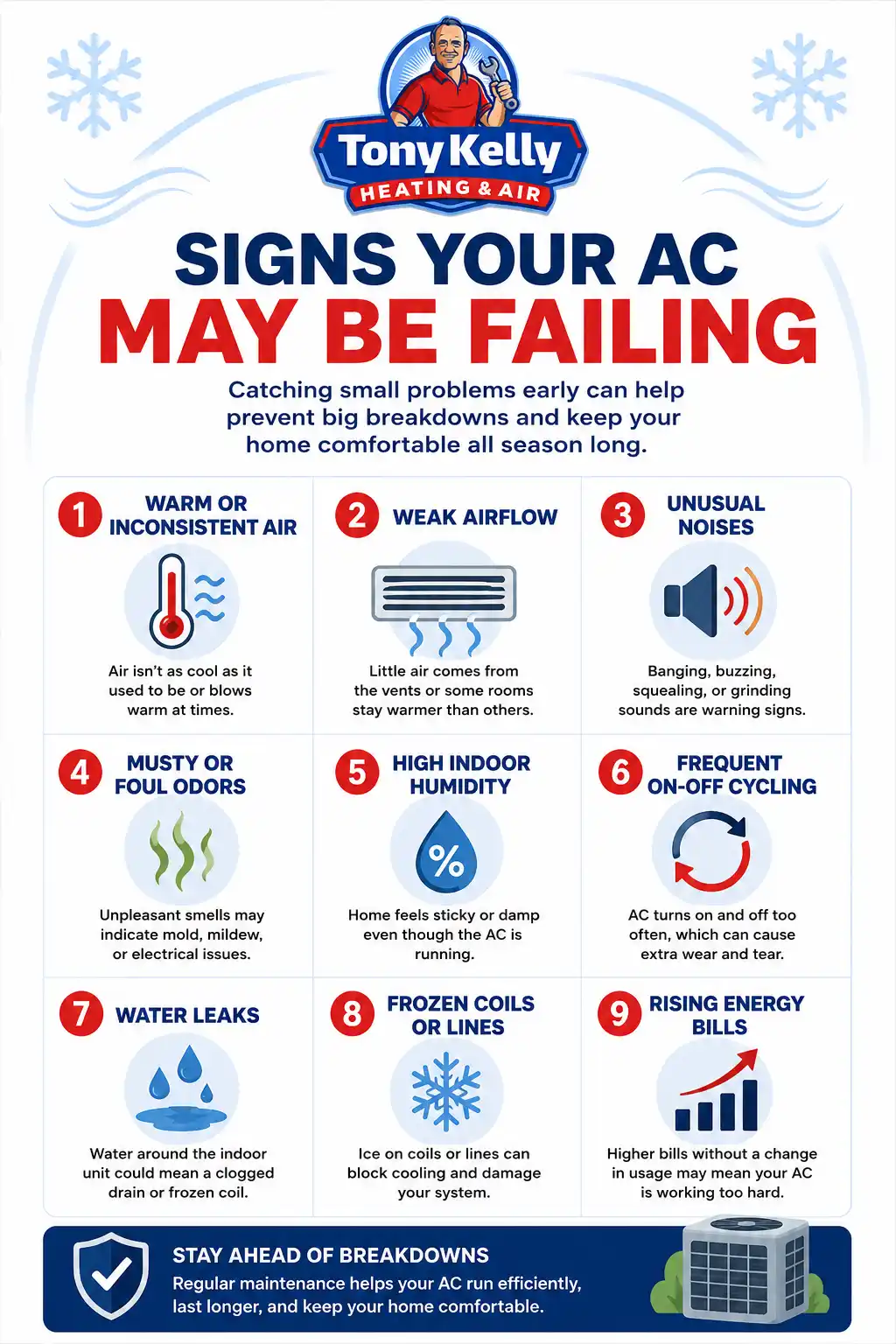
The most common signs your AC is broken or about to break include warm air from the vents, weak airflow, strange noises, bad odors, high indoor humidity, frequent on-and-off cycling, water leaking around the indoor unit, ice on the coils or refrigerant lines, and higher energy bills without a clear reason.
One warning sign by itself may have a simple cause, such as a dirty filter or blocked vent. Multiple signs happening together usually point to a larger issue. For example, warm air, ice buildup, and weak airflow together may indicate restricted airflow, low refrigerant, or a frozen evaporator coil. High humidity, musty odors, and water near the indoor unit may point to drainage, coil, or ductwork problems.
One of the clearest signs your AC is going out is air that feels warm, room temperature, or only slightly cool. Your air conditioner’s main job is to remove heat from indoor air. If the system is running but the air from the vents is not cooling the home, something is preventing that heat transfer from happening properly.
Warm air can come from several issues. The thermostat may be set incorrectly. The air filter may be clogged. The evaporator coil may be dirty or frozen. The outdoor condenser may be unable to release heat. The system may have a refrigerant leak. In some cases, a failing compressor can keep the AC from cooling even though the fan still runs.
Before assuming the worst, check the basics. Make sure the thermostat is set to “cool” and the temperature is set lower than the current indoor temperature. Replace the air filter if it is dirty. Check whether the outdoor unit is running and whether leaves, grass, or debris are blocking airflow around it.
If the AC still blows warm air after those checks, the issue likely needs professional diagnosis. This is especially true if the outdoor unit is running, the indoor fan is blowing, but the home never cools. For homeowners comparing symptoms, Tony Kelly Heating & Air’s AC repair in Tallahassee page can help explain common cooling repair issues.
Weak airflow is another common sign of air conditioner problems. You may notice that air is coming from the vents, but it feels faint. Some rooms may cool normally while others stay warm and stuffy. You may also notice that the system runs longer than usual because it cannot move enough conditioned air through the home.
The most common cause of weak airflow is a dirty air filter. When a filter becomes packed with dust, pollen, pet hair, and debris, it restricts the amount of air that can move through the system. In North Florida, filters can clog faster during heavy pollen seasons or when the system is running daily.
Weak airflow can also come from ductwork problems, blocked return vents, dirty evaporator coils, a failing blower motor, or closed supply registers. If the airflow restriction is severe, the evaporator coil can get too cold and freeze. Once that happens, cooling drops even more.
Start by replacing the filter and making sure vents are open and unobstructed. Look for furniture, curtains, rugs, or boxes blocking return or supply vents. If airflow does not improve, the issue may be inside the air handler, ductwork, or blower assembly. General HVAC airflow and system concerns may also connect to broader HVAC repair in Tallahassee needs.
Air conditioners are not silent, but they should sound consistent. If your system starts making banging, buzzing, rattling, squealing, grinding, clicking, or hissing noises that were not there before, it is trying to tell you something has changed.
Different sounds can point to different problems. A rattling sound may come from a loose panel, debris in the outdoor unit, or a worn component. Squealing may point to a belt or motor bearing issue. Grinding can suggest motor wear. Buzzing may be electrical or compressor related. Hissing can sometimes indicate refrigerant escaping from a leak.
Some noises are minor, but others should not be ignored. A loose part can damage nearby components if it continues vibrating. A worn motor can eventually stop. Electrical buzzing can indicate a control, capacitor, contactor, or wiring issue that should be inspected safely.
Homeowners can check whether a panel is loose or whether debris is visible around the outdoor unit, but avoid opening electrical compartments or trying to repair internal components. If the noise is loud, persistent, or getting worse, the safest next step is a professional inspection.
Your AC should not make the house smell unpleasant. If you notice musty, sour, burning, electrical, or dirty sock-like odors when the system turns on, the smell may be coming from moisture, dust, microbial growth, wiring, or a dirty coil.
Musty odors are especially common in humid climates. Your AC removes moisture from the air as part of the cooling process. That moisture should drain away through the condensate system. If moisture sits inside the air handler, drain pan, coil area, or ductwork, it can create stale odors and indoor air quality concerns.
A burning smell is different. If you notice a sharp electrical odor, overheated smell, or burning plastic smell, turn the system off and avoid running it until it has been inspected. Electrical problems should not be treated as a DIY repair.
For musty odors, start with the filter. Replace it if needed. Make sure the condensate drain is not obviously backed up. If the smell continues, the evaporator coil, drain pan, blower compartment, or ductwork may need attention.
In Tallahassee and surrounding North Florida communities, indoor humidity is one of the biggest comfort clues homeowners notice. Your thermostat may show the right temperature, but the house still feels sticky, damp, or uncomfortable. This can be a sign your AC is not removing moisture properly.
An air conditioner needs proper airflow and adequate run time to dehumidify. If the system short cycles, has low refrigerant, has a dirty coil, or is oversized for the home, it may cool the air briefly without removing enough moisture. That can leave rooms feeling clammy even when the temperature looks normal.
High humidity can also point to duct leaks, poor ventilation, drainage issues, or a condensate problem. If humid air is entering through leaky ducts in an attic or crawl space, the system may have to work harder to keep the home comfortable.
Check your filter and make sure the AC is completing normal cooling cycles. If the system runs briefly and shuts off often, or if humidity remains high day after day, it is worth having the system evaluated. Persistent humidity issues can affect comfort, indoor air quality, and long-term home performance.
An AC that turns on, runs for a short time, shuts off, and then starts again soon after may be short cycling. This is different from normal cycling. A healthy system should run long enough to cool the home evenly and remove humidity before shutting off.
Short cycling can happen for several reasons. The air filter may be clogged. The thermostat may be placed near a heat source, direct sunlight, or supply vent. The system may be oversized. Refrigerant levels may be low. Electrical controls may be failing. The outdoor condenser may be overheating due to restricted airflow.
Short cycling is hard on the system because motors and compressors experience extra wear during startup. It can also leave the home less comfortable because the AC does not run long enough to balance temperature and humidity.
Start by checking the filter and thermostat location. Make sure the outdoor unit has clear airflow. If the problem continues, short cycling should be diagnosed by a professional. It may be a simple control issue, but it can also signal a deeper problem inside the system.
A small amount of condensation is normal because air conditioners remove moisture from the air. However, water pooling around the indoor unit, dripping from the ceiling, filling the drain pan, or backing up from the condensate line is not something to ignore.
Most indoor AC water leaks come from condensate drainage problems. The drain line can clog with algae, dust, sludge, or debris. The drain pan can crack or rust. A condensate pump can fail. The evaporator coil can freeze and then drip heavily as it thaws.
In humid North Florida homes, condensate drain issues are common because the system removes a lot of moisture during long cooling cycles. If the drain line backs up, water can overflow into nearby walls, floors, ceilings, or insulation.
If you see water around the indoor unit, turn the system off if leaking is significant. Check whether the drain line is clogged and whether the filter is dirty. If water continues to return, the system should be inspected to identify the source. Water leaks often start small, but they can create bigger home damage if left alone.
Ice on an air conditioner may seem strange during hot weather, but it is a common sign of a problem. You may see ice on the refrigerant lines, evaporator coil, outdoor unit, or around the air handler. Ice usually means the coil is getting too cold because heat is not being absorbed properly.
The most common causes are restricted airflow and low refrigerant. If the air filter is clogged, airflow across the evaporator coil drops. Without enough warm air moving across the coil, condensation can freeze. Low refrigerant can also lower coil temperature and cause ice to form.
Running the system while it is frozen can make the problem worse and may strain the compressor. If you see ice, turn the system off and let it thaw completely. Check the filter and replace it if dirty. Do not chip ice off the coil or refrigerant lines, because that can damage delicate components.
If the AC freezes again after thawing and replacing the filter, the issue likely needs professional diagnosis. Refrigerant problems, blower issues, dirty coils, and airflow restrictions should be handled carefully.
Energy bills often rise during hot months because the AC runs more often. But if your bill jumps unexpectedly and your usage habits have not changed, your air conditioner may be working harder than it should.
A struggling AC may run longer to reach the thermostat setting. Dirty filters, dirty coils, weak airflow, low refrigerant, duct leaks, thermostat problems, or aging equipment can all reduce efficiency. When efficiency drops, the system may still cool the home, but it takes more energy to do it.
Compare your current bill to the same month last year if possible. Consider weather differences, thermostat settings, guest visits, and household changes. If the bill is unusually high and you also notice warm air, weak airflow, humidity, short cycling, or frequent repairs, the AC may be the reason.
Routine maintenance can help reduce unnecessary strain. For more prevention-focused tips, this related article on minimizing the strain on your HVAC system during summer explains simple ways to help your system handle North Florida heat more effectively.
Uneven temperatures are another warning sign. If one bedroom stays warm, the living room cools normally, and another area feels too cold, the issue may involve airflow, ductwork, insulation, sun exposure, or system performance.
In multi-story homes, rooms with large windows, bonus rooms, additions, and spaces over garages often have different cooling needs. But if uneven cooling is new, it may indicate that airflow has changed. A duct may be leaking, crushed, disconnected, or blocked. A dirty filter may reduce overall airflow. The blower may be weakening. The system may also be losing cooling capacity.
Check that all vents are open and that return air pathways are not blocked. Avoid closing vents in unused rooms as a long-term strategy, because this can increase pressure in the duct system and reduce performance elsewhere.
If the problem has always existed, your home may need airflow balancing, duct evaluation, or zoning discussion. If the problem appeared suddenly, treat it as a potential repair symptom.
Sometimes the AC system itself is not the only issue. A thermostat problem can make your system behave like it is failing. You may notice that the AC does not turn on, shuts off too soon, runs too long, or does not match the temperature shown on the display.
Common thermostat issues include dead batteries, incorrect settings, faulty wiring, poor placement, calibration problems, or Wi-Fi thermostat connection issues. A thermostat located near a lamp, sunny window, kitchen appliance, or supply vent may read the temperature inaccurately and control the AC poorly.
Start by checking the thermostat mode, temperature setting, batteries, schedule, and fan setting. Make sure it is set to “cool” and not just “fan.” If you have a smart thermostat, verify that the schedule has not been changed accidentally.
If the thermostat is blank, unresponsive, or sending inconsistent signals, the issue may need professional attention. Thermostat wiring connects to system controls, so it is best not to guess with electrical terminals.
Occasional AC repairs can happen, especially in a climate where cooling systems run often. But repeated repair needs are a sign that the system may be wearing down or that one unresolved issue is causing related problems.
Frequent repairs may involve capacitors, contactors, motors, refrigerant leaks, drain problems, blower issues, or control failures. If a system is older and repairs are becoming more common, it may be time to compare repair history with replacement options.
This does not mean replacement is always the answer. Some repairs are minor and make sense. Others may be symptoms of an aging system that is becoming less reliable. A good decision depends on the system’s age, repair history, condition, efficiency, comfort performance, and how well it fits the home.
For homeowners trying to understand the difference, Tony Kelly Heating & Air’s guide to AC repair vs. AC replacement in Tallahassee can help frame the decision without jumping straight to replacement.
Many homeowners notice this symptom during the hottest part of the day: the outdoor unit is running, the indoor fan is on, but the home does not cool. This can be frustrating because the system appears to be working, but comfort does not improve.
This may point to low refrigerant, compressor issues, dirty condenser coils, dirty evaporator coils, weak airflow, duct leakage, or excessive heat gain in the home. It may also happen when the system is undersized or when attic insulation, air sealing, or duct performance is poor.
Check the filter, thermostat, and outdoor unit first. Make sure the condenser is not covered with leaves, grass clippings, or debris. If the unit runs continuously and the temperature does not drop, the system needs diagnostic testing.
Older systems may reach a point where they can run constantly without keeping up. If the AC is near the end of its lifespan, this symptom may be part of a larger repair-or-replace conversation. Homeowners who are exploring that path can also review the complete guide to AC replacement in Tallahassee.
North Florida storms can affect AC systems in several ways. Heavy rain, lightning, power surges, windblown debris, and brief outages can all cause trouble. After a storm, your thermostat may be blank, the breaker may trip, the outdoor unit may not start, or the system may run differently than before.
If the AC stops after a storm, check the thermostat and breaker first. If a breaker has tripped once, it may be safe to reset it one time. If it trips again, do not keep resetting it. Repeated breaker trips can indicate an electrical issue that needs professional attention.
Look around the outdoor unit for branches, leaves, or debris. Do not reach into the unit or remove panels while power is connected. If there was lightning nearby or the AC controls seem unresponsive, a technician may need to inspect electrical components, surge damage, capacitors, contactors, and control boards.
Storm season awareness is not about panic. It is about knowing what changed and avoiding unsafe troubleshooting.
Before assuming your AC is broken, there are a few safe checks homeowners can make. These simple steps may solve minor issues or help you describe the problem clearly if professional service is needed.
These checks can help with simple problems. However, refrigerant work, electrical repairs, compressor diagnosis, blower motor repairs, and internal component testing should be handled by a qualified HVAC professional.
You should call a professional when basic troubleshooting does not restore normal cooling, when the same issue keeps returning, or when the symptom involves electrical parts, refrigerant, frozen coils, water leaks, or unusual noises.
Warm air that continues after a filter change, weak airflow that affects multiple rooms, ice buildup, short cycling, repeated breaker trips, persistent musty odors, and water near the indoor unit are all signs that the system needs a closer look.
A professional diagnosis can help identify whether the issue is a small repair, maintenance problem, airflow concern, refrigerant issue, ductwork problem, or aging equipment. The goal is not to assume the most expensive outcome. The goal is to understand what is actually happening so you can make the right decision.
Many AC problems can be repaired. A clogged drain line, bad capacitor, dirty coil, faulty thermostat, or worn contactor may be fixable without replacing the system. However, repair may not always be the best long-term answer if the system is older, inefficient, unreliable, or struggling to keep the home comfortable.
Repair may make sense when the system is relatively young, the problem is isolated, the equipment has been maintained, and the repair restores performance. Replacement may be worth discussing when the system is older, repair needs are frequent, major components are failing, refrigerant leaks keep returning, or comfort problems persist even after service.
In Tallahassee’s long cooling season, reliability matters. An older AC that runs constantly, fails to control humidity, and needs repeated repairs may cost more in stress and energy use than homeowners expect.
That said, replacement should not be the first assumption for every symptom. A careful inspection can separate repairable issues from deeper system decline.
Preventive maintenance is one of the best ways to reduce AC breakdown risk. It helps catch small issues before they create larger problems, improves system efficiency, and supports better comfort through the hottest parts of the year.
These habits help your system handle the demands of North Florida’s heat and humidity more effectively.
Your AC may be broken if it is running but not cooling, blowing room temperature air, producing weak airflow, leaking water, freezing up, making loud noises, or turning on and off too frequently. Start by checking the thermostat, air filter, vents, breaker, and outdoor unit. If those basics look normal and the problem continues, the system likely needs professional diagnosis.
Signs your AC is going out include repeated repairs, rising energy bills, poor humidity control, uneven cooling, weak airflow, short cycling, strange noises, and reduced cooling performance. One symptom may be repairable. Several symptoms together, especially on an older unit, may suggest the system is nearing the end of its useful life.
Room temperature air can be caused by incorrect thermostat settings, a dirty air filter, low refrigerant, a frozen evaporator coil, a dirty condenser coil, electrical issues, or compressor problems. If the filter and thermostat are fine but the air is still not cold, the system should be inspected.
An AC may keep breaking because of age, poor maintenance, dirty coils, airflow restrictions, electrical wear, refrigerant leaks, duct problems, or an incorrectly sized system. Repeated repairs should be evaluated as a pattern, not as separate isolated issues.
Weak airflow can be a sign of an AC problem, but it may also be caused by a dirty filter or blocked vent. If replacing the filter and opening vents does not restore airflow, possible causes include blower motor problems, duct leaks, dirty coils, or a frozen evaporator coil.
If your AC turns off after only a few seconds, it may be short cycling. Causes can include a clogged filter, thermostat issue, electrical problem, low refrigerant, overheating outdoor unit, or oversized system. Because short cycling can strain the compressor, it should be checked if it continues.
Closing a few vents may seem harmless, but closing too many can increase pressure in the duct system, reduce airflow, and make the AC work harder. It can also contribute to uneven temperatures and frozen coils. If certain rooms are uncomfortable, duct balancing or zoning may be a better long-term solution.
There is no exact answer because it depends on outdoor temperature, humidity, insulation, system size, ductwork, thermostat setting, and home layout. On very hot North Florida days, an AC may run longer than usual. But if the system runs for hours without lowering the temperature at all, something may be wrong.
Refrigerant does not get “used up” like fuel. In a properly sealed system, it should stay in the system. If refrigerant is low, there is likely a leak or an installation-related issue. Simply adding refrigerant without finding the cause may not solve the problem.
You do not usually need to “give your AC a break” if it is working properly. Air conditioners are designed to run during hot weather. However, if the system is freezing, short cycling, overheating, making loud noises, or failing to cool, turning it off until it can be inspected may help prevent additional damage.
Your house may feel humid if the AC is short cycling, oversized, low on refrigerant, dealing with poor airflow, or struggling with drainage or duct issues. In North Florida, humidity problems are especially noticeable because the system has to remove moisture as well as heat.
Replacement may be worth discussing when the system is older, repair needs are frequent, major components are failing, comfort problems continue, or energy bills keep rising. Repair may still make sense for isolated problems on a newer or well-maintained system. A professional evaluation can help you compare both options.
Your AC will usually give you warning signs before it breaks completely. Warm air, weak airflow, strange noises, musty odors, high humidity, short cycling, water leaks, frozen coils, and rising energy bills all deserve attention.
Some problems have simple causes, such as a dirty filter or blocked vent. Others involve refrigerant, electrical components, airflow restrictions, ductwork, drainage, or aging equipment. The more signs you notice at the same time, the more important it becomes to have the system inspected.
For Tallahassee and surrounding North Florida homeowners, paying attention early can help protect comfort, reduce system strain, and make repair-or-replacement decisions clearer.
Address:
870 Blountstown Hwy. Unit # 9
Tallahassee, FL 32303
Phone: 850-385-3774
License #: CMC1249702
Open Monday Through Friday
8:00 am to 8:00 pm

