CALL US 850-385-3774
Heating and cooling equipment in Tallahassee rarely gets a long break. Air conditioners and heat pumps operate through an extended cooling season, manage persistent North Florida humidity, and may switch to heating mode when temperatures drop during winter. That year-round workload makes routine HVAC system maintenance especially important for local homeowners.
An HVAC maintenance plan organizes that care into a scheduled agreement. Instead of waiting for unusual noises, weak airflow, rising utility bills, or a complete system shutdown, homeowners receive planned inspections and tune-ups intended to identify developing concerns before they become larger problems.
A good plan may also include benefits such as priority scheduling, repair discounts, documented inspection reports, automatic service reminders, and other protections that vary by provider. These features can make heating and air conditioning maintenance more predictable while helping homeowners avoid relying exclusively on emergency service.
This guide explains how HVAC maintenance plans work, what they typically include, how preventative care supports efficiency and reliability, and what Tallahassee homeowners should compare before enrolling in an HVAC service plan.
An HVAC maintenance plan is an ongoing agreement between a property owner and an HVAC contractor. Under the agreement, the contractor schedules professional maintenance visits at established intervals, usually before the system enters its busiest cooling and heating periods.
You may also see these programs described as:
The terminology varies, but the basic purpose is the same: to give the HVAC system regular professional attention instead of servicing it only after something stops working.
A maintenance plan is not usually the same as a repair warranty or an insurance policy. It does not necessarily cover every failed component, service call, or replacement part. The agreement should clearly explain what maintenance is included, which benefits apply to repairs, and whether diagnostic charges, emergency labor, after-hours service, parts, or additional systems involve separate costs.
For Tallahassee homeowners comparing options, the plan details matter more than the name. A dependable plan should explain the number of visits, inspection procedures, membership benefits, scheduling process, repair policies, and responsibilities of both the contractor and homeowner.
Tallahassee’s climate places different demands on HVAC equipment than a mild climate with short cooling seasons. Local systems must remove both heat and moisture from the indoor air, often for long periods at a time.
During hot, humid weather, the air conditioner transfers heat from inside the home while moisture collects on the evaporator coil and drains through the condensate system. This process is normal, but extended operation means filters, coils, blower components, drain lines, electrical connections, and outdoor equipment all need periodic attention.
North Florida homes may also experience:
These conditions do not mean every HVAC system will develop a serious problem. They do make it important to catch restricted airflow, drainage concerns, loose wiring, dirty heat-transfer surfaces, thermostat inaccuracies, and worn components before peak-season demand places additional strain on the equipment.
Homeowners who need a one-time seasonal visit can review Tony Kelly’s AC maintenance services in Tallahassee. An ongoing HVAC maintenance plan may be more appropriate for homeowners who prefer recurring appointments, year-round documentation, and membership benefits in addition to routine tune-ups.
Preventative HVAC maintenance is based on identifying and correcting developing concerns before they interrupt comfort or damage other components. It is similar to maintaining a vehicle: a scheduled inspection cannot prevent every future repair, but it can reveal wear, contamination, improper operation, or safety concerns that might otherwise go unnoticed.
During a maintenance visit, a technician generally evaluates how the system starts, runs, transfers heat, moves air, drains moisture, and responds to thermostat commands. The exact procedures depend on the equipment type, season, age, condition, manufacturer guidance, and terms of the maintenance agreement.
A cooling-season visit may emphasize the condenser, evaporator coil, refrigerant circuit, blower, air filter, thermostat, electrical components, temperature change, and condensate drainage. A heating-season visit may include heat-pump operation, auxiliary heat, burners, ignition components, heat exchangers, venting, safety controls, or other heating-related equipment where applicable.
The purpose is not simply to confirm that the system turns on. A unit can operate while still experiencing restricted airflow, excessive electrical demand, poor drainage, inaccurate temperature control, loose connections, or other conditions that reduce performance and increase wear.
After the evaluation, the technician should explain the findings. Routine adjustments or cleaning included in the agreement may be completed during the visit. Any repair outside the maintenance scope should be discussed separately so the homeowner can review the recommendation before authorizing additional work.
Coverage differs among contractors, so homeowners should never assume that two plans with similar names include the same service. However, a residential HVAC preventative maintenance plan commonly includes one or two scheduled visits each year and a defined inspection checklist.
The thermostat is checked to confirm that it communicates correctly with the HVAC system and responds to temperature settings. A technician may verify operating modes, temperature accuracy, programmed schedules, and the condition of accessible wiring.
An inaccurate thermostat can cause unnecessary run time, premature shutdowns, temperature swings, or comfort complaints that appear to be equipment problems. Smart or programmable thermostats may also need schedule adjustments when household routines change.
A clogged filter restricts airflow through the system. Restricted airflow can reduce comfort, increase blower workload, contribute to coil icing, and allow the equipment to operate longer than necessary.
Some HVAC service plans include filter replacement, while others include inspection and a replacement reminder. The agreement should specify whether filters are supplied, how many are included, and whether specialty filter sizes cost extra.
Filter selection also matters. A filter that is too restrictive for the equipment may create airflow problems even when it is clean. The U.S. Environmental Protection Agency notes that all HVAC filters require regular replacement and that homeowners should choose a filter compatible with their system rather than assuming the highest available rating is appropriate. EPA guidance on HVAC filters and residential air cleaning provides additional background.
HVAC systems depend on capacitors, contactors, relays, motors, wiring, disconnects, and control boards. Maintenance may include checking accessible electrical connections, measuring voltage and current where appropriate, and looking for overheating, corrosion, looseness, or unusual wear.
Loose or damaged connections can affect performance and may shorten the life of major components. Electrical testing should be handled by a trained professional because the equipment contains high-voltage circuits and components that can retain an electrical charge.
The outdoor condenser needs adequate airflow to release heat. Leaves, vegetation, grass clippings, pine needles, dirt, and storm debris can collect around the cabinet or coil.
During maintenance, the technician may inspect the condenser coil, cabinet, fan motor, fan blade, electrical compartment, refrigerant lines, and the space surrounding the unit. Cleaning procedures depend on coil condition and manufacturer recommendations.
Homeowners can support airflow between visits by keeping plants and loose debris away from the equipment. The power should remain off before working near moving components, and the cabinet should not be opened for DIY electrical cleaning.
The evaporator coil absorbs heat and collects moisture from indoor air. Dirt on the coil can interfere with heat transfer and airflow. In humid conditions, moisture and organic debris may also contribute to musty odors or biological growth around damp components.
The technician may inspect accessible portions of the coil, drain pan, blower compartment, insulation, air handler, refrigerant lines, and surrounding area. A complete coil cleaning may be included in some plans but treated as a separate service in others, especially when the coil is difficult to access or heavily contaminated.
As the air conditioner removes humidity, water drains away from the indoor coil through the condensate line. Slime, algae, dust, insects, or debris can restrict that line.
A blocked condensate drain may trigger a safety switch, shut down the system, cause water to collect around the air handler, or contribute to ceiling and property damage depending on the installation. Maintenance commonly includes inspecting the drain pan and clearing or flushing the accessible drain line.
Because Tallahassee air conditioners manage moisture for much of the year, the condensate system deserves consistent attention rather than being treated as a minor accessory.
The blower moves conditioned air through the ductwork and into the living space. Maintenance may include checking the blower motor, wheel, speed settings, cleanliness, amperage, accessible belts where used, and general airflow.
Weak airflow does not always mean the blower has failed. A dirty filter, contaminated coil, closed damper, blocked return, damaged duct, undersized return, zoning issue, or improper equipment setup can produce similar symptoms. A professional evaluation helps separate a simple maintenance issue from a larger airflow problem.
Refrigerant carries heat between the indoor and outdoor components. It is not consumed like fuel, so a low refrigerant level can indicate a leak or another system concern.
A maintenance visit may include checking operating pressures, temperatures, refrigerant lines, insulation, and overall cooling performance when conditions allow. Refrigerant handling and charging must be left to properly trained professionals.
Adding refrigerant without finding the cause of a low charge does not correct an active leak. The appropriate next step depends on the leak location, equipment condition, refrigerant type, repairability, and manufacturer requirements.
Once inspections and included maintenance tasks are completed, the technician may run the system to evaluate startup, shutdown, operating sounds, temperature change, airflow, thermostat response, and overall performance.
This final test helps confirm that the system is operating as expected at the time of service. It also creates a baseline that can make future changes easier to identify.
ENERGY STAR recommends professional pre-season checkups and lists thermostat settings, electrical connections, moving parts, condensate drainage, system controls, coils, refrigerant, and blower components among the areas commonly addressed during maintenance. Its full heating and cooling maintenance checklist can help homeowners understand what a thorough visit may involve.
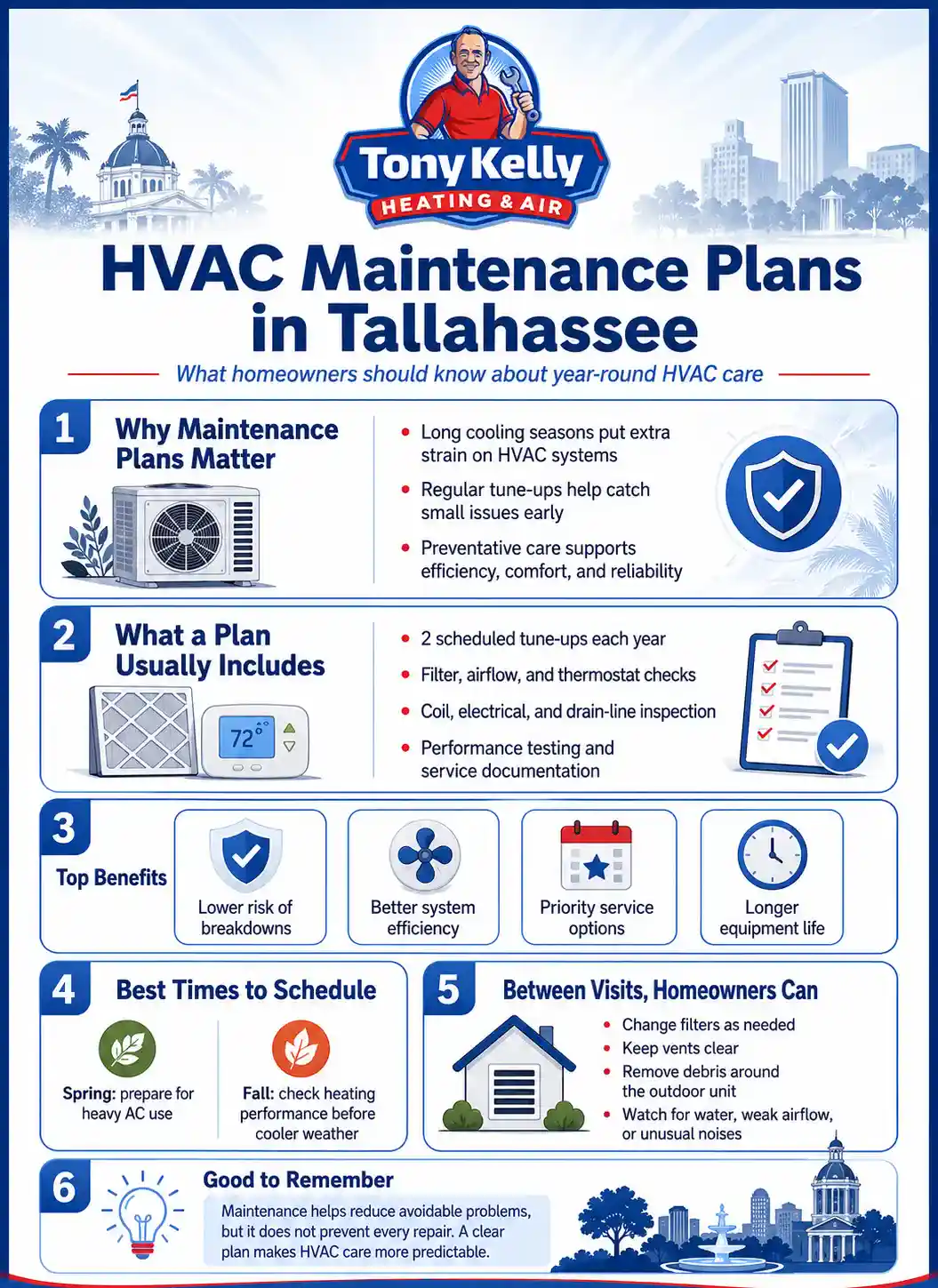
Many Tallahassee homes benefit from two scheduled HVAC visits each year: one before the heaviest cooling season and another before regular heating operation.
A spring or early-summer visit helps prepare the air conditioner for extended run times. A fall visit allows the technician to evaluate heating operation, heat-pump components, safety controls, and any concerns that developed during the cooling season.
Twice-yearly service may be particularly useful for:
Some newer or lightly used systems may follow a different schedule based on manufacturer guidance. The appropriate frequency should account for equipment type, age, operating environment, usage, and warranty terms.
An HVAC maintenance plan makes the schedule easier to manage because the provider can issue reminders or arrange visits automatically. That reduces the chance that maintenance will be postponed until the first very hot or cold week, when appointment availability may be more limited.
For many homeowners, HVAC maintenance plans are worth considering because they combine planned service with convenience and potential membership benefits. Their actual value depends on the plan price, included services, equipment needs, and likelihood that the homeowner would otherwise schedule routine maintenance.
A plan may provide value in several ways.
Without an agreement, it is easy to forget a tune-up until the system begins struggling. A maintenance plan converts an occasional task into a defined schedule.
This is especially useful in Tallahassee because air conditioning systems often move directly from mild spring operation into long daily run times. Completing maintenance before that workload begins gives the contractor an opportunity to identify developing concerns under less urgent conditions.
Maintenance cannot guarantee that a component will not fail. It can, however, reveal signs such as swelling capacitors, worn contactors, loose electrical connections, unusual motor readings, poor drainage, abnormal temperature changes, or deteriorated insulation.
Addressing a minor concern may prevent it from placing additional stress on other components. Even when a repair cannot be avoided, early identification gives the homeowner time to review options instead of making a rushed decision during a system shutdown.
Airflow restrictions, dirty heat-transfer surfaces, thermostat errors, improper refrigerant operation, and failing components can cause longer run times or reduced output. Correcting maintenance-related problems may help the system perform closer to its intended efficiency.
That does not mean every tune-up will produce a dramatic drop in the utility bill. Energy use is also affected by outdoor temperatures, thermostat settings, insulation, duct leakage, home size, equipment efficiency, occupancy, windows, and humidity.
The more accurate claim is that routine maintenance helps prevent avoidable efficiency losses. It keeps dirt, airflow restrictions, drainage issues, and minor operating concerns from quietly increasing system workload.
Priority service can become valuable during the hottest periods of the year, when HVAC companies receive a high volume of calls. Plan members may be moved ahead of nonmembers or given access to designated appointment availability, depending on the agreement.
Homeowners should read this benefit carefully. “Priority” may not mean immediate service, and response policies can vary based on demand, weather, safety, parts availability, and operating hours.
Many professional HVAC maintenance plans offer a percentage discount on qualifying repairs. This can reduce the cost of an unexpected repair, but homeowners should confirm what the discount applies to and whether exclusions exist for parts, equipment, refrigerant, after-hours labor, or major projects.
Service records show when the equipment was inspected, what readings or conditions were observed, and what work was recommended. These records can help technicians track changes over time.
Documentation may also be helpful when reviewing a manufacturer warranty, selling a home, evaluating recurring performance concerns, or deciding whether additional repairs remain reasonable for an aging system.
For some homeowners, the greatest value is simply not having to remember each appointment. Automatic reminders and recurring scheduling reduce the administrative work of caring for the equipment.
A plan is less valuable when it includes vague inspections, unnecessary extras, confusing exclusions, or benefits the homeowner will never use. The best HVAC maintenance plan is not automatically the one with the longest list of perks. It is the one that clearly covers the maintenance the system actually needs.
Preventative maintenance reduces avoidable risk, but it cannot eliminate every breakdown. Mechanical and electrical components can fail even when properly maintained, particularly as equipment ages.
A maintenance plan generally cannot guarantee:
This distinction matters because maintenance and repair serve different purposes. Maintenance focuses on cleaning, adjustment, evaluation, and prevention. Repair corrects a confirmed failure or malfunction. Replacement may become appropriate when the equipment is no longer reliable, repairable, efficient, or economically reasonable to keep operating.
The contractor should explain which category applies instead of presenting every finding as an emergency.
A one-time tune-up and an annual HVAC maintenance plan may include similar inspection procedures, but the service relationship is different.
Neither option is universally better. A homeowner who reliably schedules seasonal service may be satisfied with individual appointments. Another homeowner may find that plan benefits and automatic scheduling justify the agreement.
Residential HVAC maintenance plans are designed around the heating and cooling needs of a home. They commonly cover a central air conditioner, heat pump, furnace, air handler, thermostat, and related comfort components.
Commercial HVAC maintenance plans may involve a different scope because commercial properties can contain rooftop units, split systems, packaged equipment, multiple thermostats, larger electrical components, building controls, ventilation equipment, or systems serving separate tenant areas.
Commercial HVAC maintenance contracts may also account for:
A homeowner-focused plan should not be assumed to provide the same coverage for a business. Light commercial property owners should ask whether the contractor offers a customized agreement based on equipment count, operating conditions, accessibility, and building use.
The HVAC system influences indoor air quality, but routine maintenance should not be presented as a cure for every air-quality concern. The system circulates air, captures some particles through its filter, removes moisture during cooling, and distributes conditioned air throughout the home.
Maintenance supports this process by addressing conditions such as:
However, an HVAC tune-up cannot resolve all sources of dust, mold, odors, allergens, or humidity. Roof leaks, plumbing leaks, wet building materials, crawl space moisture, inadequate ventilation, duct leakage, and household activities can all affect indoor conditions.
The EPA recommends controlling moisture and generally keeping indoor relative humidity below 60%, ideally in a range of roughly 30% to 50%. It also notes that filtration can supplement source control and ventilation but cannot remove every indoor pollutant.
In Tallahassee, a system that cools the house but leaves it feeling damp may need more than routine cleaning. Potential causes can include short cycling, improper sizing, airflow issues, thermostat settings, duct leakage, equipment configuration, or a separate moisture source. Maintenance provides a useful starting point because it helps determine whether the HVAC equipment is operating correctly before other solutions are considered.
An HVAC preventative maintenance plan does not replace basic homeowner care. Several simple tasks can help keep the system accessible and reduce unnecessary airflow restrictions between professional appointments.
Inspect the air filter according to manufacturer guidance and household conditions. Homes with pets, remodeling dust, frequent door openings, allergies, or heavy system use may need more frequent attention.
Replace the filter when it is dirty rather than relying only on a fixed calendar. Make sure the replacement is the correct size and installed in the proper airflow direction.
Furniture, rugs, curtains, and stored items can block vents. Keep return grilles and supply registers clear so air can move through the intended pathways.
Closing numerous supply vents to redirect air may create pressure and airflow problems. Persistent room-to-room temperature differences should be evaluated rather than managed by closing most of the system.
Remove loose leaves, grass clippings, and debris from the immediate area. Trim vegetation so the condenser has room to move air.
Do not open electrical panels, bend coil fins, spray high-pressure water into the equipment, or work around the fan while the unit has power.
Water near the indoor equipment may indicate a blocked drain, frozen coil, damaged pan, disconnected line, or another moisture problem. Shut the system down when necessary to prevent additional damage and arrange an evaluation.
Contact a professional when you notice new grinding, buzzing, rattling, burning odors, repeated breaker trips, frequent cycling, ice, weak airflow, unusual humidity, or a sudden change in performance.
Maintenance plans are most effective when the homeowner reports changes instead of waiting for the next scheduled visit while the system continues operating abnormally.
Homeowners should not perform work involving refrigerant, live electrical components, internal motors, combustion equipment, gas connections, capacitors, control boards, or system pressure.
Professional HVAC maintenance may require specialized tools to:
Attempting internal repairs without the proper training can cause injury, equipment damage, refrigerant release, fire risk, or inaccurate diagnosis. Safe homeowner maintenance should remain limited to accessible tasks such as filter replacement, vent clearance, thermostat checks, and keeping debris away from the outdoor unit.
The best way to compare maintenance plans for year-round HVAC care is to examine the written coverage rather than comparing price alone.
Confirm whether the agreement includes one or two visits per year. Ask whether the company schedules appointments automatically, sends reminders, or expects the customer to initiate each visit.
Determine whether the plan covers one complete system, one outdoor unit, one air handler, or every system in the home. Ask how pricing changes for additional equipment, ductless systems, zoning controls, dehumidifiers, or specialized accessories.
Look for a clear description of the inspection and tune-up. Terms such as “complete maintenance” are difficult to evaluate without a checklist.
Ask which cleaning tasks are included. A routine coil inspection is not necessarily the same as deep evaporator coil cleaning, blower removal, duct cleaning, or biological remediation.
Confirm how priority scheduling works during peak season. Ask whether it applies to regular business hours, after-hours calls, emergencies, or all service requests.
Review the discount percentage and exclusions. Find out whether the discount applies to parts, labor, diagnostic charges, refrigerant, major repairs, and equipment replacement.
Some plans reduce or waive certain fees, while others charge normal rates. The agreement should explain which charges remain the homeowner’s responsibility.
Ask whether plan members receive a different labor warranty on qualifying repairs. Confirm the warranty duration, covered work, transferability, and membership requirements.
Review the contract term, billing schedule, renewal policy, cancellation procedure, and refund rules. Do not assume every plan can be canceled at any time.
A useful plan should provide understandable documentation. The report may include measurements, component condition, work completed, concerns found, and recommendations.
Choose a licensed and insured contractor with trained technicians, clear communication, and experience with the equipment installed in your home.
Maintenance findings should be explained before additional repair work begins. A technician should distinguish between an immediate safety concern, a developing reliability issue, an efficiency recommendation, and an optional improvement.
Tony Kelly Heating & Air Conditioning offers an ongoing maintenance option for homeowners who want scheduled care and additional service benefits.
According to the current Ultimate Savings Agreement, listed benefits include:
The agreement’s stated objective is to maintain equipment at efficient operation and identify developing problems before they lead to unplanned downtime. Repair components and emergency-service materials are not included in the maintenance-program cost, and qualifying repair work is invoiced separately with the applicable agreement discount.
Homeowners should review the current agreement directly before enrolling because benefits, terms, coverage, and availability may change. Questions about the program or a specific property can be submitted through Tony Kelly’s contact page.
A homeowner can enroll whenever a plan is available, but the most convenient time is often before the system’s busiest season.
Spring enrollment allows the cooling system to be evaluated before extended summer operation. Fall enrollment provides an opportunity to check heating performance and review how the equipment handled the cooling season.
Other useful times to consider a maintenance agreement include:
Planned maintenance is often performed during moderate weather because contractors may have greater scheduling flexibility and the system can be inspected before peak demand. Waiting for the first extreme-temperature event may mean the system is already operating under its heaviest workload.
Repair-only service is reactive. It restores operation after a problem becomes noticeable. Preventative maintenance is designed to identify wear, contamination, drainage concerns, and performance changes before they create a complete interruption.
New equipment still has filters, drains, coils, electrical connections, motors, controls, and outdoor components. Routine care helps establish maintenance records and gives the contractor an opportunity to identify installation, airflow, or operating concerns early.
No responsible contractor can promise that. Maintenance reduces preventable stress and improves the chance of finding developing problems. It cannot eliminate random component failures, storm damage, manufacturing defects, or age-related deterioration.
Filter replacement is important, but it does not evaluate electrical operation, condensate drainage, motors, coils, refrigerant performance, safety controls, thermostat accuracy, or system cycling.
Plans differ significantly in visit frequency, inspection depth, cleaning, response policies, repair discounts, warranties, fees, covered equipment, and cancellation terms.
A lower price may be appropriate when the coverage matches the homeowner’s needs. It may offer poor value when it excludes important procedures, provides only a brief visual inspection, or adds fees for services assumed to be included.
They can be worthwhile for homeowners who want recurring tune-ups, service reminders, inspection records, priority scheduling, and repair-related benefits. The value depends on the plan cost, included maintenance, equipment needs, and how often the homeowner is likely to use the additional benefits.
The homeowner enrolls in an agreement that includes scheduled maintenance visits and specified membership benefits. The contractor performs the included inspections and tune-ups, documents findings, and discusses any repairs that fall outside the agreement.
Many local homes benefit from two visits per year: cooling-system maintenance before the hottest weather and heating-system maintenance before winter operation. The final schedule should reflect equipment type, age, usage, and manufacturer recommendations.
Typical plans include thermostat checks, filter inspection, electrical testing, coil and blower evaluation, condensate drain service, refrigerant-system evaluation, heating checks, and performance testing. Some plans also include priority service, discounts, reports, or extended repair warranties.
Usually not automatically. Maintenance agreements commonly include inspections, cleaning, adjustment, and testing. Repairs, parts, refrigerant, and emergency materials are normally charged separately unless the written agreement states otherwise.
Maintenance can prevent avoidable efficiency losses caused by dirty filters, restricted airflow, contaminated coils, thermostat problems, and poorly operating components. Actual utility savings vary because weather, insulation, ductwork, equipment efficiency, and thermostat settings also affect energy use.
Routine care can reduce unnecessary wear and help correct problems before they damage related components. It may support a longer useful life, but no plan can guarantee that every system will operate for a specific number of additional years.
Yes. New systems still require filter care, drain inspection, electrical evaluation, coil maintenance, and performance checks. Professional records may also be important when reviewing warranty requirements.
Many do. Automatic reminders and pre-scheduled visits are common plan features, but the homeowner should verify who is responsible for arranging each appointment.
Pre-season maintenance prepares the equipment before its heaviest workload and may provide more flexible scheduling. Cooling maintenance is commonly completed in spring, while heating maintenance is often completed in fall.
Routine maintenance is scheduled in advance to evaluate and care for functioning equipment. Emergency service responds after the system has stopped working or developed an urgent problem. Maintenance may reduce emergency risk, but it cannot prevent every unexpected failure.
It can support indoor air quality by addressing dirty filters, standing water, drain issues, airflow restrictions, and contamination on accessible HVAC components. It does not replace moisture repair, ventilation improvements, duct repair, source control, or professional remediation when those are needed.
Homeowners can change filters, clear vents, check thermostat settings, remove debris near the outdoor unit, and watch for water or unusual operation. Refrigerant, internal electrical, combustion, motor, and mechanical work should be handled by trained professionals.
Yes. Commercial agreements may cover multiple units, rooftop equipment, controls, longer operating hours, filter schedules, after-hours access, tenant requirements, and customized inspection frequencies. They are usually tailored to the building and equipment.
Ask about the number of visits, covered equipment, maintenance checklist, cleaning procedures, repair discounts, priority-service terms, diagnostic charges, overtime fees, warranties, renewal, cancellation, and documentation.
No. It can reduce preventable problems and identify developing concerns, but components can still fail because of age, electrical events, manufacturing defects, storm damage, or normal wear.
The technician should explain the finding, its potential effect, the urgency, and the available options. Repair work outside the agreement should not begin until the homeowner understands and authorizes it.
HVAC maintenance plans help turn heating and cooling care into a scheduled process rather than a reaction to the next breakdown. For Tallahassee homeowners, that structure can be especially useful because air conditioners and heat pumps operate through long periods of heat, humidity, pollen, storms, and seasonal temperature changes.
The strongest plans combine meaningful inspections with clear documentation and straightforward terms. They explain what the technician will evaluate, how frequently visits occur, which equipment is covered, and which repair or scheduling benefits apply.
Routine maintenance cannot guarantee perfect performance or eliminate every future repair. It can help preserve airflow, drainage, electrical reliability, heat transfer, humidity control, and overall system operation. It can also give homeowners more time to make informed decisions when a developing concern is found.
Homeowners evaluating preventative care can also read about the broader benefits of preventative HVAC maintenance and compare those benefits with the terms of a recurring service agreement.
The right plan should make HVAC care easier to understand, easier to schedule, and less dependent on emergency service. Before enrolling, review the written agreement carefully, ask questions about any unclear terms, and choose coverage that matches your equipment, property, and expectations.
Address:
870 Blountstown Hwy. Unit # 9
Tallahassee, FL 32303
Phone: 850-385-3774
License #: CMC1249702
Open Monday Through Friday
8:00 am to 8:00 pm

