
The short answer is no—most fans do not reduce the amount of moisture in the air. Ceiling fans, portable fans, box fans, and your HVAC blower primarily move air. That air movement can make you feel cooler, but it does not work like a dehumidifier and physically remove water vapor from your home.
Your air conditioning system is different. While actively cooling, an AC system removes moisture as humid air passes over the cold evaporator coil. However, the way your blower operates matters. Leaving a conventional HVAC fan continuously set to On can interfere with humidity control, while some modern variable-speed systems deliberately adjust airflow during cooling to improve moisture removal.
For North Florida homeowners, understanding the difference between air circulation and actual dehumidification can make it easier to choose the right thermostat settings and recognize when high humidity points to a larger HVAC problem.
If excessive moisture is an ongoing issue, learn more about how whole-home dehumidifiers work in Florida homes.
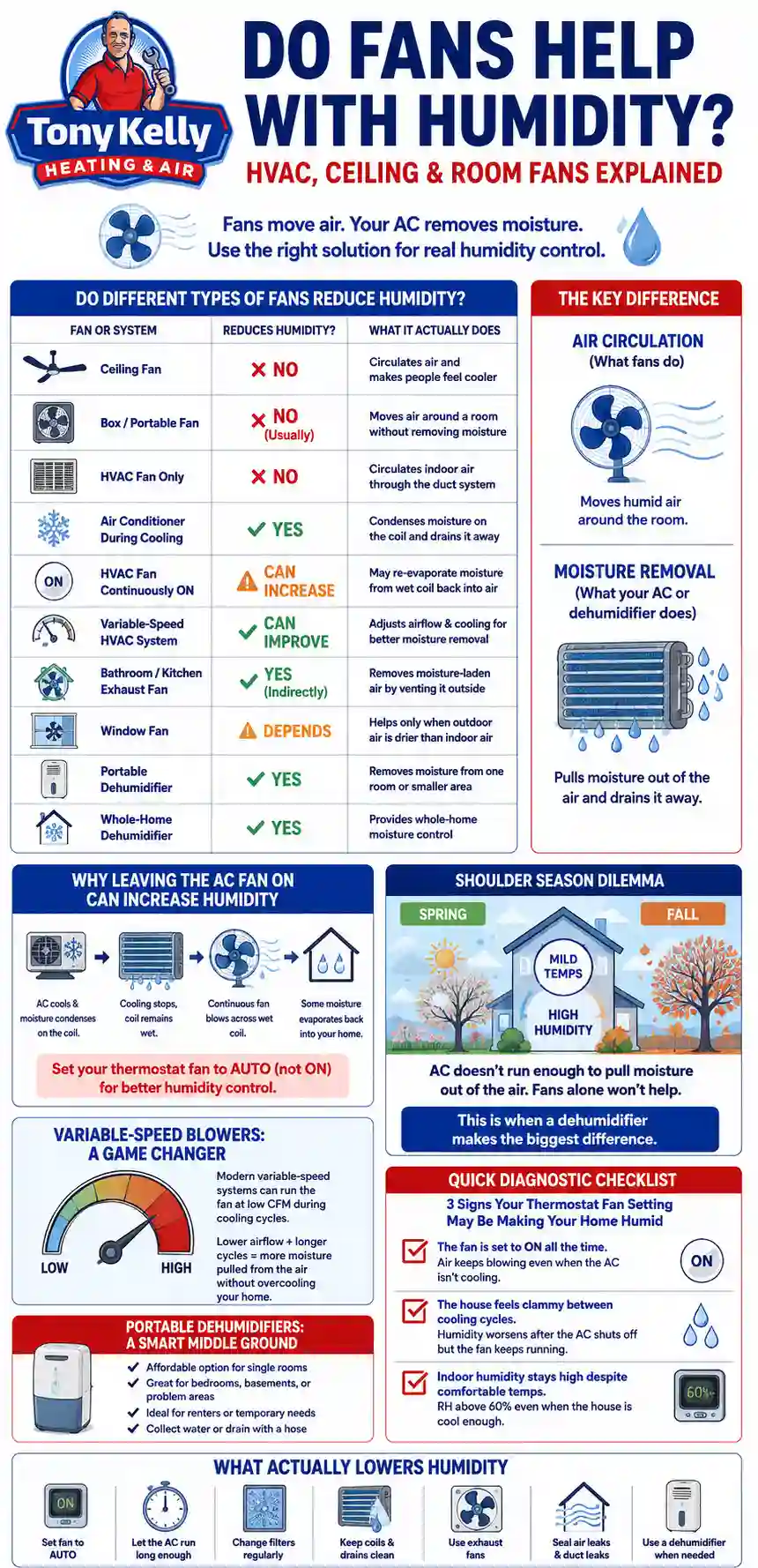
Do Different Types of Fans Reduce Humidity?
Not all fans affect indoor humidity in exactly the same way. A ceiling fan and HVAC blower primarily circulate air, while a properly vented exhaust fan can actually remove moisture-laden air from the house.
| Fan or System | Does It Reduce Humidity? | What It Actually Does |
|---|---|---|
| Ceiling fan | No | Circulates air and makes people feel cooler |
| Box or portable fan | Usually no | Moves air around a room without removing water vapor |
| Standard HVAC fan only | No | Circulates indoor air through the duct system |
| Air conditioner during cooling | Yes | Condenses moisture on the evaporator coil and drains it away |
| HVAC fan continuously On | Can make humidity worse | May interfere with moisture drainage and reintroduce some coil moisture |
| Variable-speed HVAC system | Can improve dehumidification | Can adjust airflow and cooling capacity to increase moisture removal during operation |
| Bathroom or kitchen exhaust fan | Yes, indirectly | Moves moisture-laden indoor air outside |
| Window fan | Depends | Helps only when outdoor air is drier than indoor air |
| Portable dehumidifier | Yes | Removes moisture from one room or smaller area |
| Whole-home dehumidifier | Yes | Provides dedicated moisture control throughout the home |
The important distinction is simple: moving humid air is not the same as removing moisture from it.
Why Does a Fan Make the Air Feel Less Humid?
Fans can be misleading because a room may feel noticeably better as soon as you turn one on, even though the relative humidity has barely changed.
Moving air across your skin helps sweat evaporate more effectively. That evaporation helps your body release heat, creating a cooling effect. The increased airflow can therefore make hot, humid conditions feel less uncomfortable.
But the fan has not necessarily removed any water from the air.
Think of it as the difference between thermal comfort and humidity control. A fan changes how your body experiences the room. An air conditioner or dehumidifier actually removes moisture.
This is why running several ceiling or portable fans in a humid house may improve comfort without addressing the underlying moisture problem.
How Does an Air Conditioner Remove Humidity?
Your air conditioner does more than lower indoor temperature. During a normal cooling cycle, it also removes moisture from indoor air.
Warm, humid return air passes over the system’s cold evaporator coil. As the air cools, water vapor condenses into liquid water on the coil. That moisture collects in the drain pan and exits through the condensate drain.
The process can be summarized as:
Warm, humid air → cold evaporator coil → condensation forms → water drains away → cooler, drier air returns to the home.
That distinction explains why simply running a blower or room fan cannot reproduce what the AC system does. Moisture removal requires a process that actually separates water from the air.
Regular HVAC maintenance in Tallahassee can help keep coils, filters, condensate components, airflow, and other parts of the cooling system operating properly.
Does Running the HVAC Fan Reduce Humidity?
Running the HVAC blower by itself generally does not reduce indoor humidity.
The blower’s job is to move air through the air handler and ductwork. During an active cooling cycle, that airflow is essential because it carries humid indoor air across the cold evaporator coil.
The problem occurs when homeowners assume that more blower runtime automatically means more dehumidification.
It doesn’t.
Once the compressor is no longer providing a cold evaporator coil, the blower alone has no mechanism for removing water vapor from the home.
Why Can Leaving the AC Fan On Increase Humidity?
This is the key mechanism to understand.
During cooling, condensation forms on the evaporator coil. Not every drop of that water immediately leaves the coil the moment the thermostat reaches its temperature setting.
With the thermostat fan set to Auto, blower operation normally stops along with the cooling cycle, allowing remaining condensation to continue draining away.
With the thermostat fan continuously set to On, air can continue moving across the damp coil after active cooling stops. Some remaining moisture may evaporate back into the passing air and return to the living space instead of draining away.
The sequence looks like this:
AC cools → moisture condenses on coil → cooling stops → coil remains damp → continuous airflow passes over coil → some moisture can return to indoor air.
This is why leaving the HVAC blower continuously On can work against humidity control in a humid climate.
For more on continuous operation, read why you may not want to run your AC fan 24/7.
What About Variable-Speed HVAC Fans?
The advice to avoid continuous fan operation needs an important qualification for newer HVAC technology.
A variable-speed blower is not the same thing as a standard single-speed fan running continuously.
Traditional blower motors tend to operate at one primary airflow rate whenever they are called to run. Variable-speed systems can change airflow based on operating conditions. Multi-stage and variable-capacity air conditioners can also operate at lower cooling outputs for longer periods instead of repeatedly cycling between full output and Off.
During active cooling, certain variable-speed controls can intentionally reduce airflow across the evaporator coil. The colder coil and longer operating cycle can allow the system to remove more moisture while still maintaining a comfortable indoor temperature.
That is one reason modern variable-speed equipment can provide better humidity control than conventional single-stage equipment.
However, there is an important distinction:
Low-speed blower operation that is intentionally coordinated with active cooling is not the same as manually setting the thermostat fan to On 24 hours a day.
The equipment’s control board, thermostat, compressor, and blower may all work together to manage airflow differently depending on the system. Homeowners with variable-speed or communicating HVAC equipment should therefore follow the operating strategy designed for their particular system rather than assuming the same blower behavior applies to every unit.
Variable-speed technology can improve dehumidification, but it does not change the underlying rule: air circulation alone does not remove moisture.
AC Fan On vs. Auto for Humidity
Most thermostats provide at least two basic fan selections: On and Auto.
Fan Set to Auto
With Auto selected, the blower operates when the HVAC system calls for airflow and shuts off afterward.
For many conventional systems, this is the better cooling-season setting because it:
- Allows condensed moisture to continue draining after cooling
- Reduces unnecessary post-cycle airflow across the evaporator coil
- Uses less blower electricity than continuous operation
- Limits unnecessary fan runtime
Fan Set to On
With On selected, the blower runs continuously, including periods when the compressor is not cooling.
Continuous circulation can sometimes help even out temperature differences between rooms, but in humid conditions it can also:
- Circulate moist indoor air without removing water from it
- Increase blower energy use
- Allow some residual evaporator-coil moisture to return to the air
- Make moisture control more difficult in some homes
For many North Florida homes with conventional HVAC equipment, Auto is generally the better starting point when humidity is a concern.
3 Signs Your Thermostat Fan Setting May Be Making Your Home More Humid
Not every humidity problem is caused by the thermostat fan setting, but these clues make it worth checking:
1. The Thermostat Fan Is Set to On Around the Clock
Your AC reaches the desired temperature and the outdoor unit shuts down, but air continues coming from the vents continuously.
Switching from On to Auto is a simple first diagnostic step for a conventional HVAC system.
2. The House Feels Clammy Between Cooling Cycles
The home may feel comfortable while the AC is actively cooling but noticeably more humid after the compressor shuts off while the blower continues running.
That timing can point toward post-cycle airflow contributing to the problem.
3. Indoor Humidity Stays High Despite a Comfortable Temperature
A thermostat reading of 74°F or 75°F does not necessarily mean your home has adequate moisture control.
Indoor temperatures can be perfectly comfortable while relative humidity remains above 60%. Checking both measurements provides a much better picture of HVAC performance.
Changing the fan setting won’t fix every humidity problem. Persistent high RH can also indicate equipment sizing, airflow, duct, drainage, infiltration, or other HVAC issues.
Do Ceiling Fans Reduce Humidity?
No. A ceiling fan does not remove water vapor from indoor air.
Ceiling fans circulate the air already in the room. Their primary comfort benefit comes from increasing air movement across your skin.
That can still be useful in Florida because moving air may help occupants feel comfortable at a warmer thermostat setting. But the ceiling fan itself is not dehumidifying the room.
If a room immediately feels sticky after you shut the ceiling fan off, the fan may have been masking the sensation of humidity rather than correcting the moisture level.
Do Box Fans and Portable Fans Lower Humidity?
Box fans, tower fans, oscillating fans, and similar portable fans generally do not lower relative humidity by circulating air inside a closed room.
Imagine a humid bedroom with all of the doors and windows closed. Turning on a box fan changes where that air moves, but it doesn’t provide anywhere for the water vapor to go.
The room may feel more comfortable because of increased air movement, but the moisture remains.
A portable fan can still complement another moisture-control strategy by improving circulation in a stagnant area. It simply should not be confused with equipment that actually removes water from the air.
Can a Window Fan Reduce Humidity?
A window fan is different because it can exchange indoor and outdoor air rather than simply recirculating the air already inside the room.
That means its effect depends on outdoor conditions.
Bringing in drier outdoor air can sometimes help. Bringing in warm, moisture-heavy Florida air can do the opposite and add to the home’s latent moisture load.
Outdoor relative humidity alone can also be misleading because temperature affects relative humidity. The broader point is that outdoor ventilation is only useful for moisture control when the incoming air is actually drier than the indoor air.
During much of North Florida’s warm season, opening windows and relying on fans is not an effective substitute for mechanical dehumidification.
Do Bathroom and Kitchen Exhaust Fans Reduce Humidity?
Yes. A properly vented exhaust fan is different from a ceiling or portable fan because it removes moisture-laden air from the indoor space.
Bathrooms are the clearest example. Hot showers can release a large amount of water vapor into a small room. A properly installed bathroom exhaust fan moves that humid air outside before it spreads throughout the house.
Kitchen ventilation can offer a similar benefit when cooking generates steam.
The key is proper outdoor venting. A fan that simply recirculates indoor air does not provide the same moisture-removal benefit.
Why Spring and Fall Can Be Surprisingly Humid Inside Florida Homes
Some of the trickiest indoor humidity problems in North Florida occur when the weather isn’t especially hot.
During spring and fall—the periods sometimes called shoulder seasons—outdoor air can still contain a significant amount of moisture while indoor temperatures are mild.
That creates an HVAC problem:
Your house may not be warm enough to require much air conditioning, but it can still be humid enough to need moisture removal.
Because the thermostat isn’t calling for much cooling, the compressor runs less frequently. Less cooling runtime also means fewer opportunities for moisture to condense on the evaporator coil and drain away.
Turning on ceiling fans, portable fans, or the HVAC blower may improve air movement, but those fans still do not remove the moisture.
This can create the frustrating situation where the thermostat reads a comfortable temperature while the home feels damp or clammy.
Dedicated dehumidification becomes especially valuable under these conditions because a dehumidifier can address the moisture load without requiring the house to become hot enough to trigger long AC cycles.
Fan vs. Portable Dehumidifier vs. Whole-Home Dehumidifier
Humidity control does not have to jump immediately from a $30 fan to a whole-home HVAC accessory. Portable dehumidifiers can provide a useful middle ground.
Fan
A fan is best for:
- Improving air movement
- Helping occupants feel cooler
- Reducing stagnant areas
It is not a moisture-removal device.
Portable Dehumidifier
A portable dehumidifier can be useful for:
- A single humid bedroom
- A small apartment
- A room with a recurring moisture issue
- Renters who cannot modify the HVAC system
- Homeowners testing whether dedicated moisture removal improves comfort
Portable units actually remove water from the air, usually collecting it in a reservoir or draining it through a hose.
The tradeoff is coverage. A portable unit is designed primarily for a limited area and may require regular emptying, cleaning, and maintenance.
Whole-Home Dehumidifier
A whole-home system is designed for broader humidity control and can integrate with the home’s HVAC system.
It can be especially useful when:
- Humidity affects several rooms
- Indoor RH routinely remains high
- The AC doesn’t run enough during mild but humid weather
- The home requires dedicated moisture control throughout much of the year
Learn more about whole-home dehumidification in Florida.
What Indoor Humidity Is Too High?
Indoor humidity is normally measured as relative humidity (RH).
The EPA recommends controlling indoor moisture and generally keeping relative humidity below 60%, with roughly 30% to 50% often cited as an ideal range. Additional guidance is available through the EPA’s information on moisture and mold.
As a practical reference:
- 30%–50% RH: Generally a comfortable target range
- 50%–60% RH: Worth monitoring, especially if rooms feel damp
- Above 60% RH: Persistent levels deserve attention
- 70%+ RH: Indicates a substantial moisture problem if sustained
A brief humidity spike after a shower or while exterior doors are open is very different from a home that remains above 60% for hours or days.
Patterns matter more than a single reading.
How to Actually Lower Humidity in Your House
Fans may improve comfort, but correcting excessive humidity requires either removing moisture or reducing the amount entering the home.
1. Check Your Thermostat Fan Setting
Owners of conventional HVAC systems can start by checking whether the fan is set to On continuously. Switching to Auto may improve moisture control by allowing condensation to drain after cooling cycles.
Homes with variable-speed or communicating systems may use more advanced blower controls, so equipment-specific settings should be considered before overriding programmed operation.
2. Make Sure the AC Runs Long Enough
An air conditioner needs sufficient runtime to provide meaningful dehumidification.
A system that repeatedly starts and stops may cool the house without removing enough moisture. This can happen because of HVAC problems, control issues, or equipment that is oversized for the home’s actual cooling load.
3. Don’t Assume a Bigger AC Is Better
This point is especially important in Florida.
An oversized air conditioner can lower the indoor temperature quickly and satisfy the thermostat before it has had enough runtime to remove an adequate amount of moisture.
The result can be a home that is technically cool but still feels clammy.
Proper HVAC sizing should account for the home’s actual cooling requirements rather than relying only on square footage or replacing an old unit with equipment of the same capacity.
4. Replace Dirty Air Filters
Restricted airflow can interfere with HVAC performance. Check filters regularly and replace them according to the filter manufacturer’s recommendations and conditions inside the home.
5. Keep the Coil and Condensate System Working Properly
The evaporator coil, drain pan, and condensate line are all part of the AC’s moisture-removal process. Dirt buildup, drainage problems, or other equipment issues can reduce effective dehumidification.
6. Use Exhaust Fans at Moisture Sources
Run bathroom exhaust fans during and after showers and use appropriate kitchen ventilation while generating steam.
Removing moisture at its source is easier than asking the air conditioner to deal with it later.
7. Reduce Humid Outdoor-Air Infiltration
Leaks around doors, windows, building penetrations, ductwork, and other parts of the home can introduce humid outdoor air.
In North Florida, that additional moisture load can be significant.
8. Use Dedicated Dehumidification When Necessary
A portable dehumidifier may solve a localized problem. A whole-home dehumidifier may make more sense when high humidity affects most of the house or persists during mild weather when the AC doesn’t run very often.
Why Is My House Humid Even Though the AC Is Running?
A running air conditioner does not automatically mean a home is being properly dehumidified.
Possible causes of persistent indoor humidity include:
- An oversized air conditioning system
- Short cooling cycles
- Improper blower airflow
- Incorrect thermostat or fan settings
- Dirty evaporator coils
- Condensate drainage problems
- Leaky ductwork
- Humid outdoor-air infiltration
- High indoor moisture production
- Equipment or controls that are not operating properly
Oversizing is particularly important because an AC can have enough capacity to cool a home very quickly while still providing poor moisture control.
In other words, meeting the thermostat setting does not necessarily mean the HVAC system is managing the home’s latent humidity load correctly.
Other HVAC symptoms may help narrow down the cause. Review these common HVAC problems if you’ve noticed changes in cycling, airflow, temperatures, sounds, or system performance.
Why Humidity Control Matters So Much in North Florida
North Florida’s climate creates a demanding environment for moisture control. Homes regularly experience warm outdoor temperatures, high moisture levels, storms, long cooling seasons, and mild periods when humidity remains high even though cooling demand drops.
Indoor moisture also comes from normal activities and building conditions, including:
- Showering
- Cooking
- Doing laundry
- Opening exterior doors
- Air leakage
- Duct leakage
Because the outdoor environment already creates a high moisture load, a system that cools well but dehumidifies poorly can still leave a Florida home uncomfortable.
Excess moisture can also contribute to condensation, musty odors, and conditions favorable to mold growth, making proper moisture management an important part of maintaining healthy indoor air quality.
Signs Your Home May Have an Indoor Humidity Problem
A digital hygrometer or thermostat with a humidity sensor can help you monitor indoor RH instead of relying entirely on how the house feels.
Warning signs include:
- Relative humidity that consistently stays above 60%
- Sticky or clammy indoor air
- Condensation on windows or other cool surfaces
- Musty odors
- Visible mold or mildew
- Sweating around ducts or supply registers
- Rooms that feel damp despite comfortable temperatures
- An air conditioner that frequently starts and stops
A single symptom doesn’t necessarily identify the cause. Persistent high humidity combined with unusually short cooling cycles is especially worth investigating because it can point toward an HVAC system that is not properly matched to the home.
Frequently Asked Questions About Fans and Humidity
Do fans help with humidity?
Most fans do not lower humidity. Ceiling fans, box fans, and portable fans circulate air and make people feel cooler, but they do not physically remove water vapor. Exhaust fans are different because they can carry humid indoor air outside.
Does a fan reduce humidity in a room?
A fan circulating air inside a closed room generally will not reduce relative humidity. It may improve comfort by increasing evaporation from your skin, making the room feel less humid without actually removing much moisture.
Does a ceiling fan reduce humidity?
No. A ceiling fan moves air but does not remove water vapor. It can still make a humid room feel more comfortable because increased airflow improves evaporative cooling at your skin.
Does running the HVAC fan reduce humidity?
The HVAC blower does not dehumidify a home by itself. Moisture removal primarily occurs during cooling as air crosses a cold evaporator coil. Some variable-speed systems can improve dehumidification by controlling blower airflow during active cooling, but that is different from simply running the fan continuously.
Does leaving the AC fan on increase humidity?
It can in many conventional systems. Continuous post-cycle airflow can pass over a still-damp evaporator coil and allow some remaining moisture to return to the indoor air rather than draining away.
Should my AC fan be On or Auto for humidity?
Auto is generally the better starting point for conventional HVAC systems in humid climates. Variable-speed and communicating systems may use more sophisticated programmed airflow strategies, so homeowners should account for the way their particular equipment is designed to operate.
Do variable-speed HVAC fans help with humidity?
They can. Variable-speed blowers can adjust airflow during active cooling, while multi-stage or variable-capacity equipment can run at lower output for longer periods. This can improve moisture removal compared with short, full-capacity cooling cycles.
Does running the furnace fan reduce humidity?
Running the furnace or air-handler blower alone does not remove moisture. Without cooling or another dehumidification process, the blower primarily circulates existing indoor air.
Can a window fan reduce humidity?
Sometimes. A window fan can help when the incoming outdoor air contains less moisture than the indoor air. During humid Florida weather, bringing outdoor air inside can instead increase the home’s moisture load.
Does an exhaust fan reduce humidity?
A properly vented exhaust fan can help by carrying moisture-laden air outdoors. This makes bathroom exhaust fans useful during showers and kitchen ventilation helpful when cooking creates steam.
Can a fan act as a dehumidifier?
No. A standard fan moves air, while a dehumidifier actually removes water from that air. Fans can improve comfort and circulation but cannot replace mechanical moisture removal.
Is a portable dehumidifier worth using?
A portable dehumidifier can be a practical option for a single room, apartment, rental property, or localized moisture problem. Whole-home dehumidification is generally better suited to persistent moisture affecting multiple areas of a house.
Why is my house humid even though the AC is running?
Possible causes include short cycling, oversized equipment, airflow problems, dirty coils, condensate issues, duct leakage, humid outdoor-air infiltration, poor controls, or moisture loads the AC cannot adequately handle.
What humidity level is too high inside a house?
Indoor relative humidity should generally remain below 60%, with approximately 30% to 50% commonly used as a target range. Persistent humidity above 60% deserves attention, particularly when paired with condensation, musty odors, or damp conditions.
Still Humid With the Fan Set Correctly? The AC May Be the Problem
Switching a conventional thermostat fan from On to Auto is an easy first step, but persistent humidity should not automatically be blamed on the fan.
An oversized air conditioner is one possible cause. A system with too much cooling capacity can drop the temperature rapidly, shut off, and repeat the process without running long enough to provide effective dehumidification.
This is especially relevant in Florida homes, where controlling latent moisture can be just as important as lowering temperature.
If your North Florida home regularly stays above 60% relative humidity, feels clammy even while the AC is running, or experiences very short cooling cycles, a more complete evaluation can help determine whether the issue involves airflow, equipment sizing, controls, ductwork, moisture infiltration, or the need for dedicated dehumidification.
Rather than relying on more fans or repeatedly lowering the thermostat, schedule a home humidity and HVAC load calculation audit with Tony Kelly Heating & Air Conditioning. Evaluating both the home’s moisture conditions and the cooling load can help identify whether your current system is properly sized and configured for North Florida’s climate.
So, Will Running a Fan Help With Humidity?
A fan can make you feel more comfortable, but most fans will not actually lower the humidity in your home.
Ceiling fans, box fans, portable fans, and HVAC blowers primarily circulate air. Exhaust fans can help by removing humid air from bathrooms and kitchens, while window fans only help under suitable outdoor conditions.
Your air conditioner removes moisture while cooling, and newer variable-speed equipment can improve that process by better coordinating airflow and cooling capacity. That should not be confused with leaving a conventional blower continuously On.
During Florida’s humid shoulder seasons, even a properly functioning AC may not run frequently enough to provide all the moisture removal a home needs. That’s where portable or whole-home dehumidification can become especially useful.
For North Florida homeowners, the most effective strategy is not simply moving more air. It is understanding where the moisture is coming from, ensuring the HVAC system is properly sized and controlled, and using dedicated dehumidification when the cooling system alone cannot maintain comfortable indoor humidity.

