
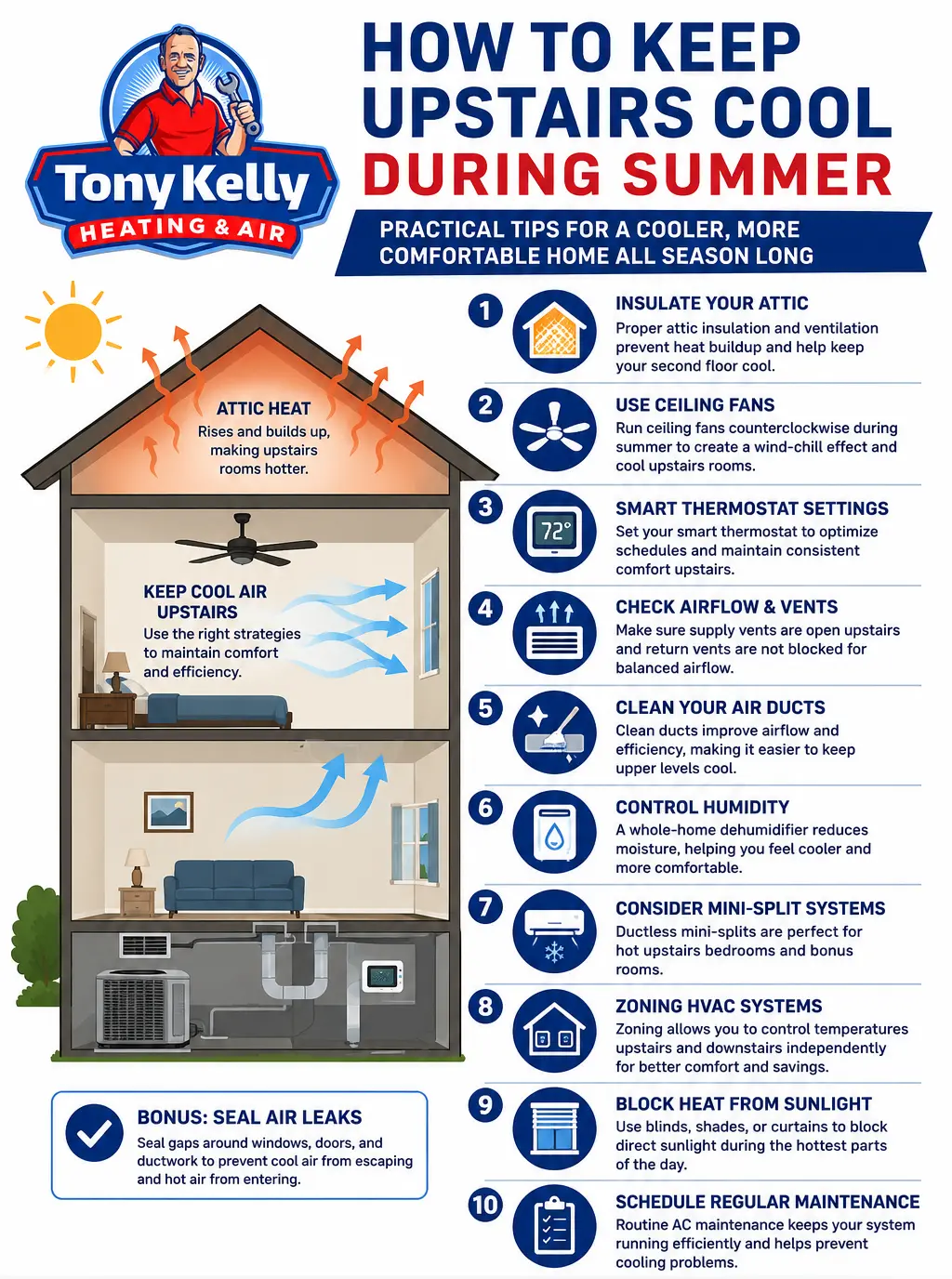
Why Is the Second Floor Hotter Than the First Floor?
Heat naturally rises because warmer air is less dense than cooler air. In a two-story house, warm air from the lower level moves toward stairwells, hallways, and upper rooms. At the same time, the second floor sits directly below the attic and roof, which absorb solar heat throughout the day. These effects combine, making upstairs rooms warmer even when the air conditioner is operating.
The temperature difference becomes more noticeable in Tallahassee and across North Florida because summer heat is paired with high humidity and long cooling cycles. An air conditioner must remove both heat and moisture. Any airflow restriction or insulation weakness can make the upper floor fall behind.
Common reasons a two-story house is hot upstairs include:
- Heat entering through an under-insulated or poorly sealed attic.
- Upstairs supply ducts that are too small, too long, disconnected, crushed, or leaking.
- Insufficient return airflow from bedrooms and upper hallways.
- A thermostat located downstairs that stops cooling before the second floor reaches a comfortable temperature.
- Closed bedroom doors that limit return-air movement.
- Dirty filters, dirty coils, refrigerant problems, or other conditions that reduce HVAC output.
- Sunlight entering through upper-floor windows.
- High indoor humidity that makes warm rooms feel even less comfortable.
- An HVAC system that was not designed or sized for the home’s current layout and cooling load.
Several of these issues can exist at the same time. That is why simply lowering the thermostat often does not solve the underlying problem.
Start With Simple Ways to Cool Upstairs Rooms
Before making major changes, check the low-cost factors that affect airflow and heat gain. These steps may not correct a serious duct or equipment issue, but they can improve comfort and help reveal where the larger problem may be.
Make Sure Every Upstairs Supply Vent Is Open and Clear
Walk through each upstairs bedroom, bathroom, hallway, and bonus room. Confirm that supply registers are fully open and not covered by rugs, furniture, curtains, toys, or storage. Dust buildup on a register can also restrict airflow. Clean the grille and note whether the airflow feels strong, weak, or absent.
A room with much weaker airflow than nearby rooms may have a duct restriction, disconnected branch, closed damper, or balancing issue. Avoid closing multiple downstairs vents to force air upstairs. A few small balancing adjustments may be appropriate, but closing too many registers can increase static pressure and reduce total system airflow.
Keep Return-Air Paths Open
Conditioned air cannot enter a room effectively unless air can also leave and return to the HVAC system. An upstairs bedroom may have a supply register but no dedicated return grille. The system may depend on air moving under the door or through a transfer grille into the hallway.
A closed door with a narrow undercut can trap pressure inside the bedroom and reduce the amount of cool air entering the room. Try leaving the door open and compare the room temperature. A noticeable improvement may point to a return-air problem that deserves professional evaluation.
Replace a Dirty Air Filter
A clogged filter reduces airflow through the entire HVAC system. The rooms farthest from the air handler, including upstairs bedrooms, may show the effects first. Use the filter size and type recommended for the system, and inspect it regularly during heavy summer use.
A very restrictive filter is not automatically better. Higher-efficiency filters can help with airborne particles, but the system must be able to move air through them. Homeowners concerned about filtration, humidity, or allergens can learn more about broader indoor air quality options for the home without assuming that a thicker filter alone will fix uneven temperatures.
Block Afternoon Sun
Upper-floor windows often receive strong afternoon sunlight. Close blinds, shades, or insulated curtains before the hottest part of the day, especially on west- and south-facing windows. Exterior shading, solar screens, or window improvements may provide additional help where solar heat gain is severe.
Keep window treatments from covering supply registers. The goal is to block radiant heat without interfering with conditioned airflow.
Use Ceiling Fans Correctly During Summer
A ceiling fan upstairs in summer does not lower the actual air temperature, but it can make occupied rooms feel cooler by moving air across the skin. This wind-chill effect can improve comfort while the air conditioner works to remove heat and humidity.
Most ceiling fans should rotate counterclockwise during summer when viewed from below. The blades should push air downward. Stand beneath the fan and confirm that you feel a breeze. Many fans have a small direction switch on the motor housing, although some modern models use a remote or wall control.
Run fans only in occupied rooms. Leaving a fan operating in an empty bedroom does not cool the furniture or reduce the room temperature. It only uses electricity. Fans are most effective when paired with adequate air conditioning, reasonable humidity control, and reduced solar heat gain.
Portable fans can also help move conditioned air from an upstairs hallway into a bedroom with weak circulation. Positioning matters: a fan near the doorway may help mix air, while a fan aimed directly at a person improves comfort without changing the room’s underlying HVAC balance.
Check Thermostat Location and Scheduling
Many two-story homes have a single thermostat on the first floor. The thermostat measures the temperature around itself, not the temperature in upstairs bedrooms. Once the downstairs reaches the setpoint, the system shuts off even if the second floor remains several degrees warmer.
Thermostat placement can make this worse. A thermostat near a supply vent, shaded interior wall, kitchen, stairwell, exterior door, or direct sunlight may not represent the average condition of the home. A programmable schedule can also allow too much heat to build upstairs during the day, making bedrooms difficult to cool by bedtime.
A modern control with remote room sensors can give the system better information. Some systems can prioritize an upstairs sensor during sleeping hours and use a downstairs sensor during the day. This does not create separate duct zones by itself, but it can improve temperature control in homes where the equipment and ductwork are otherwise capable.
Homeowners considering this approach can review how smart thermostat installation may support scheduling, remote sensing, and more useful temperature control. Compatibility matters because not every thermostat works with every HVAC system or zoning configuration.
Inspect Attic Insulation and Air Sealing
Attic insulation and cooling are closely connected because the attic sits directly above the second-floor ceiling. Roof surfaces can become extremely hot under summer sun. Without an effective thermal boundary, that heat moves downward into bedrooms and hallways.
Insulation slows heat transfer, but insulation alone is not enough. Gaps around wiring, plumbing penetrations, recessed lights, attic hatches, duct chases, and top plates can allow hot attic air to leak into the conditioned space. Air sealing addresses these pathways while insulation reduces conductive heat flow.
Signs of a possible attic-related problem include:
- Upstairs ceilings that feel noticeably warm in late afternoon.
- Rooms beneath certain roof sections that are consistently hotter.
- Thin, uneven, compressed, or missing insulation visible from the attic access.
- An attic hatch that is uninsulated or does not seal tightly.
- High energy use combined with long cooling cycles.
- Hot air leaking around recessed lights or ceiling penetrations.
Do not disturb old insulation or enter a hot attic without appropriate precautions. Attics may contain electrical hazards, weak walking surfaces, sharp fasteners, pests, and extreme temperatures. A qualified energy auditor, insulation contractor, or HVAC professional can help identify deficiencies.
Do Not Overlook Ducts in the Attic
Many North Florida homes have ductwork routed through a hot attic. Cool air traveling through poorly insulated or leaking ducts can gain heat before reaching the upstairs rooms. A disconnected branch may dump conditioned air into the attic, while a return leak can pull hot, dusty attic air into the system.
Duct inspection should include visible connections, insulation condition, damaged flex duct, crushed sections, and signs of air leakage. Cleaning may be appropriate where contamination or debris is present, but cleaning and repair are different services. Homeowners can review what is involved in professional air duct cleaning in Tallahassee while recognizing that temperature imbalance may also require sealing, repair, or redesign.
Make HVAC Maintenance a Priority
Weak upstairs cooling can be one of the first signs that an air conditioner is losing performance. The second floor often has the greatest cooling load and the longest duct runs. A system that is only delivering part of its expected capacity may still keep the downstairs comfortable while allowing the upstairs to remain warm.
Routine maintenance supports airflow, heat transfer, drainage, and reliable operation. A professional inspection may include checking the filter, evaporator coil, condenser coil, blower assembly, electrical components, refrigerant performance, condensate drainage, and temperature change across the system.
Homeowners looking for seasonal service information can review air conditioning maintenance services in Tallahassee. Those interested in a broader year-round approach can also learn about HVAC maintenance for Tallahassee homes.
Warning Signs That the Problem Is More Than Normal Heat Rise
Some upstairs temperature differences are expected, but certain symptoms suggest an HVAC problem:
- The upstairs suddenly became hotter than it was in previous summers.
- Airflow from upstairs vents is extremely weak or has stopped.
- The air conditioner runs almost continuously without reaching the thermostat setting.
- Supply air feels warm or only slightly cool.
- Ice appears on refrigerant lines or the indoor coil.
- Water is leaking around the air handler or drain line.
- Some upstairs rooms cool normally while one branch remains very hot.
- Indoor humidity stays high even during long cooling cycles.
- The system is making new noises or frequently turning on and off.
An upstairs AC not cooling may involve airflow, refrigeration, electrical, control, or duct issues. Repeatedly lowering the thermostat can increase runtime without correcting the cause.
Control Humidity to Improve Upstairs Comfort
Temperature is only one part of summer comfort. High humidity slows the evaporation of perspiration, making a room feel warmer than the thermostat reading suggests. Upper floors may feel especially uncomfortable at night when bedroom doors are closed and several people add moisture through breathing and daily activity.
An oversized air conditioner can cool the home quickly but shut off before removing enough moisture. Duct leakage, outdoor-air infiltration, crawl-space moisture, and thermostat settings may also contribute to humidity problems.
Use bathroom exhaust fans during showers and allow them to run long enough to remove moisture. Make sure dryers vent outdoors and that kitchen exhaust is used during cooking. Avoid opening windows during humid periods just because the outdoor temperature is slightly lower; the added moisture can increase the indoor cooling load.
Homes with persistent moisture problems may benefit from dedicated humidity control. A whole-home dehumidifier for Tallahassee’s climate can work with the HVAC system to remove moisture more consistently than portable units in individual rooms.
Consider Moisture Entering From Below the Home
A vented or damp crawl space can introduce humid air into the home through floor penetrations, duct leaks, and pressure differences. Moisture from below may not seem connected to a hot second floor, but the air conditioner must handle the total moisture load of the entire house. Excess humidity can lengthen cooling cycles and make every level feel less comfortable.
Homeowners with musty odors, damp insulation, condensation, or moisture concerns below the home can learn about crawl-space encapsulation in Tallahassee as one part of a whole-home moisture strategy.
Improve Airflow Without Damaging the HVAC System
It is common to hear advice about closing downstairs vents to push more air upstairs. The idea sounds reasonable, but residential duct systems do not always respond safely or effectively. Closing too many registers can raise static pressure, reduce blower airflow, increase duct leakage, contribute to coil freezing, or create noise.
A better approach is professional air balancing. This process measures supply and return airflow, evaluates static pressure, and adjusts dampers where appropriate. It may reveal that an upstairs branch is undersized, a return path is inadequate, or a duct is damaged.
Useful homeowner checks include:
- Keeping all return grilles clear.
- Vacuuming dust from register faces.
- Opening upstairs supply registers fully.
- Checking that downstairs registers have not been accidentally closed.
- Leaving problem-room doors open temporarily to test return airflow.
- Recording room temperatures at the same time each day.
Temperature notes can help identify patterns. Record the thermostat reading and the temperature in several upstairs rooms in the morning, afternoon, and evening. A room that heats rapidly after direct sun may need shading or insulation improvements. A room that stays warm all day despite minimal sun may have an airflow problem.
Consider HVAC Zoning for Upstairs Comfort
Zoning HVAC for upstairs is one of the most direct ways to manage different cooling needs between floors. A zoned system divides the ductwork into areas controlled by separate thermostats or sensors. Motorized dampers direct conditioned air to the zones that need it.
In a typical two-story configuration, the first floor may be one zone and the second floor another. During the afternoon, the upstairs zone can call for more cooling without forcing the downstairs to become excessively cold. At night, the system can focus on bedrooms while reducing unnecessary cooling in unused areas.
Zoning is not simply a matter of adding dampers. The system must be designed to handle changes in airflow and static pressure. Equipment capacity, blower operation, duct size, bypass strategies, variable-speed components, and control compatibility all matter. Poorly designed zoning can create noise, short cycling, or equipment stress.
Homeowners can learn more about HVAC zoning system installation and how separate controls may help a home with persistent floor-to-floor temperature differences.
When Zoning May Be a Good Fit
- The downstairs reaches the setpoint long before the upstairs.
- Family members use the upper and lower floors at different times.
- The home has a single ducted system with accessible branch ducts.
- The equipment and duct system can support zoning modifications.
- Remote sensors alone do not provide enough control.
- The home has large temperature differences caused by orientation or floor level.
A load calculation and duct evaluation should come before any recommendation. Zoning cannot compensate for severely undersized equipment, major duct leakage, or inadequate insulation.
Use a Ductless Mini-Split for Difficult Upstairs Rooms
Some rooms are difficult to serve with the central duct system. Finished attic rooms, bonus rooms over garages, additions, converted spaces, and distant bedrooms may have high heat gain or limited duct access. A ductless mini-split can provide targeted cooling without extending or rebuilding large sections of ductwork.
A mini-split uses an outdoor unit connected to one or more indoor air handlers. Each indoor unit controls a specific room or zone. This can be useful when only one or two upstairs spaces remain uncomfortable while the rest of the home performs well.
A ductless system should be sized for the room’s actual cooling load. Bigger is not always better. Oversized equipment may cycle quickly, provide uneven comfort, and remove less moisture. Placement also affects air distribution, condensate drainage, appearance, and service access.
Homeowners considering targeted room-by-room comfort can review ductless mini-split system installation as an alternative to major duct alterations.
Know When the Existing HVAC System May Be the Limitation
Older homes are often modified over time. Bedrooms are added, attic areas are finished, windows are changed, walls are moved, and insulation levels vary. The original HVAC system may no longer match the home’s layout or cooling load.
An air conditioner can also lose effective capacity because of age, wear, poor installation, duct losses, or maintenance problems. A system that was marginal when new may struggle during today’s hottest weather, especially on the second floor.
Before considering replacement, a qualified professional should evaluate the full system. That includes equipment condition, ductwork, insulation, air sealing, return paths, humidity, thermostat controls, and room-by-room load. Replacing equipment without addressing duct or building-envelope problems can leave the upstairs temperature imbalance unchanged.
Homes that need a broader redesign can review information about HVAC installation in Tallahassee. The appropriate system should be based on the home’s measured needs rather than the size of the old unit alone.
How to Cool Upstairs Bedrooms at Night
Bedrooms may feel acceptable during the day but become uncomfortable at bedtime. Closed doors, body heat, electronics, late-afternoon solar gain, and limited return airflow can all contribute.
To cool upstairs bedrooms more effectively at night:
- Close blinds or curtains several hours before sunset.
- Confirm the ceiling fan is rotating counterclockwise and producing a downward breeze.
- Keep supply and return grilles clear.
- Use thermostat scheduling to begin cooling before the room becomes excessively hot.
- Leave the door open temporarily to see whether return airflow improves the temperature.
- Reduce heat-producing electronics and lighting.
- Use breathable bedding and avoid placing large furniture over vents.
- Check indoor humidity, not just temperature.
Pre-cooling can help, but extreme thermostat setbacks are usually counterproductive. Allowing the second floor to become very hot during the day can require a long evening recovery period. A moderate daytime setting combined with shading and airflow improvements is often more manageable.
A Step-by-Step Plan to Keep the Second Floor Cool
Use the following order to avoid spending money on a solution before identifying the cause.
Step 1: Measure the Temperature Difference
Use reliable thermometers to compare the thermostat area with several upstairs rooms. Measure at the same times for several days. Note outdoor conditions, sun exposure, door position, and whether the system is running.
Step 2: Check Filters, Registers, and Return Paths
Replace a dirty filter, open registers, remove obstructions, and test bedrooms with doors open. These checks are simple and may identify an obvious airflow restriction.
Step 3: Reduce Heat Gain
Close shades before peak sun, use ceiling fans correctly, seal obvious window gaps, and inspect the attic hatch. Consider a professional attic insulation and air-sealing assessment where ceilings become very warm.
Step 4: Schedule HVAC Maintenance
Have the system checked for airflow, coil condition, refrigerant performance, drainage, electrical operation, and general capacity. Ask the technician to compare upstairs and downstairs airflow rather than evaluating only the equipment.
Step 5: Evaluate Ductwork and Air Balance
Inspect attic ducts, supply branches, returns, dampers, and static pressure. Repair leakage or damage before assuming that larger equipment is necessary.
Step 6: Review Controls and Humidity
Consider remote sensors, thermostat scheduling, or humidity control. Controls can improve comfort only when the mechanical system and ductwork can deliver the needed cooling.
Step 7: Compare Long-Term Solutions
Persistent problems may justify zoning, a ductless mini-split, duct redesign, insulation upgrades, or a properly designed replacement system. The right choice depends on whether the main limitation is heat gain, airflow, control, moisture, or equipment capacity.
Mistakes to Avoid
- Setting the thermostat extremely low: This does not make the air conditioner cool faster. It can overcool the first floor while increasing runtime.
- Closing most downstairs vents: Excessive restriction can create pressure and airflow problems.
- Running ceiling fans in empty rooms: Fans cool people through air movement, not the room itself.
- Assuming insulation is the only issue: Attic insulation is important, but duct leakage, thermostat location, and return airflow may be equally important.
- Replacing equipment without evaluating ducts: A new system connected to damaged or poorly designed ductwork may still leave upstairs rooms warm.
- Opening windows during humid weather: Outdoor air can add moisture and increase the cooling load.
- Using portable air conditioners without considering ventilation: Some units can create pressure imbalances or add heat through poorly sealed exhaust connections.
- Ignoring sudden changes: A new upstairs cooling problem may indicate a repair issue rather than a permanent design limitation.
Frequently Asked Questions About Keeping Upstairs Cool
Why is my upstairs so hot in summer?
The upstairs receives rising heat from below and heat transferred through the roof and attic. Limited duct airflow, insufficient returns, air leaks, solar gain, thermostat placement, high humidity, and reduced HVAC performance can increase the temperature difference.
Should I close downstairs vents to make upstairs cooler?
Do not close many vents or shut them completely without professional guidance. Excessive restriction can raise duct pressure and reduce total airflow. A measured air-balancing approach is safer and more effective.
What direction should an upstairs ceiling fan turn in summer?
Most ceiling fans should rotate counterclockwise when viewed from below. This creates a downward breeze that helps occupants feel cooler. Confirm the direction by standing beneath the fan.
Can a smart thermostat keep the second floor cool?
A smart thermostat with remote sensors can improve temperature awareness and scheduling. It does not create separate airflow zones on its own, but it may help the system prioritize upstairs comfort during selected times.
Does attic insulation help keep upstairs bedrooms cool?
Yes. Attic insulation slows heat transfer from the roof and attic into the rooms below. Air sealing is also important because gaps can allow hot attic air to enter the conditioned space.
Would HVAC zoning help a two-story house?
Zoning can help by controlling upstairs and downstairs areas separately and directing conditioned air where it is needed. The equipment, ductwork, dampers, and controls must be designed as a complete system.
Can a mini-split cool only the upstairs?
A ductless mini-split can cool one room or several upstairs zones independently. It is often considered for bonus rooms, additions, converted attics, or bedrooms that are difficult to serve with central ductwork.
Why is the upstairs humid even though the AC runs?
Possible causes include outdoor-air leakage, duct leakage, an oversized system, drainage or performance problems, crawl-space moisture, and high indoor moisture production. Humidity should be evaluated along with temperature.
Keep Upstairs Comfort Focused on the Cause
The best answer to how to keep upstairs cool in summer depends on why the second floor is overheating. A hot upstairs may improve with shades, ceiling fans, a clean filter, and better thermostat scheduling. Larger temperature differences may point to attic insulation, air sealing, duct leakage, return-air limitations, humidity, or HVAC performance.
Start with measurements and basic airflow checks. Then evaluate maintenance, ducts, insulation, controls, and moisture in a logical order. Long-term options such as zoning, a ductless system, or a redesigned HVAC installation are most effective after the home’s actual limitations are understood.
A balanced approach can help keep the second floor cool without making the downstairs uncomfortably cold or relying on an extreme thermostat setting. The result should be more consistent comfort throughout the home, especially during Tallahassee’s hottest and most humid months.

