CALL US 850-385-3774
Seeing what looks like smoke coming from an air conditioner can be unsettling, especially when the system is running during a hot, humid Tallahassee afternoon. The good news is that white vapor coming from an AC vent is often not smoke at all. It may simply be condensation created when very cold air meets the warm, moisture-heavy air inside the room.
However, visible smoke accompanied by a burning smell, electrical odor, popping sound, sparks, or a tripped breaker may point to a more serious mechanical or electrical problem. The difference between harmless mist and actual smoke often comes down to the color, odor, duration, source, and behavior of the air conditioning system.
Homeowners searching for “why is smoke coming out of my AC?” should begin by turning their attention to those clues. White, odorless mist that disappears quickly is generally connected to moisture. Gray or black smoke, persistent haze, or an odor resembling burned plastic, rubber, wiring, or oil should be treated more cautiously.
This guide explains why an AC may appear to be blowing smoke, how to distinguish condensation from an equipment problem, what steps are safe for a homeowner to take, and when the system should remain off until it can be inspected.
Before assuming that the air conditioner is burning, look closely at the material coming from the vent. What appears to be smoke may actually be a cloud of tiny water droplets.
Air conditioners remove heat and moisture from indoor air. During normal operation, warm household air moves across the cold evaporator coil. The cooled air then travels through the ductwork and enters the room through the supply vents. When that cold air meets especially warm and humid air near a vent, moisture can condense into a visible fog.
This is similar to the cloud that appears when a freezer is opened on a humid day. The vapor may be white or light gray, remain close to the register for a few seconds, and disappear without leaving a smoke smell.
Tallahassee’s high humidity makes this effect more noticeable. A home may feel warm and sticky after the AC has been off, following a power outage, after a thermostat adjustment, or when doors have been open for an extended period. Once the system starts moving very cold air into that humid environment, a temporary mist may form.
A small amount of white fog is generally less concerning when:
Persistent mist may still deserve attention. Continued vapor can sometimes be associated with poor airflow, a dirty filter, an evaporator coil beginning to freeze, an obstructed condensate drain, or an unusually large temperature difference between the supply air and the surrounding room.
Homeowners who repeatedly notice mist coming out of an AC should avoid treating it as a normal condition indefinitely. Even when the vapor itself is only water, the conditions creating it may reveal an airflow or moisture-management issue that could eventually affect comfort and system performance.
An air conditioner can appear to blow smoke for several very different reasons. Some involve normal condensation, while others involve overheating components, damaged wiring, accumulated debris, moisture problems, or smoke entering the ductwork from another area.
The most likely explanation depends on where the smoke appears, what it smells like, how long it lasts, and what the HVAC system was doing immediately before the problem began.
Common possibilities include:
The first priority is determining whether the material is odorless white mist or actual smoke. A visible cloud with a distinct burning odor should not be dismissed as condensation.
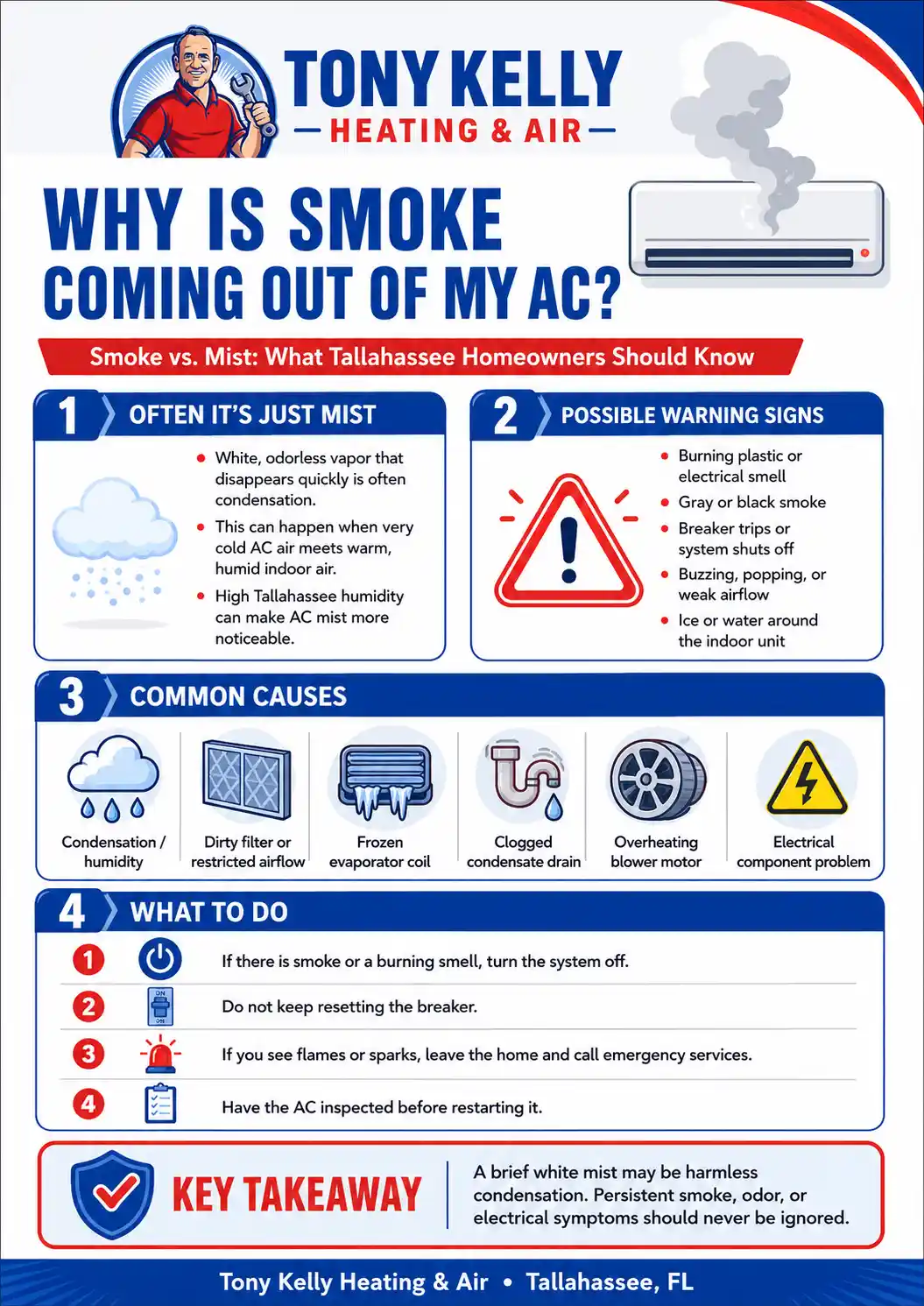
White mist is the most common reason homeowners believe their air conditioner is smoking. In many cases, the mist is formed by condensation rather than combustion.
Cold supply air can lower the temperature of nearby humid air below its dew point. When that happens, water vapor becomes tiny suspended droplets. Those droplets create a visible cloud that looks like smoke.
This condition is more likely when:
A short burst of odorless vapor may disappear once the room temperature and humidity begin to stabilize. If the cloud continues throughout the cooling cycle, the system may need further evaluation.
North Florida air often contains a large amount of moisture. The higher the indoor humidity, the more water vapor is available to condense when it encounters a cold stream of conditioned air.
This is one reason the same air conditioner may appear normal most days but produce visible mist after a storm, power outage, extended door opening, or period of unusually high humidity.
The system may still be cooling, but the home could be holding more moisture than usual. That may occur when the AC is oversized, short-cycling, operating with an airflow problem, or struggling to complete long enough cooling cycles to remove humidity effectively.
A comparison of mini-split and central AC operation in Tallahassee can help homeowners understand how system design, zoning, runtime, and moisture removal may differ between cooling configurations.
A frozen evaporator coil can contribute to visible vapor near an air vent. The evaporator coil is the indoor component that absorbs heat from the home. It must remain cold, but it should not become covered in ice.
When airflow across the coil is restricted or the refrigeration process is not operating correctly, the coil temperature may fall below freezing. Moisture in the air can then freeze onto the coil. As the system warms or the ice begins to melt, excess moisture may produce fog-like air, dripping water, reduced cooling, or unusual humidity around the vents.
Common conditions associated with a frozen coil include:
Other symptoms may include weak airflow, ice on the refrigerant line, water around the air handler, longer cooling cycles, or an AC that runs without lowering the indoor temperature.
Turning the thermostat lower will not correct a frozen coil. Continuing to operate the compressor may allow more ice to form. A homeowner can turn the cooling mode off and set the fan to run only when there is no burning smell, electrical concern, or visible equipment damage. The system should remain off completely when smoke, overheating, or unsafe electrical behavior is suspected.
Recurring coil freezing is not normal. It requires identifying the airflow, drainage, blower, coil, or refrigerant condition responsible for the ice.
Air conditioners remove moisture from indoor air and collect it as liquid water. That water typically drains through a condensate pan and drain line. In Florida, algae, dust, biological buildup, and debris can obstruct the drain line over time.
A clogged drain does not usually create actual smoke, but it can contribute to excessive moisture inside the air handler. That moisture may become visible as mist under the right temperature and humidity conditions.
Drainage problems may also cause:
Homeowners should not open electrical compartments or reach into the air handler while the equipment is energized. Standing water near HVAC electrical components is another reason to turn the system off and arrange an inspection.
Routine service can help identify drainage buildup before it causes an overflow. The AC maintenance information for Tallahassee homes explains why filters, coils, drain components, airflow, and system operation should be reviewed together rather than treating each as an unrelated issue.
Smoke coming from AC vents becomes more concerning when it is paired with an odor. A burning smell suggests that something may be overheating, melting, rubbing, arcing, or burning inside the HVAC equipment or near the duct system.
Potential odor descriptions include:
The type of smell can provide a clue, but homeowners should not attempt to identify a failing electrical part by opening the system. Capacitors and other HVAC components may retain electrical energy even after the equipment stops running.
When visible smoke and a burning odor appear together, turn the thermostat off. Shut off the HVAC breaker only when it is safe to reach the electrical panel. Do not restart the system to see whether the smell returns.
Dense smoke, flames, sparks, or smoke alarms activating are emergency conditions. Leave the area and contact emergency services. An HVAC inspection comes after the immediate fire risk has been addressed.
The blower motor moves conditioned air through the ducts and into the rooms of the home. If the motor overheats, the odor or smoke it produces may be distributed through multiple supply vents.
A blower motor may overheat because of:
Signs of a blower problem may include weak airflow, humming, squealing, rattling, delayed fan startup, intermittent airflow, an unusually hot air handler cabinet, or the system shutting itself off.
Because the blower is responsible for carrying air throughout the home, an odor generated near the motor may seem to be coming directly from every register. The vent is not necessarily the original source. It may simply be the point where the air exits the ductwork.
A struggling blower can also reduce air movement across the evaporator coil. That can contribute to coil freezing, excess moisture, lower cooling capacity, and mist formation. In some situations, a homeowner may see white vapor first and notice a hot or electrical odor later as the airflow problem worsens.
Air conditioning systems use multiple electrical components to start motors, control equipment, regulate operation, and communicate with the thermostat. A loose connection, damaged wire, failing relay, worn contactor, deteriorated insulation, or overheating circuit board can create an electrical odor and, in severe cases, visible smoke.
Electrical problems may develop because of normal wear, moisture exposure, vibration, corrosion, insects, storm-related power disturbances, or repeated system cycling.
Possible warning signs include:
A breaker is a protective device. Resetting it repeatedly without identifying why it is tripping may expose the equipment to further damage. A homeowner may reset a breaker once after a known outage when there are no signs of smoke, heat, burning, or equipment damage. A breaker associated with smoke or a burning odor should remain off.
Storms and power interruptions are common considerations in North Florida. Voltage changes can affect contactors, capacitors, control boards, compressors, and motors. An electrical problem may become noticeable immediately after power returns or during the next cooling cycle.
Capacitors help certain HVAC motors start and run. When a capacitor deteriorates, the associated motor may struggle to start, draw excessive current, hum, overheat, or stop operating.
A failed capacitor does not always create smoke by itself. However, the motor it supports may become hot when it cannot start or operate correctly. In some cases, a capacitor can swell, leak, rupture, or contribute to an electrical odor.
Symptoms may include:
Capacitors should not be handled by an untrained homeowner. They can retain a charge after power has been disconnected. Diagnosis requires safe electrical testing and confirmation that the motor, wiring, contactor, and other connected components are also operating correctly.
Burning dust is more commonly associated with the first heating cycle of the season than with normal air conditioning. Heat pumps and central HVAC systems may use auxiliary electric heat strips during colder weather. Dust can settle on those heating elements during long periods of cooling-only operation.
When the heat activates, the dust may create a temporary burning smell. A faint odor that fades after a brief period may be normal. It should not produce heavy smoke, sparks, or an intense electrical smell.
In Tallahassee, auxiliary heat may also turn on unexpectedly because of a thermostat setting, a control problem, or emergency heat mode. A homeowner who believes the AC is running may actually have a heating component energized inside the air handler.
Burning dust is less concerning when:
Turn the system off when the odor grows stronger, continues for an extended period, returns during every cycle, or is accompanied by visible smoke. Debris on heating elements, failing heat-strip controls, damaged wiring, and airflow problems can create conditions that should not be mistaken for ordinary seasonal dust.
Dust is not the only material that can enter HVAC equipment. Insulation fragments, construction debris, leaves, pest nesting material, small objects, and other contaminants may reach the return duct, blower compartment, air handler, or supply ducts.
Debris can create odor or smoke when it contacts a hot component, interferes with a blower motor, restricts airflow, or becomes exposed to auxiliary heat.
Older Tallahassee homes may have ductwork routed through attics, crawl spaces, wall cavities, or other areas where damage can go unnoticed. A disconnected or deteriorated return duct may pull dust, insulation, attic air, or odors into the system. Supply leaks can also create moisture and temperature conditions that encourage condensation.
Do not insert tools, vacuums, or cleaning products deeply into a supply register in an attempt to remove an unknown source. The visible vent may be far from the actual problem, and improper cleaning can push debris farther into the ductwork.
Air moving through a central HVAC system can transport smoke and odors from one part of a building to another. The AC may appear to be creating smoke when the return system is actually drawing it from a different source.
Possible sources include:
Return vents pull air toward the HVAC system. If smoke is present near a return, the blower can distribute it through supply registers in several rooms. This can make the smoke coming from AC vents seem like an equipment failure even though the original source is elsewhere.
Check whether the smoke appears at every supply register or only one. A single affected vent may point toward a localized duct or room condition. Smoke throughout the home may indicate a source near the return, air handler, blower, or central duct system.
Do not spend time searching for the source when there is active smoke, a strong burning odor, or an alarm. Leave the building and contact emergency services when a fire may be present.
Outdoor smoke can enter a building through open doors, windows, cracks, exhaust systems, fresh-air intakes, and normal infiltration. Once indoors, smoke particles may circulate through the HVAC system.
Many residential air conditioners primarily recirculate indoor air, but homes can still receive outdoor air through leakage and pressure differences. Commercial systems may intentionally introduce outdoor air as part of ventilation requirements.
Signs that the AC is circulating outside smoke include:
During an outside smoke event, close doors and windows and avoid operating exhaust fans unnecessarily. Replace a heavily loaded HVAC filter with a filter that is compatible with the system. A filter should not be upgraded to an extremely restrictive option without confirming that the blower and duct system can handle the added resistance.
Commercial properties may need to evaluate fresh-air dampers, ventilation controls, filtration, and building pressure. The considerations can differ from those in a typical home, which is why information about commercial AC repair in Tallahassee is more relevant when smoke, odor, or airflow concerns affect an office, retail space, or other light commercial property.
Refrigerant is not normally visible as smoke coming from indoor supply vents. A leak may create hissing, bubbling, reduced cooling, ice formation, or oily residue near a refrigerant connection. Under certain conditions, a rapid release near equipment may appear as a brief vapor cloud, but visible material from a room vent is more commonly condensation.
Refrigerant-related conditions can indirectly contribute to mist by allowing the evaporator coil to become abnormally cold or frozen. As ice accumulates and later melts, the added moisture may affect the air leaving the system.
Possible refrigerant-related symptoms include:
Refrigerant should not be added without locating and evaluating the reason the charge is low. The cooling system is designed as a closed circuit. A loss of refrigerant indicates a condition that should be diagnosed rather than treated as routine consumption.
A chemical, solvent-like, oily, or exhaust-like odor should also be evaluated carefully. Turn the system off, ventilate the area when it is safe to do so, and avoid remaining close to visible fumes.
Mold does not normally produce a cloud that behaves like smoke. However, microbial growth, dust, and accumulated debris may release particles when airflow begins. A homeowner may describe the resulting haze as smoke, especially when it appears near a register.
Mold and moisture problems are more commonly associated with:
A musty odor does not confirm that mold is inside the duct system. Moisture may be present near the coil, drain pan, insulation, ceiling, wall cavity, crawl space, or another building material.
Surface cleaning of the vent cover may improve appearance but will not resolve a concealed moisture source. The first step is determining why the area is damp. That may involve checking insulation, air leakage, condensate drainage, duct temperature, indoor humidity, and nearby building materials.
Smoke or mist from one vent can suggest a localized condition rather than a problem affecting the entire air conditioning system.
Possible explanations include:
Condensation may be especially visible from a ceiling vent when a room has high humidity and the supply air is very cold. Moisture around the grille, staining on the ceiling, or recurring droplets suggest that the vent, boot, duct connection, or surrounding insulation should be examined.
Actual smoke from one vent should still be treated seriously. Ductwork can pass through attics and concealed cavities where electrical wiring, insulation, pests, or other building materials may be present.
The appropriate response depends on whether the material appears to be harmless condensation or actual smoke.
Leave the property and contact emergency services when you see flames, sparks, thick smoke, rapidly increasing haze, or smoke alarms are sounding. Do not remain inside to inspect the air handler or electrical panel.
When there is visible smoke or a burning odor but no active fire, turn the HVAC system off at the thermostat. This stops the normal operating signal, although it may not remove electrical power from every component.
Turn off the appropriate breaker only when the electrical panel is safely accessible and there is no smoke or fire near it. Do not touch a hot, damaged, wet, buzzing, or discolored panel.
Restarting the AC may cause an overheating component to energize again. Leave the equipment off until the source of the smoke or odor has been identified.
Without approaching unsafe equipment, record useful details such as:
These observations can help narrow the diagnostic process without requiring the homeowner to open equipment.
Visible smoke, recurring mist, electrical odors, frozen coils, water near equipment, repeated breaker trips, and abnormal operation are all reasonable reasons to have the system checked. The goal is to identify the source rather than simply clearing the odor and restarting the equipment.
Homeowners can review information about diagnosing AC problems in Tallahassee homes when the system shows smoke, unusual odors, weak airflow, poor cooling, water leakage, or electrical symptoms.
A homeowner should not remove electrical access panels or touch internal HVAC components. There are still several observations that can be made from a safe distance.
You can check:
Do not repeatedly reset a breaker, operate a motor that is humming without starting, chip ice from a coil, handle refrigerant lines, reach into the air handler, or pour chemicals into an unknown drain opening.
A clean filter may improve airflow when the existing filter is dirty, but replacing it does not confirm that the underlying issue has been corrected. A frozen coil, failing blower, duct restriction, or electrical fault may still be present.
The diagnostic process should account for both the visible symptom and the conditions that produced it. Simply confirming that the smoke has disappeared may not explain why it occurred.
An evaluation may include:
The technician may also consider when the event occurred. A problem after a power outage may point toward different components than mist that appears only on very humid afternoons. An odor during the first heating cycle of the year may involve dust on heat strips, while an odor during every cooling cycle may indicate an active electrical or mechanical condition.
Maintenance cannot prevent every component from failing, but it can identify many conditions that contribute to overheating, poor airflow, moisture accumulation, frozen coils, and abnormal electrical operation.
A maintenance visit may reveal:
Regular filter replacement is also important, although the correct replacement frequency depends on the filter type, household conditions, pets, occupancy, construction activity, and system runtime.
Tallahassee air conditioners often operate for much of the year. Long cooling seasons, pollen, humidity, storms, and frequent runtime can accelerate the buildup of dirt and expose developing problems sooner than in milder climates.
Maintenance is not a substitute for turning off equipment that is actively smoking. It is a way to review system condition before a minor airflow, drainage, or electrical issue becomes more disruptive.
Visible AC mist depends heavily on temperature and humidity. Tallahassee’s climate provides both of the ingredients needed to create condensation: warm moisture-heavy air and air conditioners producing a much colder supply-air stream.
Several local conditions can make mist more noticeable:
A system that cannot maintain the thermostat setting may run for extended periods and produce very cold air while indoor humidity remains elevated. Homeowners experiencing this combination can learn more about why an AC may struggle to keep up with Tallahassee heat.
Long runtime does not automatically mean the system is failing. Properly sized equipment may run for longer cycles during extreme conditions. However, weak airflow, rising humidity, ice, mist, unusual odors, and poor temperature control together provide more reason to investigate.
Actual smoke from an air conditioner can indicate that a component has already failed or is operating under damaging conditions. Mist alone does not mean the equipment is about to break, but persistent vapor may be associated with airflow, coil, drainage, or humidity problems that deserve attention.
Warning signs that may appear before or alongside a breakdown include:
No single symptom determines the remaining life of the system. The age of the equipment, repair history, condition of major components, refrigerant type, installation quality, duct performance, and maintenance history all affect the decision.
The article on common signs an AC may be approaching a breakdown provides additional context for homeowners noticing multiple symptoms rather than an isolated burst of condensation.
Smoke does not automatically mean the entire air conditioner must be replaced. The source could be a repairable electrical component, blower issue, piece of debris, drainage problem, or isolated wiring failure.
Replacement may become part of the discussion when:
The recommendation should be based on inspection findings rather than the appearance of smoke alone. A newer system with a failed relay presents a different situation than an older system with damaged wiring, a failing blower, poor coils, refrigerant issues, and repeated breakdowns.
A ductless mini-split can also produce visible white mist when cold discharge air meets warm humid room air. Because the indoor head delivers air directly into the room, the fog may be especially noticeable near the louvers.
Possible mini-split causes include:
White odorless mist that disappears quickly is different from smoke accompanied by an electrical smell. A mini-split showing actual smoke should be turned off and isolated from power when safe.
Because mini-splits do not rely on central supply ducts, smoke from one indoor head is less likely to have traveled through a whole-house duct system. The source may be near that specific indoor unit, electrical connection, drain assembly, or room.
Commercial HVAC systems may have more complex controls, larger air handlers, multiple zones, outdoor-air intakes, rooftop equipment, duct smoke detectors, fire-alarm connections, and building-management controls.
Smoke appearing at commercial vents may originate from:
Building occupants should follow the property’s emergency and evacuation procedures. Facility staff should not override fire-alarm or smoke-control systems merely to restore cooling.
After emergency concerns have been addressed, diagnosis may require coordination among HVAC technicians, electricians, building management, fire-alarm providers, and other contractors depending on the source.
Clear information can make an HVAC diagnosis more efficient. Instead of reporting only that the “AC is smoking,” describe exactly what was observed.
Useful descriptions include:
Photos or videos taken from a safe location may also help document a temporary condition. Do not remain near active smoke or delay leaving the property in order to record it.
White smoke is often water vapor created when cold supply air meets warm, humid indoor air. It is usually odorless and disappears quickly. Persistent white mist may be associated with high humidity, restricted airflow, a dirty filter, a frozen evaporator coil, or excess moisture inside the air handler.
A burned-plastic odor may indicate overheating wiring, melting insulation, a failing motor, a damaged control, or another electrical problem. Turn the system off and do not restart it until the source has been inspected. Leave the property and call emergency services if there are flames, sparks, dense smoke, or an active fire.
Temporary odorless mist is generally condensation rather than smoke. It is less concerning when it disappears quickly and the system operates normally. Recurring or continuous mist may indicate an airflow, freezing, drainage, or humidity problem that should be evaluated.
A dirty filter does not normally create smoke by itself. It can restrict airflow, contribute to coil freezing, reduce cooling performance, increase motor strain, and make condensation-related mist more noticeable. Severe airflow restriction may also contribute to overheating in components that depend on normal air movement.
Turn the HVAC system off. Shut off the breaker when it is safe to do so, and do not restart the equipment. Leave the property and call emergency services when there are flames, sparks, thick smoke, or an active fire. When the immediate area is safe, arrange for the HVAC system and any related electrical components to be inspected.
Electrical faults, overheated motors, damaged wiring, debris contacting hot components, and other failures can create a fire risk. Smoke, sparks, burning odors, hot electrical panels, and repeated breaker trips should not be ignored.
One affected vent may point to localized condensation, a damaged duct connection, wet insulation, debris, a nearby smoke source, or a problem within that part of the duct system. Actual smoke from one vent should still be treated cautiously because ducts may pass through concealed spaces.
A frozen coil may contribute to fog-like air as moisture accumulates, ice melts, or very cold air meets humid indoor air. Other signs include weak airflow, water near the air handler, visible ice, and poor cooling.
A brief, odorless cloud that disappears quickly may be monitored. Turn the system off when the mist persists, cooling performance declines, ice or water is present, or the vapor is accompanied by a burning, electrical, chemical, or musty odor.
Yes. Smoke from cooking, outdoor burning, a garage, an attic, another room, or a neighboring commercial space can be pulled into return air and circulated through the supply ducts. The HVAC system may distribute the smoke even when it did not create it.
The answer to “why is smoke coming out of my AC?” depends on what the homeowner is actually seeing. White, odorless vapor that disappears quickly is often condensation caused by cold air mixing with warm, humid air. Tallahassee’s climate can make that fog especially noticeable.
Persistent mist may point toward a dirty filter, restricted airflow, frozen evaporator coil, condensate problem, or humidity-control issue. Those conditions may not be emergencies, but they should not be ignored when they continue or affect cooling.
Gray or black smoke, burned-plastic odors, electrical smells, sparks, repeated breaker trips, or an overheating air handler are different. Turn the system off and leave it off. Active flames, thick smoke, or fire-alarm activation require evacuation and emergency assistance.
The vent where smoke appears is not always the original source. Airflow may carry smoke from a blower motor, electrical compartment, heating element, duct area, outside source, or another part of the building. A complete diagnosis should determine where the material originated and why the HVAC system distributed it.
Homeowners who understand the difference between mist and smoke can respond calmly without overlooking a legitimate safety concern. Observe the color, smell, duration, location, equipment behavior, and recent conditions. Avoid opening electrical compartments or repeatedly restarting the system. When the cause is uncertain, keeping the equipment off is the safer approach until it can be evaluated.
Address:
870 Blountstown Hwy. Unit # 9
Tallahassee, FL 32303
Phone: 850-385-3774
License #: CMC1249702
Open Monday Through Friday
8:00 am to 8:00 pm

