CALL US 850-385-3774
HVAC UV lights can work, but they are most effective for a specific purpose: controlling mold, bacteria, and other microbial growth on damp surfaces inside an HVAC system. A properly positioned UV-C light can help keep an evaporator coil, drain pan, and nearby air handler surfaces cleaner, especially in humid climates like Tallahassee and North Florida.
An HVAC UV light cannot remove dust, pollen, pet dander, or excess moisture from your home. It also cannot replace an air filter, professional coil cleaning, ventilation, or humidity control. Its value depends on the problem you are trying to solve, the type of light installed, its location inside the system, and how well it is maintained.
This guide explains how HVAC UV lights work, their benefits and drawbacks, common installation costs, safety considerations, maintenance needs, and how to decide whether one is worth adding to your air conditioner or heat pump.
Yes, HVAC UV lights can work when they are properly selected, positioned, and maintained. Their most dependable residential use is continuously treating damp evaporator coils, drain pans, and nearby surfaces where microbial growth may develop.
Results are less predictable when a small UV lamp is expected to disinfect rapidly moving air throughout an entire home. UV-C effectiveness depends on the intensity of the light, the distance between the lamp and its target, and the amount of time a microorganism remains exposed.
That makes an HVAC UV light a supplemental indoor air quality tool rather than a complete air-cleaning system. It can address biological growth in specific parts of the HVAC equipment, but it should not replace filtration, ventilation, cleaning, moisture control, or routine HVAC maintenance.
| HVAC UV Lights May Help With | HVAC UV Lights Do Not |
|---|---|
| Microbial growth on exposed evaporator coils | Remove dust, pollen, or pet dander |
| Growth around drain pans and damp cabinet surfaces | Replace an HVAC air filter |
| Musty odors caused by growth on treated components | Correct excess indoor humidity |
| Slowing regrowth after proper coil cleaning | Clean existing dirt and debris from a coil |
| Supporting cleaner exposed HVAC surfaces | Treat hidden growth outside the lamp’s reach |
| Supplementing a broader indoor air quality plan | Guarantee germ-free air throughout a home |
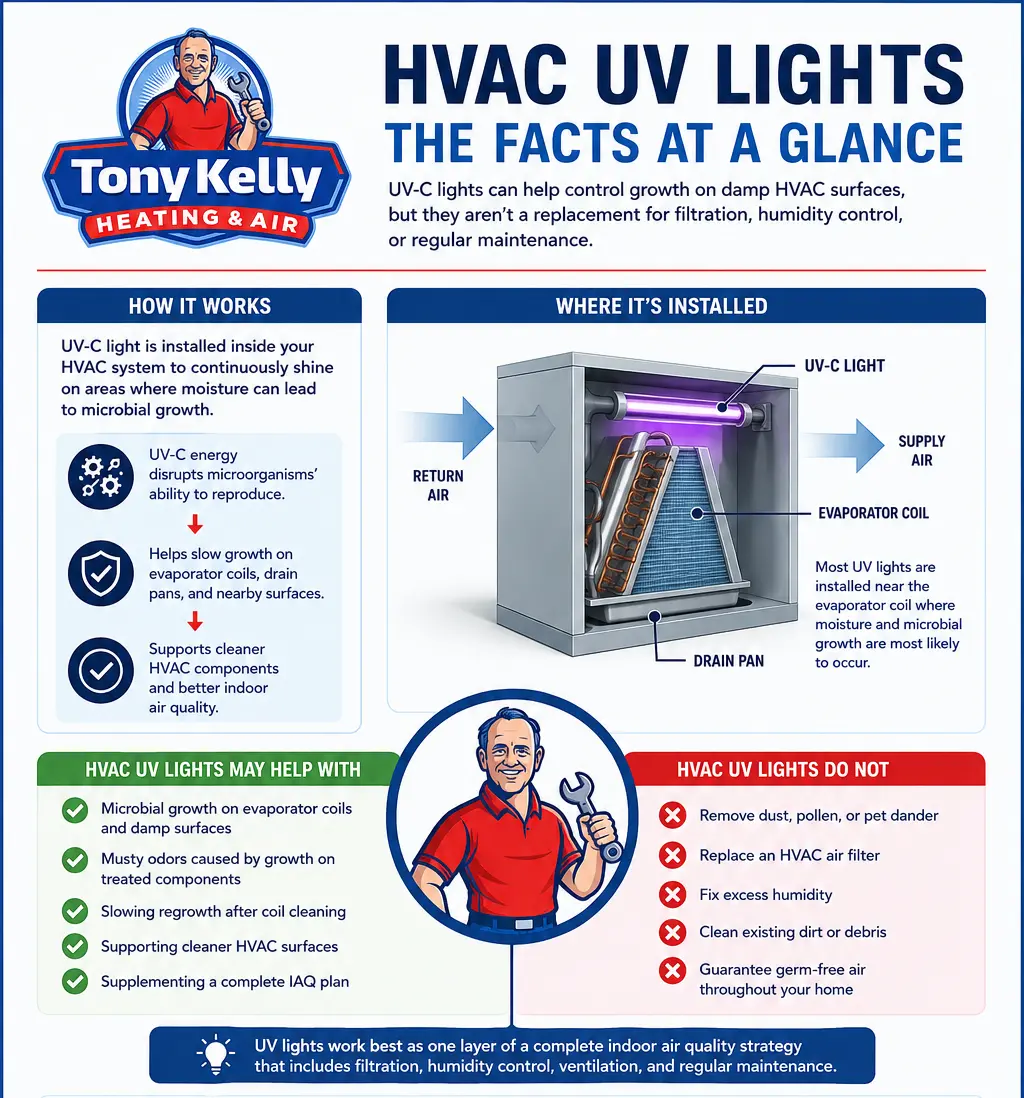
HVAC UV lights are ultraviolet light systems installed inside heating and cooling equipment. Most use UV-C energy, which can disrupt microorganisms that receive a sufficient dose of the light.
Unlike an air filter, a UV light does not trap or remove particles. Instead, it targets microorganisms on surfaces or in moving air. In residential systems, the most common installation location is near the evaporator coil inside the air handler.
The coil is a useful target because it regularly becomes wet during cooling operation. Warm indoor air passes over the cold coil, moisture condenses on its surface, and the resulting water drains through the condensate system. In North Florida’s long cooling season, this process may occur for much of the year.
Indoor air quality depends on more than one device. Filtration, ventilation, indoor humidity, duct conditions, equipment maintenance, and activities inside the home all affect the air occupants breathe. Learn more about improving indoor air quality in Florida homes.
An HVAC UV light directs UV-C energy toward selected areas inside the equipment. Microorganisms must receive enough UV-C exposure for the light to interfere with their ability to reproduce.
Three factors have a major effect on performance:
Dust, debris, insulation, equipment components, and shadows can block UV-C energy. A lamp can therefore be operating correctly without treating every part of the cabinet.
This is why professional placement matters. Simply adding a bulb anywhere inside a duct or air handler does not guarantee useful results. Homeowners considering UV-C for their system can learn more about our professional HVAC UV light installation in Tallahassee, including how we evaluate air handlers, evaporator coils, equipment compatibility, and UV light placement. ASHRAE’s guidance on UV-C in HVAC applications emphasizes the importance of design, UV dose, lamp output, exposure time, and system conditions.
The value of an HVAC UV light depends on the installation and the problem being addressed. Its most realistic benefits involve exposed, moisture-prone components inside the system.
The evaporator coil is one of the strongest residential applications for UV-C. The coil regularly becomes damp as it removes heat and moisture from indoor air, creating conditions that can support microbial growth.
A properly installed coil-sanitizing UV light continuously irradiates the exposed portions of the coil and surrounding surfaces. This may help slow the development of biological buildup between maintenance visits.
Microbial growth on damp coils, drain pans, or nearby cabinet surfaces can contribute to a musty odor when the air conditioner starts. UV-C may help reduce the source when the odor is directly related to growth on surfaces illuminated by the lamp.
UV light will not resolve every HVAC odor. Drain problems, accumulated debris, duct contamination, standing water, electrical issues, animals, plumbing problems, and sources elsewhere in the home may produce similar smells. Homeowners experiencing recurring odors should first determine why the air conditioner smells.
UV-C does not physically clean a dirty evaporator coil. Existing dust, debris, biofilm, or heavy contamination may need to be professionally removed before installing a UV light.
Once the coil is clean, continuous UV exposure may help slow biological regrowth on illuminated areas. Normal coil inspection and cleaning are still necessary because nonbiological debris can continue accumulating.
Biological buildup can interfere with airflow and heat transfer when it becomes significant. By helping control this buildup on treated coil surfaces, UV-C may support cleaner operation.
This should not be interpreted as a guarantee of lower energy bills. Actual performance depends on equipment condition, airflow, refrigerant operation, ductwork, filtration, maintenance, and other factors.
UV lights work best as one layer of a broader plan. A filter captures particles, humidity control limits damp conditions, ventilation helps manage indoor pollutants, and UV-C targets biological growth in selected parts of the equipment.
Combining appropriate solutions is usually more effective than expecting one product to correct every indoor air concern.
HVAC UV lights also have limitations and ongoing costs. Understanding these drawbacks helps homeowners set realistic expectations before installing one.
UV lights also do not fix the underlying causes of moisture around an air handler. A clogged drain, poor airflow, damaged insulation, equipment-sizing issue, or uncontrolled indoor humidity must be addressed separately.
HVAC UV light installation costs vary based on the type of light, number of lamps, equipment design, electrical requirements, installation access, and whether the product is intended primarily for coil treatment or air-stream treatment.
Typical professional installation may range from [insert Tony Kelly’s confirmed installed price range]. A basic single-lamp coil treatment system generally costs less than a higher-output, multi-lamp, or in-duct air treatment system.
Factors that can affect HVAC UV light installation cost include:
Homeowners should also consider long-term ownership costs. Depending on the system, these may include replacement lamps, professional inspections, cleaning, and eventual power-supply or ballast replacement.
The least expensive UV light is not always the best value. Correct placement, appropriate output, safety certifications, lamp availability, and proper installation all affect how well the system performs over time.
Residential HVAC UV lights generally fall into two categories: coil-sanitizing lights and air-sanitizing lights. Both use UV-C energy, but they target different areas and require different expectations.
Coil-sanitizing UV lights are positioned to irradiate the evaporator coil, drain pan, or nearby air handler surfaces. Because the target remains stationary, it can receive UV-C exposure for long periods.
This tends to be the most consistent residential use in humid climates. It targets the part of the HVAC system where moisture and microbial growth are most likely to meet.
Air-sanitizing UV systems expose moving air to UV-C energy as it passes through the air handler or ductwork. Their performance depends on lamp intensity, airflow speed, duct dimensions, reflectivity, placement, and exposure time.
Residential air moves quickly through HVAC equipment. A properly designed air-treatment system may require greater UV intensity or more than one lamp to deliver a meaningful dose during that brief exposure.
| Feature | Coil-Treatment UV Light | Air-Treatment UV Light |
|---|---|---|
| Primary target | Coil, drain pan, and nearby surfaces | Microorganisms moving through the air stream |
| Exposure pattern | Continuous treatment of a fixed surface | Brief exposure as air passes the lamp |
| Common location | Inside the air handler near the coil | Inside a duct or air-handler air path |
| Main advantage | Longer exposure to damp surfaces | Can target organisms passing through the system |
| Main limitation | Only treats exposed surfaces | Performance is sensitive to airflow and UV dose |
Most residential HVAC UV lights are installed inside the indoor air handler near the evaporator coil. Depending on the equipment design, the lamp may be positioned above, beside, or downstream of the coil.
Other possible locations include:
There is no single placement that works for every system. The installer must consider the lamp’s line of sight, distance from the target, temperature, airflow, equipment access, electrical connections, and nearby materials.
The lamp should not be positioned where prolonged UV exposure can unnecessarily affect filters, flex duct, wiring, plastic drain components, insulation, or other vulnerable materials.
HVAC UV light, AC UV light, air-conditioner UV light, and air handler UV light generally refer to the same broad technology. The differences usually describe the equipment or installation location rather than completely different products.
Heat pumps can also use HVAC UV lights. A heat pump’s indoor air handler contains an evaporator coil during cooling operation, so many of the same installation principles apply.
HVAC UV lights can inactivate some mold and help limit growth on directly exposed surfaces when the organisms receive a sufficient UV-C dose. They are most useful for slowing growth on damp cooling coils, drain pans, and nearby surfaces.
However, a UV light does not physically remove existing mold. It also cannot treat mold that is hidden behind insulation, inside debris, around corners, deep within porous materials, or elsewhere in the home.
Heavy contamination may shield underlying microorganisms from the light. Existing buildup should therefore be properly evaluated and cleaned rather than relying on UV-C alone.
Moisture correction remains essential. Mold or microbial growth may return when high humidity, standing water, drain problems, duct leakage, or other moisture sources remain unresolved. The EPA explains that residential UV systems should not be treated as the sole method of controlling mold or biological pollutants.
A UV light in an AC system is not normally dangerous to occupants when an appropriate product is professionally installed inside a closed HVAC cabinet. However, direct exposure to UV-C can harm the eyes and skin.
The light should be turned off before the air handler or duct section is opened for inspection or service. Homeowners should not stare directly at an operating UV-C lamp or handle it while it is energized.
Professional installation also helps address electrical safety, lamp containment, cabinet access, component protection, and proper shutdown procedures.
Some UV lamps are designed to avoid ozone production, while certain wavelengths can generate ozone. Homeowners should select an HVAC-specific product whose manufacturer clearly identifies it as ozone-free or confirms compliance with applicable emissions and safety requirements.
Ozone should not be treated as a desirable indoor air-cleaning feature. The EPA warns that ozone can irritate the respiratory system and is not effective at safe indoor concentrations for removing many common contaminants.
Some conventional UV-C lamps contain a small amount of mercury, while other products use different technologies. Follow the manufacturer’s instructions for handling, replacement, and disposal.
A damaged lamp should not be handled like ordinary household glass. Turn off the system, avoid direct contact with broken materials, and follow the product manufacturer’s cleanup guidance.
A properly installed HVAC UV light should not damage the equipment, but prolonged UV-C exposure can degrade certain materials. Potentially vulnerable components include plastic, rubber, wire insulation, filters, adhesives, drain tubing, flex duct liners, and some insulation materials.
An installer should evaluate everything within the lamp’s direct line of sight and add shielding or adjust the placement where needed. The light should irradiate the intended coil or air path without unnecessarily exposing sensitive components.
This is one reason a do-it-yourself installation can be risky. A lamp may fit inside the cabinet while still being positioned too close to wiring, aimed toward a filter, or placed where it cannot treat the intended surface effectively.
HVAC UV lights are not designed to remove most common particulate allergens. Dust, pollen, pet dander, fibers, and other particles must be captured by filtration or removed through cleaning.
UV-C may affect certain biological organisms when they receive sufficient exposure, but inactive mold fragments and other biological material can still remain in the system or air. A UV lamp should not be expected to eliminate allergy or asthma triggers by itself.
Homeowners concerned about airborne particles may benefit more from evaluating filter selection, filter fit, airflow, duct leakage, humidity, and other indoor air quality services.
HVAC UV lights may reduce odors caused by microbial growth on an evaporator coil, drain pan, or another directly treated surface. The improvement usually develops as the light limits growth over time rather than immediately masking a smell.
UV-C will not resolve odors caused by:
The odor source should be diagnosed before choosing a UV light as the solution.
The useful life of an HVAC UV lamp depends on its design, output, operating schedule, and manufacturer specifications. Many conventional UV-C lamps require replacement approximately every one to two years, while some products have different service intervals.
A UV bulb may still emit visible light after its useful germicidal output has declined. Looking through an indicator window and seeing a glow does not necessarily mean the lamp is producing its intended UV-C dose.
Follow the manufacturer’s replacement schedule rather than waiting for the bulb to burn out completely. The power supply or ballast may last through several lamp replacements, but it should still be inspected during service.
HVAC UV lights require less day-to-day attention than many HVAC components, but they are not maintenance-free.
Typical UV-light maintenance may include:
A UV light does not eliminate the need for normal heating and cooling maintenance. Filters, coils, drain lines, blowers, electrical components, refrigerant operation, and airflow should still be inspected regularly.
HVAC UV lights may be worth it when the goal is to control recurring microbial growth on damp equipment surfaces. They are especially relevant when a home has a history of coil contamination, air-handler buildup, or musty odors traced to the evaporator coil.
Homes with clean coils, controlled humidity, and no history of microbial growth may notice less benefit. The best way to decide is to identify the underlying indoor air or HVAC concern before selecting a product.
Air conditioners in Tallahassee and surrounding North Florida communities operate through long periods of heat and high humidity. During cooling cycles, the evaporator coil repeatedly collects condensation as the system removes moisture from indoor air.
These damp operating conditions can make coil treatment more relevant than it might be in a drier climate. However, installing a UV light does not lower indoor humidity or stop condensation from forming.
A home that still feels damp or sticky may need further evaluation of equipment sizing, cooling cycles, airflow, duct leakage, ventilation, or dehumidification. Learn how whole-home dehumidifiers work in Florida’s humid climate.
UV-C and humidity control address different problems. A dehumidifier reduces moisture in the home, while a UV light targets biological growth on selected HVAC surfaces. Some homes may benefit from both, but one should not be treated as a substitute for the other.
Indoor air quality is rarely improved by one product alone. The right approach depends on the pollutants, comfort problems, equipment conditions, and moisture levels found in the home.
A more complete plan may include:
UV lights should support these fundamentals rather than replace them. For homes with persistent humidity concerns, whole-home dehumidifier installation in Tallahassee may address a more important source of indoor discomfort and moisture.
Professional installation is recommended. Installing an HVAC UV light may require drilling into the cabinet, connecting electrical components, selecting the correct location, protecting nearby materials, and preventing direct UV-C exposure. Incorrect placement can reduce performance or damage wiring, filters, insulation, and other components.
Many coil-sanitizing UV lights operate continuously because the goal is to provide ongoing exposure to a stationary surface. Some air-treatment systems operate with the blower. The correct operating schedule depends on the UV product, application, and manufacturer instructions.
Some systems include an external indicator, sight glass, alarm, or monitoring feature. A visible glow only confirms that the lamp is illuminated; it does not confirm that the lamp is still producing its original UV-C output. Replacement should follow the manufacturer’s schedule.
Many conventional UV-C lamps require replacement approximately every one to two years, but intervals vary by product and operating schedule. Follow the specific manufacturer’s recommendation rather than waiting for the lamp to stop glowing.
No. UV-C may help slow biological growth on an exposed coil, but it cannot remove existing dirt, lint, dust, or heavy buildup. A contaminated coil may need to be professionally cleaned before a UV light is installed.
They can be, but effectiveness depends on UV intensity, airflow speed, exposure time, duct dimensions, placement, and system design. Moving air usually receives a much shorter exposure than a stationary evaporator coil.
Prolonged direct UV-C exposure can degrade some filter materials. A UV light should be positioned or shielded so that it treats the intended target without unnecessarily irradiating a filter or other vulnerable component.
Yes. Heat pumps use indoor air handlers and evaporator coils during cooling operation, so UV-C lights can often be installed using principles similar to those used with central air conditioners. The equipment should be inspected to determine the appropriate product and placement.
Not automatically. Additional lamps may improve coverage in some large or complex air handlers, but performance depends on lamp output, placement, target area, and system design. One properly positioned light may be more useful than multiple poorly positioned lamps.
No. Homes with clean equipment, controlled humidity, and no recurring microbial growth may receive limited value. A UV light is most appropriate when an inspection identifies a problem or operating condition the light can realistically address.
HVAC UV lights can be useful for controlling microbial growth on damp coils and air-handler surfaces, but they are not the right solution for every indoor air quality concern. Dust, humidity, odors, airflow problems, and recurring equipment contamination may each require a different approach.
Tony Kelly Heating & Air Conditioning can evaluate your HVAC equipment, identify conditions inside the air handler, and explain whether a UV light, filtration improvement, humidity-control system, cleaning, repair, or another solution makes sense for your North Florida home.
Our team serves homeowners in Tallahassee, Crawfordville, Woodville, Monticello, Havana, Quincy, and surrounding communities with practical heating, cooling, and indoor air quality recommendations based on the condition of the home and HVAC system.
Address:
870 Blountstown Hwy. Unit # 9
Tallahassee, FL 32303
Phone: 850-385-3774
License #: CMC1249702
Open Monday Through Friday
8:00 am to 8:00 pm

