CALL US 850-385-3774

What is crawl space encapsulation? Crawl space encapsulation is the process of sealing and conditioning the area beneath a home to help control moisture, humidity, pests, mold risk, wood rot, and air quality issues. In simple terms, it turns a damp, exposed crawl space into a cleaner, drier, more controlled space under the house.
For homeowners in Tallahassee and surrounding North Florida communities, crawl space moisture is not a small issue. Hot, humid summers, frequent rain, storm season, shaded lots, older homes, and long cooling seasons can all make the space under your home more vulnerable to moisture problems. When that moisture sits under the house, it can affect floor joists, insulation, ductwork, indoor comfort, and even the way the HVAC system performs.
A crawl space encapsulation system usually includes a heavy-duty vapor barrier, sealed vents, sealed seams, moisture control, insulation improvements, and often a crawl space dehumidifier. The goal is to help prevent crawl space rot, reduce damp air under the home, and create a more stable environment beneath the living space.
This guide explains what crawl space encapsulation means, what the process includes, what materials are commonly used, what problems it can help prevent, and when homeowners should consider professional crawl space encapsulation Tallahassee services.
To encapsulate a crawl space means to seal the crawl space from exposed soil, outside air, foundation vents, and uncontrolled moisture sources as much as possible. Instead of leaving the crawl space open to humid air and ground moisture, encapsulation creates a closed crawl space that is easier to manage.
In many older crawl spaces, the ground is exposed dirt or partially covered with thin plastic. The foundation vents may remain open year-round, allowing humid outdoor air to enter. Insulation may be loose, sagging, damp, or missing. Ductwork may run through the crawl space and lose efficiency when surrounded by high humidity. Plumbing lines, wood framing, and subfloor materials may also be exposed to moisture.
A fully encapsulated crawl space is different. The ground is covered with a durable vapor barrier. The barrier is sealed at seams and attached to foundation walls or piers. Foundation vents and obvious air gaps are sealed. The access door is tightened. Insulation may be added or improved. Drainage issues are addressed when needed. A dehumidifier may be installed to keep humidity under control.
That combination of sealing, insulating, draining, and dehumidifying is what makes encapsulation more complete than simply laying plastic on the crawl space floor.
One of the most common points of confusion is the difference between a vapor barrier and full crawl space encapsulation. They are related, but they are not the same thing.
A vapor barrier is usually a plastic or reinforced liner placed over the crawl space floor to slow moisture rising from the ground. This can be helpful, especially in crawl spaces with exposed soil. However, a basic vapor barrier may not seal foundation walls, vents, piers, seams, gaps, or access points. It may also leave humid outside air free to move through the crawl space.
Crawl space encapsulation is more complete. It includes the vapor barrier but also focuses on sealing and conditioning the entire crawl space environment. That may include sealed vents, sealed wall connections, sealed support piers, insulation adjustments, drainage corrections, air sealing, and humidity control.
Think of a vapor barrier as one component. Think of crawl space encapsulation as the full system.
This distinction matters because homeowners often search for crawl space encapsulation materials or crawl space encapsulation supplies thinking that the liner alone solves the problem. In reality, the quality of the seams, wall attachment, vent sealing, drainage, and humidity control often determines how well the system performs over time.
For a deeper overview of the topic, Tony Kelly Heating & Air also has a related guide on understanding crawl space encapsulation.
Crawl spaces are naturally vulnerable because they sit below the living area and close to the ground. In North Florida, moisture pressure is especially strong because of the climate. Tallahassee homes often deal with long periods of humidity, heavy rain, warm soil temperatures, and extended AC use.
Moisture can enter a crawl space in several ways:
Once moisture enters the crawl space, it can become trapped. A shaded crawl space may not dry quickly. Damp insulation can hold moisture. Wood framing may absorb humidity. Ductwork may sweat when warm humid air meets cooler conditioned surfaces. Over time, the crawl space can become a hidden source of musty odors, uneven comfort, pest activity, and structural concerns.
This is why crawl space humidity control in Tallahassee is so important. Encapsulation is not just about making the crawl space look cleaner. It is about controlling the conditions that allow moisture problems to continue beneath the home.
The crawl space may be out of sight, but it is not separate from the rest of the house. Air, humidity, odors, and temperature changes can move upward through small gaps in the floor system, plumbing penetrations, duct openings, and framing cavities. This is one reason a damp crawl space can contribute to indoor comfort problems.
When the crawl space stays humid, homeowners may notice:
Moist crawl spaces can also affect HVAC performance. If ductwork, return leaks, or air handler connections are located near or inside a damp crawl space, the HVAC system may pull in humid, dirty, or musty air. This can make the air conditioner work harder during the cooling season and may reduce overall indoor comfort.
That is why encapsulation connects closely with indoor air quality, humidity control, ductwork performance, and whole-home comfort. It supports the living area by improving the environment below it.
A crawl space encapsulation system can vary depending on the home, but most professional systems include several core components. The exact design should be based on the crawl space condition, moisture level, foundation layout, access, drainage, insulation, and HVAC setup.
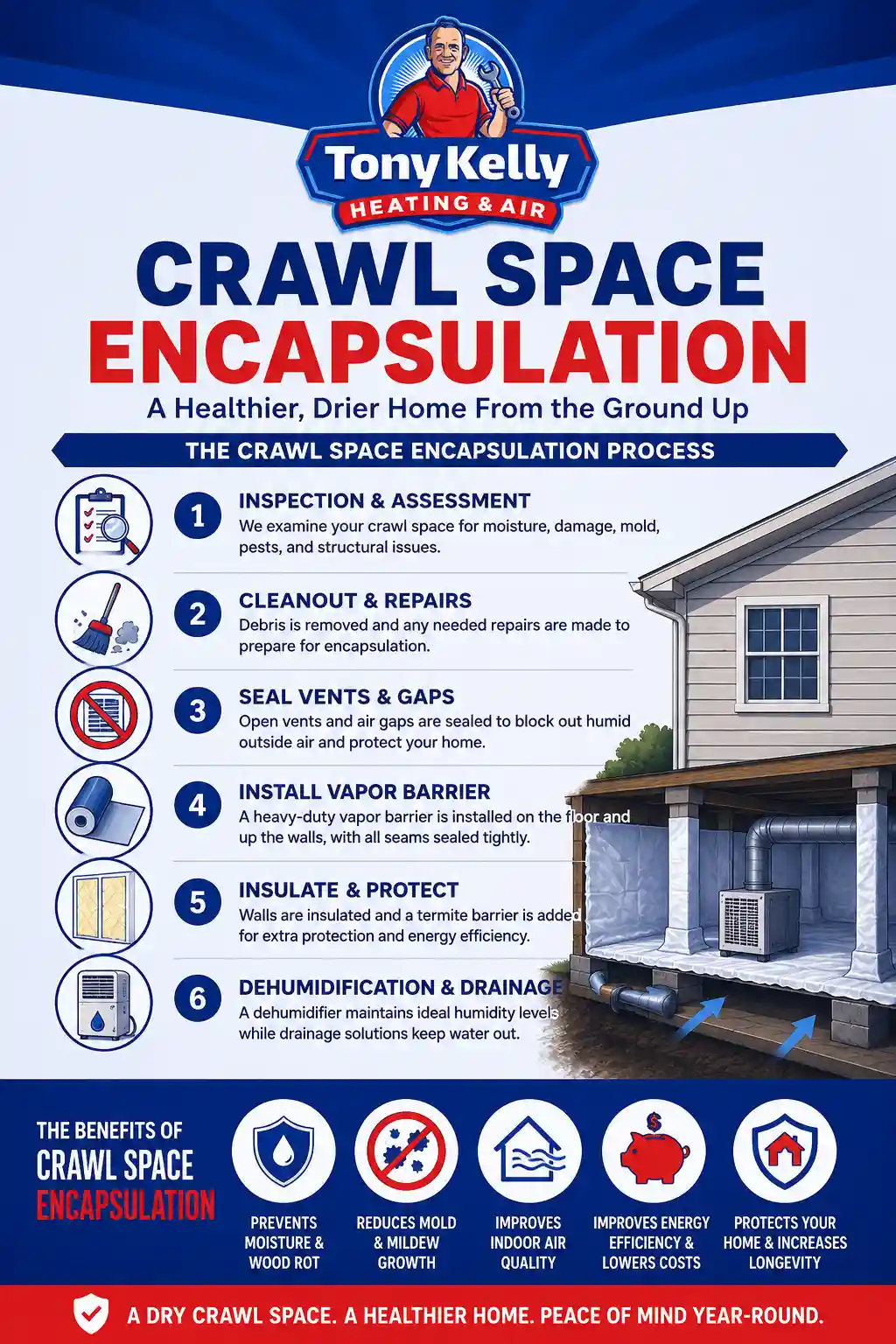
The process usually begins with an inspection. A technician looks for moisture, standing water, wood rot, mold-like growth, pest activity, damaged insulation, plumbing leaks, ductwork concerns, open vents, damaged access doors, and drainage issues around the foundation.
This step matters because encapsulation should not simply cover up existing problems. If wood rot, standing water, or damaged insulation is present, those issues need to be addressed before the space is sealed.
Before a liner is installed, the crawl space usually needs to be cleaned. Old plastic, fallen insulation, debris, rocks, sharp objects, and damaged materials may need to be removed. The ground may also need to be leveled or prepared so the vapor barrier can sit properly.
Skipping this step can lead to punctures, trapped debris, uneven liner placement, and poor long-term performance.
If water is entering the crawl space, encapsulation alone may not be enough. Drainage problems may need to be corrected first. This can include improving grading, extending downspouts, addressing foundation drainage, or adding a sump pump when standing water is a recurring issue.
The goal is to stop bulk water before relying on the vapor barrier and dehumidifier to manage humidity.
The vapor barrier is one of the most visible parts of encapsulation. It is installed over the crawl space floor and often extended up foundation walls and around piers. Seams should be overlapped and sealed. Edges should be secured to reduce gaps where moisture can escape.
Common crawl space encapsulation materials include reinforced polyethylene liners, seam tape, fasteners, sealants, insulation panels, drainage matting, and dehumidification equipment. The thickness and durability of the liner can affect how well it resists tears and punctures over time.
Traditional crawl spaces were often built with foundation vents, but in humid climates, venting can introduce moisture rather than remove it. During warm months, outdoor air carries moisture into the crawl space. When that air meets cooler surfaces, condensation can form.
Encapsulation typically includes sealing vents, gaps, and access points so humid air cannot freely enter. This helps create a closed crawl space that is easier to control.
Encapsulated crawl space insulation may be installed along foundation walls or adjusted based on the home’s layout. The goal is to support temperature stability while avoiding insulation materials that absorb moisture or hide termite inspection areas.
In termite-prone areas like North Florida, insulation design should allow for proper inspection access where required.
Many crawl space encapsulation systems include a dehumidifier. A vapor barrier helps block ground moisture, but humidity can still build if the space is not conditioned properly. A dehumidifier helps keep moisture levels stable, especially during Tallahassee’s long humid season.
Once the system is installed, seams, edges, access doors, vents, and penetrations should be inspected. The crawl space should be monitored over time to make sure humidity remains controlled and the liner stays intact.
Homeowners often ask, “What is the process of crawl space encapsulation?” While every home is different, the process usually follows a clear sequence.
The most important point is that encapsulation should be designed as a system. A liner without moisture correction, vent sealing, drainage, or humidity control may not solve the root issue.
For homeowners comparing educational resources, the article why you need crawl space encapsulation can support the decision-making process without turning this guide into a service page.
Preventing crawl space rot is one of the most important reasons homeowners consider encapsulation. Wood rot occurs when wood stays damp long enough for decay organisms to develop. Crawl spaces with exposed soil, high humidity, poor airflow, or repeated water intrusion can create the right conditions for rot.
Floor joists, beams, subflooring, and sill plates are especially important because they support the structure above. When these components absorb moisture over time, they may soften, darken, warp, or weaken. Homeowners may not notice the problem until floors begin to sag or feel uneven.
Crawl space encapsulation helps prevent crawl space wood rot by addressing the moisture conditions that allow decay to progress. The vapor barrier blocks ground moisture. Sealed vents reduce humid outdoor air. Drainage corrections help move water away. Dehumidification keeps humidity in a safer range. Together, these steps create a drier environment beneath the home.
Encapsulation cannot reverse wood rot that already exists. Damaged wood may need to be repaired or replaced before the system is installed. However, once those issues are corrected, encapsulation can help prevent the same moisture conditions from returning.
Many homeowners first begin researching crawl space encapsulation after noticing a musty smell or seeing moisture beneath their home. Others discover the need during a home inspection or while dealing with high humidity inside the house. Regardless of how the issue is found, the benefits of a properly designed crawl space encapsulation system extend far beyond simply covering the dirt floor.
Because nearly half of the air in many homes can originate from the crawl space through natural air movement, improving the environment below the home often improves conditions above it as well. That’s one reason encapsulation has become one of the most recommended moisture-control upgrades for homes throughout Tallahassee and surrounding North Florida communities.
Humidity is one of the biggest challenges homeowners face in this part of Florida. Even when your air conditioner is running properly, excess moisture beneath the home can continue working against your HVAC system.
By reducing ground moisture and limiting humid outside air from entering through crawl space vents, encapsulation helps stabilize humidity levels beneath the house. When paired with a properly sized crawl space dehumidifier, homeowners often notice that the home feels more comfortable throughout the year.
This is especially important during Tallahassee’s long cooling season, when air conditioners spend months removing both heat and moisture from indoor air.
Mold needs moisture to grow. Damp wood, wet insulation, condensation, and elevated humidity all increase the likelihood of mold developing inside the crawl space.
While encapsulation is not mold remediation, it helps remove many of the conditions that allow mold to continue spreading after cleanup has been completed. By keeping humidity lower and reducing moisture intrusion, the crawl space becomes much less favorable for mold growth.
Many homeowners are surprised to learn that odors from a crawl space can migrate into the living area. Small openings around plumbing, wiring, ductwork, framing, and flooring allow air movement between the crawl space and the rest of the home.
When the crawl space is damp, those odors may include:
Reducing moisture below the home often results in cleaner-smelling indoor air and fewer humidity-related odors throughout the house.
High humidity makes your air conditioner work harder. Even when indoor temperatures reach the thermostat setting, excess humidity can leave the home feeling uncomfortable.
If crawl space ductwork is exposed to hot, humid air, condensation may form on ducts and cooling efficiency can suffer. Encapsulation helps create a more controlled environment around HVAC components located beneath the home.
Homeowners looking to improve comfort often combine crawl space improvements with other indoor air quality services such as air duct cleaning in Tallahassee when duct contamination or excess dust has become part of the overall problem.
Many pests are attracted to damp crawl spaces. Termites, cockroaches, rodents, ants, spiders, and other insects often seek out moist environments with exposed wood and easy entry points.
Although encapsulation is not pest control, reducing moisture and sealing many crawl space openings makes the environment less attractive for unwanted visitors.
Homeowners should continue regular termite inspections, especially in North Florida where subterranean termites remain common.
One of the biggest long-term advantages of encapsulation is protecting the structure of the home. Excess moisture affects wood framing, subfloor materials, support beams, insulation, and even metal fasteners.
Keeping the crawl space dry helps preserve these structural components and may reduce the likelihood of expensive repairs related to moisture damage years later.
For homeowners interested in a deeper discussion of these long-term advantages, our guide covering the benefits of crawl space encapsulation in Tallahassee expands on how encapsulation supports healthier homes throughout North Florida.
Encapsulation is not a cure-all, but it addresses many of the underlying conditions responsible for common crawl space issues.
Homeowners frequently consider encapsulation after experiencing one or more of the following:
A persistent musty smell often starts below the home. Moist soil, damp insulation, wood rot, mildew, or mold can all contribute to odors that eventually move into the living space.
By sealing moisture sources and controlling humidity, encapsulation often reduces these odors significantly.
Although Tallahassee winters are relatively mild, homes with vented crawl spaces often have colder floors because outside air moves freely beneath the home.
Encapsulation helps reduce temperature swings under the floor system, making rooms feel more comfortable during cooler months.
If your home always feels sticky despite running the air conditioner, excess crawl space moisture could be contributing to the problem.
Humidity moving upward through the floor system increases the amount of moisture your HVAC equipment must remove from indoor air.
Wood rot and prolonged moisture exposure may weaken joists or support members over time.
Encapsulation will not repair structural damage that already exists, but it helps prevent repaired framing from being exposed to the same moisture conditions again.
Insulation hanging beneath floor joists is often one of the first visible signs of moisture problems.
Once insulation becomes saturated, it loses much of its insulating value and may need replacement before encapsulation is completed.
Air conditioning ducts located inside humid crawl spaces commonly develop condensation.
Over time this moisture can damage insulation around ducts, contribute to mold growth, or even drip onto the vapor barrier below.
Creating a controlled crawl space environment helps reduce condensation around HVAC components.
Not necessarily.
Some crawl spaces remain relatively dry throughout the year and only require routine monitoring or minor moisture improvements. Others have significant drainage issues that should be corrected before encapsulation is considered.
The best candidates for crawl space encapsulation generally include homes with:
A professional inspection helps determine whether full encapsulation is appropriate or whether simpler drainage or ventilation improvements may solve the issue.
One of the most searched questions online is, “How much does crawl space encapsulation cost?”
There is no universal price because every crawl space is different. Costs vary depending on:
A crawl space that is already clean and dry typically requires less preparation than one with standing water, damaged insulation, mold growth, or wood repairs.
While encapsulation represents a significant home improvement investment, many homeowners view it as preventative maintenance that helps reduce future repair costs while improving comfort and protecting the home’s structure.
When comparing crawl space encapsulation companies, homeowners should focus on the overall system design rather than simply choosing the lowest estimate. Proper preparation, durable materials, sealed seams, drainage solutions, and humidity control often determine how well the encapsulation performs years after installation.
A professionally installed crawl space encapsulation system is designed to provide long-term moisture control rather than being a temporary repair.
The lifespan depends on several factors, including:
Most reinforced vapor barriers are designed to last for many years when properly installed and protected from punctures.
Like any part of a home, encapsulation systems should be inspected periodically. Small tears, plumbing work, pest activity, or foundation repairs can occasionally require sections of the liner to be resealed or repaired.
Annual inspections also help ensure the dehumidifier, drainage system, and humidity levels continue operating as intended.
One of the most searched topics online is crawl space encapsulation problems. While encapsulation is one of the most effective long-term moisture control solutions for homes with crawl spaces, no system is perfect. Most problems homeowners experience are not caused by encapsulation itself—they’re caused by improper installation, poor preparation, or existing issues that weren’t corrected before the crawl space was sealed.
Understanding these potential challenges helps homeowners know what to expect and what questions to ask when comparing crawl space encapsulation contractors.
A vapor barrier should never be installed over standing water, saturated soil, active plumbing leaks, or structural damage without addressing the underlying cause first.
If water continues entering the crawl space after encapsulation, humidity can remain high and moisture problems may continue. Drainage improvements, grading corrections, plumbing repairs, or sump pump installation may be necessary before the crawl space is sealed.
The vapor barrier is only as effective as its installation. Loose seams, gaps around support piers, poorly attached wall sections, or punctures in the liner allow moisture to bypass the system.
Professional installation includes sealing seams, properly attaching the liner to foundation walls, wrapping support columns where appropriate, and inspecting the completed system for leaks.
Not all crawl space encapsulation materials are created equally.
Thin plastic sheeting sold at home improvement stores may work as temporary ground cover, but it is far more susceptible to punctures and tears than reinforced encapsulation liners designed for long-term use.
Professional systems generally use thicker reinforced materials that better withstand maintenance access and normal crawl space conditions.
Some homeowners assume sealing the crawl space alone eliminates humidity problems.
While the vapor barrier dramatically reduces ground moisture, North Florida’s climate often still requires active humidity control. A properly sized crawl space dehumidifier helps maintain stable moisture levels throughout the year, especially during Tallahassee’s long, humid summers.
Encapsulation is not completely maintenance free.
Homeowners should periodically inspect the crawl space for plumbing leaks, pest activity, damage to the vapor barrier, and proper dehumidifier operation. Small issues are much easier and less expensive to address before they become larger problems.
While crawl space encapsulation is primarily a moisture-control solution, many homeowners notice improvements in overall HVAC performance after the crawl space environment becomes drier and more stable.
This happens because many homes throughout Tallahassee have HVAC components located inside the crawl space, including:
When these components operate inside a damp crawl space, condensation becomes more likely. Humid air surrounding cold ductwork can lead to sweating ducts, wet insulation, energy loss, and unnecessary strain on the cooling system.
Reducing crawl space humidity creates a healthier operating environment for HVAC equipment.
Encapsulation also works well alongside other indoor comfort improvements, including whole-home air dehumidifier installation for homeowners dealing with persistent indoor humidity throughout the house.
Many crawl space issues develop slowly over several years, making them easy to overlook. Homeowners often don’t realize there’s a problem until symptoms begin appearing inside the home.
Consider scheduling a crawl space inspection if you notice any of these warning signs:
These symptoms don’t automatically mean encapsulation is required, but they do suggest that moisture conditions beneath the home deserve closer evaluation.
Because crawl space encapsulation is a long-term investment, choosing the right contractor is just as important as choosing the right materials.
Rather than comparing estimates based only on price, homeowners should understand exactly what each proposal includes.
Questions worth asking include:
A quality crawl space encapsulation contractor should explain why each part of the system is recommended rather than simply selling the largest package available.
Homes vary significantly throughout Leon County, Wakulla County, and surrounding North Florida communities. Older homes, elevated homes, and homes built on sloped lots often require different encapsulation approaches.
Although this guide focuses on educating homeowners about crawl space encapsulation, many North Florida homes experience similar moisture challenges regardless of the neighborhood or nearby community.
Whether your home is located in Tallahassee itself or a surrounding area, prolonged humidity, heavy rainfall, and warm temperatures can all contribute to crawl space moisture problems.
If you’re researching local information, Tony Kelly Heating & Air has developed community-specific resources covering crawl space encapsulation in several nearby service areas, including:
Each location has its own housing styles, soil conditions, drainage characteristics, and moisture concerns, but the overall principles of crawl space encapsulation remain the same.
Crawl space encapsulation is the process of sealing the crawl space beneath a home using a heavy-duty vapor barrier, sealed vents, moisture-control methods, insulation improvements, and often a dehumidifier. The goal is to reduce humidity, help prevent wood rot, improve indoor air quality, and create a cleaner, more controlled environment beneath the house.
The process typically includes inspecting the crawl space, correcting moisture problems, removing debris, installing a reinforced vapor barrier, sealing vents and gaps, improving insulation when needed, installing humidity-control equipment, and performing a final inspection to verify the system is properly sealed.
The cost depends on factors such as crawl space size, accessibility, moisture damage, drainage requirements, insulation needs, and whether repairs or a dehumidifier are needed. Because every home is different, a professional inspection provides the most accurate estimate.
Yes. By controlling moisture and reducing humidity beneath the home, encapsulation helps create conditions that discourage wood rot. Existing damaged wood should be repaired before the crawl space is encapsulated.
A professionally installed crawl space encapsulation system can last for many years when quality materials are used and the system is properly maintained. Periodic inspections help identify small issues before they affect performance.
For homes with persistent moisture, musty odors, mold concerns, wood rot, or high crawl space humidity, encapsulation often provides long-term benefits by protecting the home’s structure, improving comfort, and reducing excess moisture beneath the house.
No. Some crawl spaces remain relatively dry and only require monitoring or minor improvements. A professional inspection helps determine whether full encapsulation is appropriate or if other moisture-control solutions would be sufficient.
Yes. By reducing moisture, odors, mold risk, and damp air beneath the home, encapsulation can contribute to healthier indoor air and a more comfortable living environment.
So, what is crawl space encapsulation? It’s much more than laying plastic across exposed dirt. A professionally designed crawl space encapsulation system combines moisture management, air sealing, vapor protection, drainage improvements, insulation strategies, and humidity control to create a healthier environment beneath your home.
For homeowners throughout Tallahassee and North Florida, where high humidity and heavy rainfall are part of everyday life, encapsulation can play an important role in protecting floor framing, improving indoor comfort, supporting HVAC efficiency, and helping prevent crawl space rot before expensive structural damage develops.
If you’ve noticed musty odors, damp insulation, high indoor humidity, wood rot, condensation on ductwork, or persistent moisture beneath your home, understanding how crawl space encapsulation works is the first step toward protecting your investment. A professional crawl space inspection can identify the underlying causes of moisture and determine whether encapsulation is the right long-term solution for your home’s specific conditions.
Address:
870 Blountstown Hwy. Unit # 9
Tallahassee, FL 32303
Phone: 850-385-3774
License #: CMC1249702
Open Monday Through Friday
8:00 am to 8:00 pm

