CALL US 850-385-3774
When the temperature rises across Tallahassee and North Florida, your air conditioner may seem like it is working harder than ever. The system runs for hours, the thermostat barely moves, and certain rooms still feel warmer than they should. You may find yourself asking, “Why can’t my AC keep up with the heat?”
Some extra runtime is normal during an especially hot, humid afternoon. Your air conditioner has to remove heat from the home while also pulling moisture from the indoor air. However, if the system runs nearly nonstop, never reaches the thermostat setting, produces weak airflow, or allows the house to become progressively warmer, there may be more happening than outdoor heat alone.
An AC struggling to cool a house can be affected by something as simple as a clogged air filter or blocked return vent. It can also point to dirty coils, leaking ductwork, low refrigerant, thermostat problems, an aging compressor, poor insulation, an incorrectly sized system, or a combination of several smaller problems.
This guide explains why an AC can’t keep up with heat, what homeowners can safely check, how Tallahassee’s climate affects cooling performance, and when a professional inspection may be the most practical next step.
It is not unusual for an air conditioner to run longer during the hottest part of a North Florida summer. Longer cycles can help the system maintain a consistent temperature and remove indoor humidity. A system that runs for an extended period is not automatically broken.
The more important question is whether the system is still making progress. Even if your AC runs for a long time, the air coming from the vents should feel cool, indoor humidity should remain manageable, and the thermostat should gradually move toward the selected temperature.
Warning signs that the problem may be more than extreme outdoor heat include:
If your home is only slightly warmer during the hottest hour of the afternoon but recovers later, the system may simply be operating near its maximum cooling capacity. If the temperature gap continues growing or the house never recovers, the HVAC system or the home itself may have a performance problem.
Air conditioners in Tallahassee operate under conditions that can challenge both cooling capacity and mechanical reliability. High temperatures are only one part of the issue. North Florida homes also deal with heavy humidity, long cooling seasons, frequent thunderstorms, power interruptions, pollen, outdoor debris, and heat buildup in attics and duct systems.
Your air conditioner does two jobs at once. It lowers the air temperature and removes moisture. When outdoor humidity is high, the system must spend more of its capacity managing moisture before the home feels comfortable.
This explains why a house can feel hot or sticky even when the thermostat reading does not seem unusually high. Humid air can make the indoor environment feel warmer, and excessive moisture may cause the AC to run longer.
If humidity remains high despite long cooling cycles, the issue may involve airflow, equipment sizing, duct leakage, thermostat settings, short cycling, or another problem affecting the system’s ability to dehumidify. Tony Kelly Heating & Air provides additional information about moisture control through its indoor air quality services.
In many parts of the country, air conditioners operate heavily for only a few months. In Tallahassee, cooling systems may run during much of the year. That additional runtime affects motors, capacitors, contactors, coils, compressors, drain lines, and other components.
A system does not have to stop working completely before wear affects performance. A weakening capacitor, dirty coil, slowing blower motor, or deteriorating electrical connection may allow the equipment to run while reducing its ability to cool effectively.
Summer thunderstorms can lead to outages, voltage fluctuations, tripped breakers, and stress on electrical components. Sometimes the AC stops entirely after a storm. In other cases, the system restarts but does not operate correctly.
If your equipment stopped during an outage, avoid repeatedly flipping breakers or opening electrical panels. Review the safe steps in this guide to troubleshoot an HVAC unit that has gone out. A breaker that repeatedly trips should be inspected rather than continually reset.
Many Tallahassee homes have ducts running through hot attics, crawl spaces, garages, or other unconditioned areas. If the ducts are poorly insulated, disconnected, crushed, or leaking, cooled air may warm up or escape before it reaches the rooms.
The AC may be producing cold air at the indoor equipment while homeowners experience weak airflow and warm rooms. This is one reason a complete cooling diagnosis should consider the duct system, not only the outdoor unit.
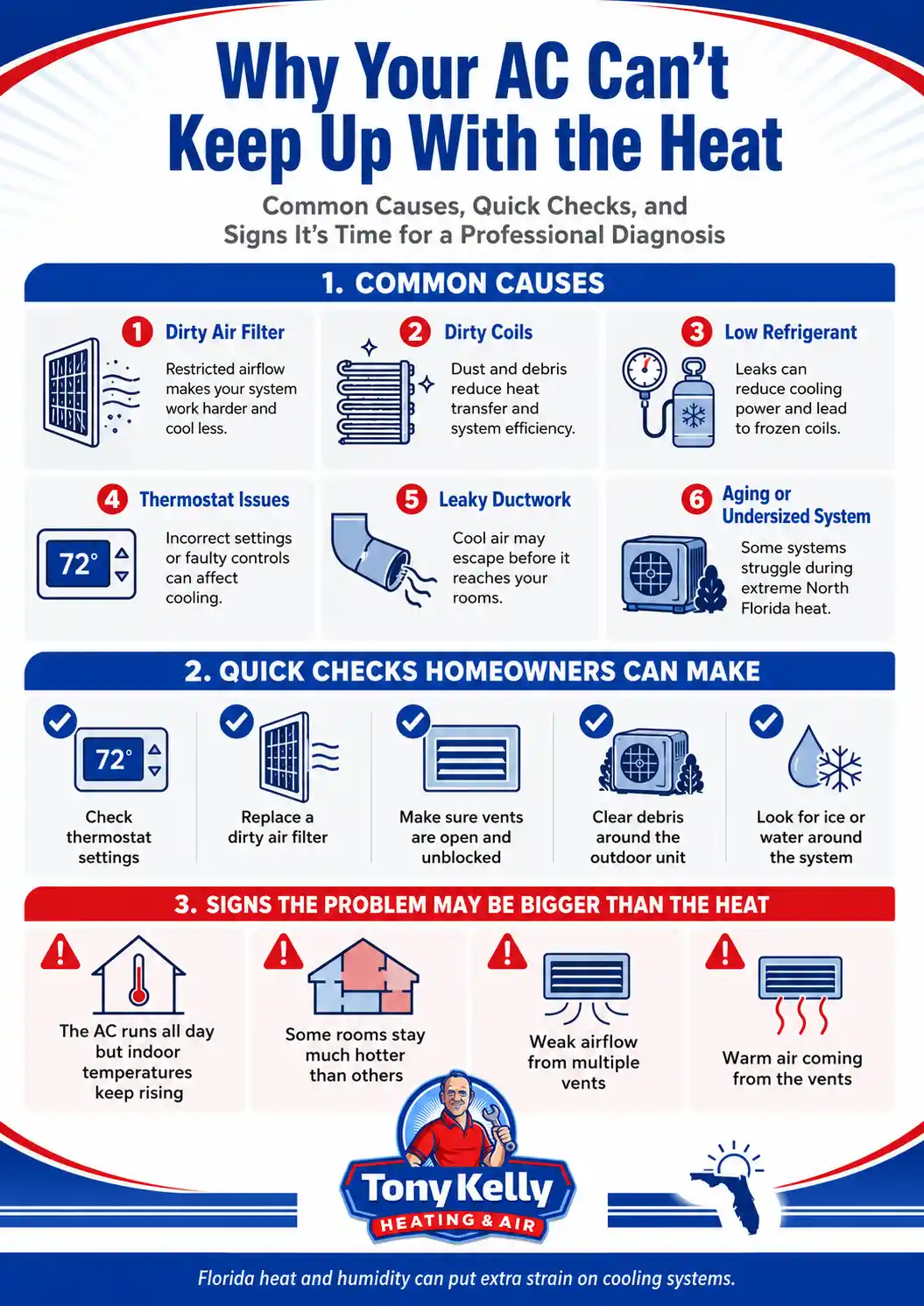
There is no single explanation for every cooling problem. When an air conditioner can’t keep up on hot days, the cause usually falls into one or more of the following categories.
A dirty air filter is one of the first things to check when your AC is struggling to cool the house. As dust, pet hair, pollen, and other particles collect on the filter, less air can pass through the HVAC system.
Restricted airflow creates several problems:
Remove the filter and inspect it. If the filter is gray, packed with debris, bent, damp, or difficult to see through, replace it with the correct size and type recommended for the equipment.
Do not automatically install the most restrictive filter available. A filter that is too restrictive for the system can reduce airflow even when it is clean. Homes with pets, renovation dust, heavy pollen, or frequent AC use may need more frequent filter checks.
Closed supply vents, furniture over return grilles, rugs covering floor registers, and heavy curtains blocking airflow can prevent the HVAC system from circulating air correctly.
Closing vents in unused rooms may seem like a way to redirect cooling, but a central AC system is designed around a specific amount of airflow. Closing too many vents can increase pressure in the duct system and contribute to uneven temperatures, air leakage, noise, and equipment strain.
Walk through the home and verify that:
If airflow remains weak throughout the house after checking the filter and vents, the issue may involve the blower, evaporator coil, ductwork, or another internal component.
The outdoor unit releases heat removed from inside the home. It needs clear airflow around the coil to perform this job efficiently.
Grass clippings, leaves, vines, pine needles, mulch, dirt, and storm debris can collect around or against the condenser. A fence, shrub, or object placed too close to the unit can also restrict airflow.
Homeowners can safely remove loose debris from around the cabinet and trim vegetation that is crowding the unit. Do not remove equipment panels, bend coil fins, reach near the fan, or spray electrical components.
A condenser coil can also become coated with dirt that is not easy to see from a distance. Professional maintenance may include inspecting and cleaning the coil using methods appropriate for the equipment.
The indoor evaporator coil absorbs heat from the air moving through the HVAC system. Dirt and debris on the coil act as insulation, limiting heat transfer.
A dirty evaporator coil can lead to:
The evaporator coil is usually located inside the indoor equipment and is not a practical DIY cleaning project. Opening the cabinet may expose electrical components, sharp metal, and delicate coil surfaces. A technician can inspect the coil and determine whether dirt, airflow, or refrigerant conditions are affecting it.
Refrigerant allows the HVAC system to absorb heat indoors and release it outside. It circulates through a closed system and should not need routine topping off.
If refrigerant is low, there is generally a leak or another condition that needs to be identified. Adding refrigerant without finding the source does not correct the underlying problem.
Possible signs of a refrigerant-related problem include:
Refrigerant work should be handled by a trained HVAC professional. The technician may evaluate pressures, temperatures, coil conditions, airflow, and the refrigerant circuit before recommending a repair.
A frozen coil cannot absorb heat properly, so the system may run while producing little or no useful cooling. Ice can result from restricted airflow, a dirty filter, a blower issue, low refrigerant, a dirty coil, blocked vents, or another performance problem.
Common symptoms include:
If you see ice, turn off the cooling mode. Continuing to run the system may worsen the freeze and add strain to the compressor. Do not chip ice from the coil or refrigerant lines. The source of the freeze still needs to be diagnosed after the ice melts.
The blower motor pushes air across the evaporator coil and through the ductwork. If the motor, fan wheel, control, or related component is not working correctly, cooled air may not reach the living areas.
You may notice:
Blower problems can resemble duct restrictions or a dirty filter. Professional testing can help separate mechanical, electrical, and airflow causes.
A thermostat problem can cause poor cooling even when the main HVAC equipment is capable of operating normally.
Possible thermostat issues include:
Confirm that the thermostat is set to cool and that the selected temperature is below the current indoor reading. Smart thermostat users should also review schedules, geofencing, energy-saving settings, and app controls.
If the thermostat does not reflect the actual room temperature or the HVAC system does not respond, the thermostat or the equipment controls may need testing.
A central AC system can produce cold air and still fail to cool the home if that air never reaches the rooms.
Duct problems may include:
Symptoms often include one room that never cools, noticeably weaker airflow in part of the house, high utility use, excessive dust, temperature differences between floors, or hot air entering from an attic or crawl space.
Some duct problems require visual inspection, airflow measurements, or pressure testing. Replacing the AC alone may not solve comfort issues when the duct system is the primary source of the problem.
As the AC removes moisture from humid indoor air, condensation flows through a drain line. Algae, dust, debris, and biological growth can restrict that line.
Many systems have a float switch designed to stop cooling if water backs up. This helps reduce the risk of overflow but can make it appear that the air conditioner suddenly stopped working.
Signs of a drain problem include:
If water is collecting around the equipment, turn the system off and address the drainage issue before continuing to operate it.
Capacitors, contactors, relays, wiring, breakers, and control boards help the AC start and continue operating. Heat and long runtimes can affect these parts, while storms and voltage fluctuations may contribute to sudden failures.
Electrical problems may cause:
Capacitors can retain an electrical charge even after the power is off. Electrical diagnosis and component replacement should be left to a trained technician.
The compressor circulates refrigerant through the system. When it overheats, wears down, or operates under poor conditions, cooling capacity can decline.
Compressor strain can be associated with:
Potential symptoms include loud humming, hard starting, frequent breaker trips, warm air, abnormal noise, or the outdoor unit failing to operate.
A compressor concern does not automatically mean the entire system must be replaced. The appropriate recommendation depends on the diagnosis, equipment age, overall condition, warranty status, and the extent of the problem. Tony Kelly Heating & Air’s overview of common AC repairs in Tallahassee explains several component failures homeowners encounter during the cooling season.
Homeowners are understandably concerned when a recently installed system struggles to cool the house. A new AC that can’t keep up with heat may not have an equipment-age problem, but installation and home-performance issues can still affect it.
System sizing should consider the home’s square footage, insulation, windows, orientation, air leakage, ceiling height, occupancy, and other heat-gain factors. Choosing equipment based only on the size of the previous unit or a simple rule of thumb can lead to poor results.
An undersized system may run continuously and fail to maintain temperature during peak heat. An oversized system can cool too quickly, shut off before removing enough humidity, and leave the house feeling damp or uneven.
New equipment still depends on correct blower settings, duct capacity, return-air pathways, and register balance. A high-efficiency unit cannot perform as designed if airflow is too low or the duct system cannot support it.
Installing a new indoor and outdoor unit does not automatically correct leaking, damaged, poorly insulated, or undersized ducts. If the old system had uneven cooling, those symptoms may continue unless the ductwork is evaluated.
Refrigerant charge, electrical connections, drain configuration, thermostat setup, equipment matching, and airflow settings all affect performance. A new system that has never cooled correctly should be evaluated as an installation and design issue rather than assumed to be normal.
Poor attic insulation, air leakage, unshaded windows, damaged weatherstripping, and direct afternoon sun can add more heat than expected. A new AC may be operating properly while the home allows heat to enter faster than the system can remove it.
When a new system cannot maintain comfort, a complete evaluation should include both HVAC performance and the building conditions affecting cooling demand.
When the entire house is warm, the issue may involve overall cooling capacity. When only certain rooms are uncomfortable, the problem is more likely connected to airflow, ductwork, insulation, sun exposure, or room-specific heat gain.
Common causes of uneven cooling include:
A room that has always been warm may have a design or insulation issue. A room that suddenly became warm may have a closed damper, duct failure, blocked register, or recent change affecting airflow.
Supplemental cooling may be useful for additions, garages, sunrooms, and areas without practical duct access. Tony Kelly Heating & Air explains how localized systems may affect comfort and energy use in its article about mini-splits and Tallahassee energy bills.
Many homeowners expect the AC to recover quickly after sunset. If the home remains warm late into the evening, stored heat or an HVAC problem may be delaying recovery.
Possible explanations include:
If the house cools gradually overnight and maintains comfort during milder weather, the system may be operating near its capacity during extreme conditions. If the home does not recover at all, or the air from the vents is not cool, the HVAC equipment should be inspected.
When you notice your AC not keeping up, use a calm, step-by-step approach. These checks may identify a simple issue and provide helpful information if professional diagnosis becomes necessary.
Make sure the thermostat is set to “cool,” not “heat,” “off,” or “fan.” Select a temperature below the current indoor reading and wait several minutes for the system to respond.
Review any programmed schedule or smart thermostat setting that could be changing the temperature. Avoid repeatedly lowering the setting. Setting the thermostat dramatically lower does not make a standard AC cool faster; it simply asks the system to run longer.
Replace a dirty filter with the correct size. Confirm that the airflow arrow points in the proper direction. If the filter becomes dirty again unusually quickly, the home may have heavy dust, duct leakage, return-air issues, or other conditions worth investigating.
Open supply vents and move objects away from return grilles. Compare airflow between rooms. Note whether the problem affects the whole house or only one area.
From a safe distance, check whether the unit is running and whether the fan is spinning. Remove loose leaves and debris from around the cabinet. Do not open the unit or touch electrical components.
Check visible refrigerant lines and the area around the indoor air handler. Ice, standing water, a full drain pan, or wet building materials are reasons to turn the cooling system off and investigate further.
Look for a breaker labeled AC, condenser, air handler, furnace, or HVAC. A tripped breaker may sit between the on and off positions. Reset it once by moving it fully off and then back on.
If it trips again, leave it off and arrange for an inspection. Repeated resetting can expose the equipment to additional stress and does not correct the cause.
While the system is working to recover, you can reduce the cooling load by:
Record the indoor temperature, thermostat setting, outdoor conditions, airflow, noises, and how long the system runs. This information can help identify whether the issue is related to peak outdoor heat, a specific room, equipment operation, or a developing mechanical problem.
Some actions may worsen the problem or create a safety risk.
A complete diagnosis looks beyond whether the equipment turns on. The objective is to determine how well the system is moving air, transferring heat, controlling humidity, and responding to the thermostat.
Depending on the symptoms and equipment, an HVAC technician may evaluate:
These measurements help distinguish between a repairable equipment problem, a duct or airflow issue, a home-performance concern, or a system that is no longer capable of meeting the home’s cooling demand.
Homeowners experiencing an AC that runs continuously, blows warm air, or cannot reach the thermostat setting can learn more about professional diagnostics through Tony Kelly Heating & Air’s AC repair services in Tallahassee.
Indoor air quality and comfort are closely connected. Excessive humidity can make the home feel warmer than the thermostat reading suggests. Dirty filters and coils can restrict airflow. Duct contamination, moisture, and poor ventilation may contribute to odors, dust, and uneven comfort.
Cooling problems connected to indoor air quality may include:
Air purification alone does not repair an AC performance problem, but filtration, dehumidification, duct condition, and airflow should be considered as part of the full comfort system.
Many North Florida homes use heat pumps for both cooling and heating. In cooling mode, a heat pump operates similarly to a central air conditioner by moving heat from inside the home to the outdoors.
A heat pump may struggle because of:
If your heat pump works in one mode but not the other, additional controls or components may need evaluation. Tony Kelly Heating & Air provides more information about heat pump repair and installation for Tallahassee-area homes.
A cooling problem does not automatically mean the system needs replacement. Repair may be practical when:
Examples may include replacing a failed capacitor, correcting a thermostat issue, clearing a drain, repairing a duct connection, cleaning coils, or correcting another specific fault.
Replacement becomes a more relevant discussion when several concerns overlap rather than because of one hot afternoon.
Factors that may support evaluating replacement include:
Before deciding, homeowners should understand whether the cooling problem comes from the equipment, the ducts, or the home. Replacing an AC without correcting severe duct leakage or poor airflow may leave the original comfort problem unresolved.
You cannot control Tallahassee’s outdoor temperature, but you can reduce unnecessary strain on the cooling system.
Check the filter regularly during periods of heavy use. The appropriate replacement schedule depends on filter type, household conditions, pets, dust, and HVAC runtime.
Remove loose debris and avoid placing landscaping, fences, storage, or decorative screens too close to the condenser.
Make sure furniture and household items do not interfere with airflow. Avoid closing large numbers of supply registers.
Close blinds, shades, or curtains on windows receiving direct afternoon sun. Exterior shade and properly selected window treatments can reduce heat gain.
Ceiling fans do not lower room temperature, but moving air can make occupied rooms feel more comfortable. Turn fans off when rooms are empty to avoid unnecessary energy use.
Ovens, dryers, dishwashers, computers, and lighting add heat indoors. Shifting some activities to the morning or evening can reduce the afternoon cooling load.
Inspect weatherstripping around doors and windows. Gaps can allow hot, humid outdoor air to enter and conditioned air to escape.
Insulation and duct sealing can reduce the amount of heat entering the home and help delivered air remain cooler.
Maintenance can identify dirty coils, weak components, drainage concerns, electrical wear, and airflow problems before they become more disruptive. Tony Kelly Heating & Air’s guide to preparing an HVAC system for Tallahassee’s summer heat covers additional seasonal steps.
Your AC may be struggling because of extreme outdoor conditions, high humidity, a dirty filter, blocked airflow, dirty coils, leaking ducts, low refrigerant, thermostat problems, electrical issues, an aging compressor, poor insulation, or incorrectly sized equipment. A small temperature difference during peak heat may be normal, but a home that becomes progressively warmer usually needs further investigation.
Check the thermostat, inspect the air filter, open supply vents, clear return grilles, look for debris around the outdoor unit, and check for visible ice or water. Reduce indoor heat gain by closing blinds and limiting appliance use. If the AC blows warm air, freezes, trips the breaker, leaks water, or fails to recover, arrange for professional diagnosis.
The system may be operating near its capacity, or it may have restricted airflow, dirty coils, low refrigerant, leaking ducts, thermostat inaccuracies, compressor problems, or excessive heat entering the home. Compare the air temperature and airflow at the vents and note whether the system recovers after sunset.
You do not necessarily need to turn off an AC simply because it is running for a long time. Turn it off if you see ice, smell burning, hear severe mechanical noises, notice water overflowing, or experience repeated breaker trips. Those symptoms may indicate a condition that could worsen with continued operation.
Lowering the thermostat does not make a standard single-stage air conditioner cool faster. It causes the system to continue running until it reaches the lower setting. Setting the thermostat far below a realistic indoor temperature may increase runtime without solving the underlying cooling problem.
Yes. A dirty filter restricts airflow through the system. This can reduce cooling performance, increase runtime, interfere with humidity removal, strain the blower, and contribute to a frozen evaporator coil.
The outdoor unit may be running while the indoor blower, evaporator coil, refrigerant circuit, ductwork, or thermostat is not functioning correctly. The condenser fan may also run even when the compressor is not operating normally. A full-system diagnosis is needed to determine where cooling is being lost.
A single hot room often points to a blocked vent, disconnected duct, insufficient return airflow, sun exposure, poor insulation, a long duct run, or a room that was added after the original HVAC system was designed.
High humidity increases the amount of work the system must perform and can make the home feel warmer. If the HVAC system is oversized, short cycling, experiencing airflow problems, or unable to drain condensation correctly, moisture control may become even more difficult.
A new AC may struggle because it is incorrectly sized, the airflow settings are wrong, the refrigerant charge needs verification, the thermostat is not configured properly, or the existing ductwork cannot support the equipment. Poor insulation and high heat gain may also affect performance.
Yes. Leaking supply ducts can release cooled air into an attic, crawl space, or wall cavity. Leaking return ducts may pull hot, humid, dusty air into the HVAC system. Both conditions can increase runtime and reduce comfort.
If the air leaving the vents is cool and airflow is strong but the house remains hot, insulation, windows, air leakage, duct losses, or unusual heat gain may be contributing. If vent air is warm or airflow is weak, the HVAC equipment or duct system may be the primary issue. Measurements are usually needed for a reliable answer.
Ceiling fans can make occupied rooms feel more comfortable by moving air across the skin, but they do not lower the room temperature or repair an AC problem. Use them as a comfort aid while continuing to evaluate why the cooling system is struggling.
Professional service is appropriate when the AC blows warm air, airflow is weak throughout the house, the system freezes, the breaker repeatedly trips, water collects around the unit, unusual odors or noises appear, cooling performance suddenly declines, or basic checks do not improve the problem.
When your AC cannot keep up with the heat, the outdoor temperature may be only one part of the explanation. The system, ductwork, thermostat, humidity level, insulation, and the way heat enters the home all work together.
Start with safe homeowner checks: verify the thermostat, inspect the filter, open vents, clear the outdoor unit, and look for ice or water. Pay attention to whether the problem affects the whole home or only certain rooms. Note whether the system produces cool air, whether airflow feels normal, and whether the home recovers after the hottest part of the day.
If the house continues getting warmer while the AC runs, the system repeatedly shuts down, or comfort has noticeably declined, a full HVAC evaluation can identify the reason. Tony Kelly Heating & Air provides HVAC repair in Tallahassee for airflow problems, thermostat concerns, cooling failures, heat pump issues, electrical problems, and systems that no longer keep up with North Florida heat.
Address:
870 Blountstown Hwy. Unit # 9
Tallahassee, FL 32303
Phone: 850-385-3774
License #: CMC1249702
Open Monday Through Friday
8:00 am to 8:00 pm

