
What Is a Whole Home HVAC System?
A whole home HVAC system is the traditional central heating and cooling setup found in many Florida homes. It typically includes one indoor air handler, one outdoor condenser or heat pump, one duct system, and one main thermostat. When the thermostat senses that the temperature is above or below your setting, the HVAC system turns on and sends conditioned air throughout the home.
This setup is simple and familiar. You choose one temperature at the thermostat, and the system works to bring the whole house to that setting. For a smaller single-story home, a compact layout, or an open floor plan, this can work well. The system does not have to decide which rooms need air. It simply conditions the home as one space.
The challenge is that most homes do not heat and cool evenly. A bedroom with afternoon sun may feel warmer than the hallway where the thermostat is located. A bonus room above a garage may stay hotter than the rest of the house. A room at the end of a long duct run may feel stuffy, while the room closest to the air handler feels too cold.
These comfort differences are common. If your AC seems to run normally but your home still feels uneven, it may help to review the signs that your system is not operating efficiently. Tony Kelly HVAC’s guide on how to tell if your AC is running efficiently is a helpful companion topic because it explains what homeowners can watch for before assuming they need a different system design.
Whole home HVAC systems are not a poor choice. They are common because they are dependable, straightforward, and often the most practical option. But they work best when the home has balanced ductwork, consistent insulation, and rooms with similar heating and cooling needs.
What Is an HVAC Zoning System?
An HVAC zoning system divides a home into separate comfort areas. Each zone has its own thermostat or sensor. Instead of one thermostat controlling the full house, multiple thermostats communicate with a zone control panel. The system then uses motorized dampers inside the ductwork to direct air to the areas that need heating or cooling.
For example, a two-story home may have one zone downstairs and one zone upstairs. A larger home might have a bedroom zone, a living area zone, and a bonus room zone. A home with a frequently used office may benefit from making that office part of a separate zone so it can stay comfortable during work hours without overcooling the rest of the house.
A zoning system usually includes:
- Multiple thermostats or temperature sensors
- A zone control panel
- Motorized dampers inside the ductwork
- Properly sized ductwork for each zone
- Compatible HVAC equipment
- Professional setup and airflow testing
Some homeowners think zoning is the same as closing vents in unused rooms. It is not. A real zoning system is designed to manage airflow and pressure. Closing vents by hand can restrict airflow without giving the system a way to respond. That can increase duct pressure, strain the blower, reduce efficiency, or make comfort problems worse.
If your home already has noticeable hot and cold spots, zoning may be one possible solution, but it should not be considered in isolation. It is also worth reviewing common system issues, such as weak airflow, thermostat problems, and duct concerns. The Tony Kelly HVAC article on common HVAC problems can help homeowners understand whether the issue may be related to the system itself before moving toward a zoning system setup.
How HVAC Zoning Systems Work
A zoned HVAC system works by combining thermostat control with duct control. Each zone thermostat monitors the temperature in its area. When a zone needs cooling or heating, that thermostat sends a signal to the zone control panel. The control panel tells the HVAC equipment to run and tells the correct dampers to open.
Imagine a North Florida home with three zones: bedrooms, living areas, and a bonus room. During the day, the living area and home office may need cooling, while the bedrooms do not need as much conditioned air. At night, the bedrooms may need more cooling, while the living room can be set slightly warmer. A zoning system allows those areas to operate based on real usage instead of forcing the entire house to follow one thermostat schedule.
This is especially useful in homes where comfort needs change throughout the day. Many households spend mornings in bedrooms and bathrooms, afternoons in living spaces, and evenings in bedrooms again. A whole home system cools everything whenever the main thermostat calls. A zoned system can focus airflow on the spaces being used.
Smart thermostats can also play a role in this conversation. A smart thermostat alone does not create zones, but smart controls can help manage schedules and temperature settings more carefully. If thermostat control is part of the issue, review Tony Kelly HVAC’s guide on the benefits of installing a smart thermostat before deciding whether zoning is the next logical step.
Ductwork is also critical. A zoning system depends on the duct system’s ability to move air properly. If ducts are undersized, disconnected, dirty, or poorly sealed, zoning may not solve the comfort problem. The U.S. Department of Energy explains that duct sealing can improve comfort and efficiency by reducing air loss through leaks. Their resource on duct sealing and home energy efficiency is a helpful outbound reference for homeowners comparing HVAC system designs.
How Whole Home HVAC Systems Work
A whole home HVAC system uses one thermostat as the main control point. When the thermostat calls for cooling, the outdoor unit and indoor blower turn on. Conditioned air moves through the duct system and exits supply vents throughout the house. Return air is pulled back to the air handler, conditioned again, and redistributed.
This design works well when airflow is balanced and the home has similar comfort needs from room to room. A compact, single-story home with good insulation and a central thermostat may not need zoning. The entire home may respond well to one temperature setting.
Whole home systems are also easier for many homeowners to operate. There is one thermostat, one schedule, and one set of equipment cycles. If most rooms are used regularly and the household is comfortable with one shared temperature, the single-zone approach can make sense.
However, whole home HVAC systems can become frustrating when rooms behave differently. A hallway thermostat may not reflect what is happening in a bedroom with direct sun. A living room with tall windows may gain heat quickly. A closed bedroom door can reduce return airflow and make that room feel stuffy. An addition or enclosed porch may have different comfort needs than the original home.
When whole home systems start showing comfort problems, homeowners often lower the thermostat, run fans constantly, close vents, or keep doors open to help air move. These workarounds may help temporarily, but they do not always solve the underlying issue. If the problem is severe or sudden, the homeowner may need basic troubleshooting first. Tony Kelly HVAC’s guide on what to do if your HVAC unit goes out is useful for understanding system-level issues before assuming the home needs zoning.
HVAC Zoning vs Whole Home HVAC: The Main Difference
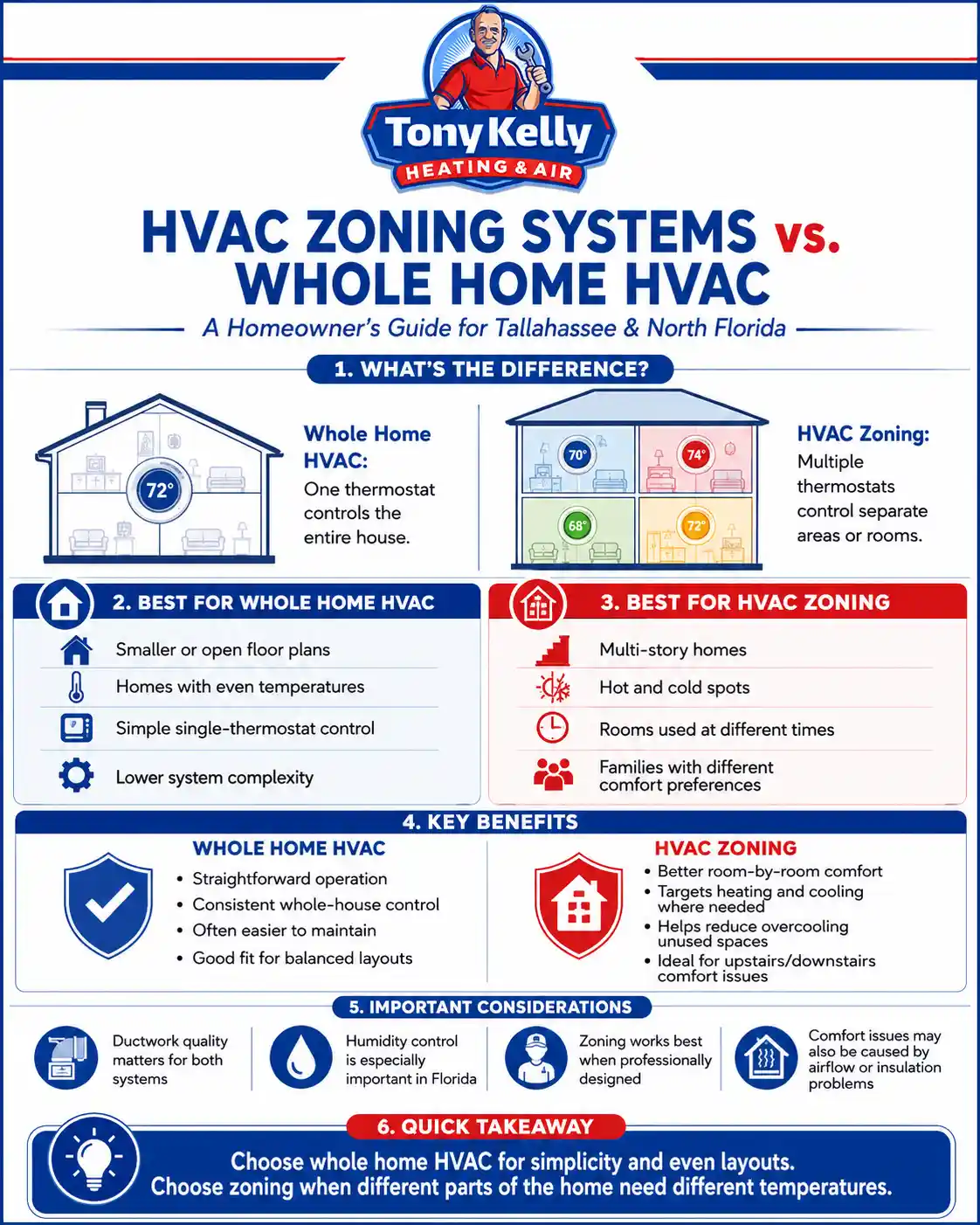
The main difference is control. A whole home HVAC system controls the entire house from one thermostat. An HVAC zoning system controls different areas separately.
That difference affects how comfort is delivered. With a whole home system, every room receives conditioned air whenever the system runs, whether the room needs it or not. With a zoning system, conditioned air can be directed toward specific areas based on thermostat demand.
Here is the simple comparison:
- Whole home HVAC: One thermostat, one comfort setting, one system response for the entire house.
- HVAC zoning system: Multiple thermostats, multiple comfort settings, targeted airflow to specific areas.
If your home feels consistent from room to room, a whole home system may be enough. If your home has uneven temperatures, different comfort preferences, or spaces used at different times, zoning may provide better control.
This comparison is not about one option being automatically better. A well-designed whole home system can outperform a poorly designed zoning system. A properly designed zoning system can solve comfort problems that a standard single-zone system cannot. The best option depends on home layout, duct condition, equipment compatibility, and how your household uses the space.
Comfort Differences Between Zoned and Whole Home Systems
Comfort is usually the first reason homeowners ask about zone control systems installation. They are not always looking for advanced equipment. They are trying to solve a daily frustration: one bedroom is too warm, the upstairs never feels right, the living room gets cold before the office cools down, or the thermostat says 74 degrees but the house does not feel that way everywhere.
A whole home system can maintain a general comfort level, but it may not solve room-by-room differences. It relies on the idea that every area responds similarly to heating or cooling. That is often not true in Florida homes. Sun exposure, attic heat, insulation levels, duct length, ceiling height, and window quality all affect how a room feels.
An HVAC zoning system gives each area more independence. The bedroom zone can stay cooler at night. The guest room can be set differently when it is not being used. The home office can stay comfortable during the day without lowering the temperature for the entire home. This can make the house feel more natural because comfort follows daily routines.
Zoning can also reduce thermostat disagreements. In a traditional system, one setting has to work for everyone. If someone wants the bedroom colder and someone else feels cold in the living room, the household has to compromise. With zoning, different areas can be set for different needs, within the limits of the equipment and system design.
That said, zoning is not a cure-all. If a room is uncomfortable because of poor insulation, a disconnected duct, a blocked return, or a failing HVAC system, zoning alone may not solve the problem. A good zoning evaluation should look at the full system, not just thermostats and dampers.
Energy Efficiency Differences
Energy efficiency is another major reason homeowners compare HVAC zoning systems to whole home systems. In theory, zoning can improve efficiency because it reduces the need to condition unused spaces. If you are only using the bedrooms at night, the system may not need to cool the main living areas to the same level. If a home office is used during the day, the system can focus on that zone instead of the entire home.
This can be helpful in North Florida, where cooling demand can last for much of the year. Any system design that reduces unnecessary runtime may help manage energy use. Zoning may also help reduce wear by preventing the system from overcooling the whole house just to satisfy one warm area.
However, energy savings depend heavily on design and behavior. If every zone is kept at the same temperature all day, the zoning system may not save much energy compared to a whole home system. If the ductwork is leaky or undersized, zoning may not perform well. If the equipment is oversized, humidity removal may suffer because the system cools too quickly and does not run long enough to pull moisture from the air.
Whole home systems can also be efficient when installed correctly. A properly sized system, clean filter, sealed ducts, good insulation, and smart thermostat settings all matter. For more homeowner-friendly efficiency ideas, Tony Kelly HVAC’s guide on energy-saving tips to enhance HVAC efficiency gives practical ways to reduce strain before investing in larger system changes.
ENERGY STAR also provides useful information on smart thermostats and how they can help manage heating and cooling schedules. Smart controls can benefit both zoned and whole home systems when they are compatible and used correctly.
The key is not simply choosing zoning and assuming energy bills will drop. The key is matching the system to the home, designing airflow correctly, and using the controls in a way that reflects real occupancy patterns.
Humidity Control in Florida Homes
Humidity is one of the biggest comfort factors in Tallahassee and North Florida. A home can technically be at the thermostat setting and still feel uncomfortable if indoor humidity is high. This is why HVAC design matters so much in Florida. Air conditioning does not only cool the air. It also removes moisture as air passes over the evaporator coil.
Whole home systems can manage humidity well when they are properly sized and maintained. If the system runs long enough, it has time to remove moisture. But if the system is too large, it may cool the house quickly and shut off before removing enough humidity. That can leave rooms feeling clammy or heavy even when the temperature looks right.
Zoning can help comfort by sending cooling where it is needed, but it must be designed carefully. If a small zone calls for cooling and the equipment is not able to operate efficiently at that reduced load, the system may short cycle. Short cycling can reduce humidity removal, increase wear, and create uneven comfort.
For Florida homes, humidity should always be part of the zoning conversation. Homeowners should ask how the system will maintain airflow across the coil, how it will manage smaller zone calls, and whether additional humidity control is needed. Tony Kelly HVAC’s article on how whole-home dehumidifiers work in Florida’s humid climate is a strong supporting resource for homeowners trying to understand the difference between cooling and moisture control.
The EPA’s guidance on mold and moisture also explains that moisture control is key to preventing mold growth indoors. Their guide to mold, moisture, and your home is a helpful reference for understanding why humidity control matters in a climate like ours.
In a humid climate, the best HVAC solution is not just the one that reaches the thermostat setting. It is the one that cools evenly, removes moisture properly, and maintains healthy airflow.
When an HVAC Zoning System Makes the Most Sense
An HVAC zoning system is often worth considering when a home has areas with clearly different comfort needs. This is common in larger homes, multi-story homes, homes with additions, and homes with rooms that receive different sun exposure throughout the day.
Zoning may make sense if:
- Your upstairs is consistently warmer than the downstairs.
- Bedrooms are uncomfortable at night unless the rest of the house is overcooled.
- You have a home office, bonus room, or guest suite with different usage patterns.
- Some rooms are rarely used but still receive conditioned air all day.
- Family members prefer different temperatures in different areas.
- Your home has large windows, vaulted ceilings, or areas with heavy afternoon sun.
- You are building a new home or planning a major renovation.
New construction is often one of the best times to plan for zoning because the ductwork can be designed around zones from the beginning. Retrofitting zoning into an existing home can still work, but it depends on duct layout, access, equipment compatibility, and airflow requirements.
If you are already planning a larger HVAC project, it may be useful to understand what the installation process involves. Tony Kelly HVAC’s guide on what to expect during HVAC installation gives helpful context for homeowners comparing zoning, replacement, and system design options.
For example, a multi-story home in North Florida may be a strong candidate for zoning because upstairs and downstairs loads are often different. The upstairs collects heat, while downstairs may remain shaded and cooler. With one thermostat downstairs, the system may not run long enough for upstairs comfort. With zoning, upstairs can receive cooling when it needs it.
When a Whole Home HVAC System Makes More Sense
A whole home HVAC system may be the better option when the home is smaller, more open, or already comfortable with one thermostat. Not every home needs zoning. If your current comfort issues are minor or caused by maintenance problems, the best solution may be service, duct balancing, insulation improvements, or thermostat adjustments rather than a full zoning system setup.
A whole home system may make sense if:
- Your home is single-story and temperatures are fairly even.
- Your floor plan is open and zones would not be clearly separated.
- Most rooms are used throughout the day.
- Your household is comfortable with one thermostat setting.
- Your ductwork is not designed in a way that supports zoning easily.
- You want a simpler system with fewer components to maintain.
- Your main concern is replacing old equipment, not solving room-by-room comfort issues.
Whole home systems are often practical and reliable. A properly sized modern HVAC system can provide steady comfort when the ductwork is well designed and the home envelope is in good condition. For many North Florida homes, a whole home system paired with a smart thermostat, clean ducts, routine maintenance, and good air sealing may be enough.
If a homeowner is dealing with an aging system that struggles to cool the whole house, zoning may not be the first step. The equipment itself may need evaluation. A zoning retrofit will not fix a failing compressor, weak blower motor, low refrigerant issue, or severely undersized system. If your system is older and you are unsure whether repair or replacement is the better path, the guide on AC repair vs. AC replacement in Tallahassee can help frame that decision.
Cost Considerations Without Focusing Only on Price
Homeowners naturally ask about HVAC zoning system installation cost, dual zone HVAC system cost, and the cost to add zones to an existing HVAC system. Cost is important, but the cheapest option is not always the best comparison point. A zoning system and a whole home system are not identical solutions. They solve different comfort problems.
A whole home system usually has a lower upfront cost because it has fewer parts. It may require one thermostat, standard duct connections, and one control strategy. A zoning system requires additional thermostats, dampers, wiring, control panels, and design time. If ductwork modifications are needed, the project becomes more involved.
However, upfront cost should be weighed against comfort value and long-term performance. If a homeowner keeps lowering the thermostat to cool one room, the whole home system may run longer than necessary. If zoning solves that problem, it may reduce unnecessary runtime. If a homeowner is constantly uncomfortable in a second-floor bedroom, the value of zoning may be comfort rather than simple monthly savings.
The most useful way to think about cost is to ask:
- What problem am I trying to solve?
- Is the problem caused by system design, ductwork, insulation, equipment age, or thermostat placement?
- Will zoning solve the problem, or is another improvement needed first?
- Will the home’s layout allow zones to operate independently?
- Will the current HVAC equipment work with zoning?
A zoning system should be viewed as a design solution, not just an add-on. If the home is a good candidate, it can improve comfort significantly. If the home is not a good candidate, the money may be better spent on duct sealing, HVAC replacement, insulation, or maintenance. Homeowners who are budgeting for equipment upgrades may also want to review available HVAC specials and deals in Tallahassee as part of the planning process.
Retrofitting Zoning Into an Existing HVAC System
Many homeowners ask whether they can add zoning to an existing HVAC system. The answer is sometimes yes, but it depends on the system. Retrofitting zoning is more complicated than installing a second thermostat. It requires access to the ductwork, room-by-room load evaluation, damper placement, wiring, and control compatibility.
The duct system is usually the biggest factor. If the ductwork already separates naturally into upstairs and downstairs branches, zoning may be easier. If all ducts are tightly connected in a way that does not allow clean separation, the project may be more difficult. If ducts are damaged, undersized, or poorly sealed, those issues should be corrected before zoning is added.
The HVAC equipment also matters. Some systems handle zoning better than others. Variable-speed and multi-stage equipment may be better suited for zoning because they can adjust output more smoothly. Single-stage systems can still be zoned in some cases, but airflow and pressure management become especially important.
A zoning system retrofit may include:
- Inspecting current ducts and airflow
- Identifying practical zone boundaries
- Adding motorized dampers
- Installing additional thermostats or sensors
- Connecting a zone control board
- Testing static pressure and airflow
- Adjusting system settings after installation
For a deeper service-level explanation, homeowners can review Tony Kelly HVAC’s page on HVAC zoning system installation. That page is a better fit for readers who have moved beyond general comparison and want to understand what professional zoning installation involves.
Homeowners should be cautious of any zoning recommendation that does not include a ductwork evaluation. If airflow is not addressed, the system may create new problems while trying to solve old ones.
Zoning in New Construction and Major Renovations
Zoning is often easier to plan during new construction or a major renovation. When walls, ceilings, and duct chases are open, the HVAC contractor can design duct routes around clear comfort zones. This may lead to cleaner airflow, better damper placement, and more predictable performance.
New construction also allows homeowners to think about how each part of the home will be used. Bedrooms may become one zone. Main living areas may become another. A bonus room, media room, or guest suite may become a separate zone. Planning early can reduce the need for future retrofits.
For North Florida homes, new construction zoning should also consider humidity, attic heat, insulation levels, and solar gain. A room with large windows may need a different load calculation than an interior bedroom. A second-floor area may need more cooling attention than a shaded first-floor space.
If the home is being built or the HVAC system is being replaced, it may also be worth reviewing the broader HVAC installation process. Tony Kelly HVAC’s page on HVAC installation in Tallahassee can help homeowners understand how system design, sizing, ductwork, and equipment selection fit together.
The best time to ask about zoning is before the ductwork is finalized. Once ducts are installed and drywall is complete, changes become more expensive. If you are building or remodeling, ask whether zoning makes sense during the design stage rather than after comfort problems appear.
Common Misconceptions About HVAC Zoning
Misconception 1: Zoning is the same as closing vents
Closing vents is not the same as installing a zoning system. A zone control system uses dampers, thermostats, and a control board to manage airflow intentionally. Closing vents by hand can restrict airflow without giving the system a way to respond properly. This can increase pressure and strain the equipment.
Misconception 2: Zoning always lowers energy bills
Zoning can reduce wasted energy, but savings depend on how the system is designed and used. If all zones are set to the same temperature all day, savings may be limited. If the ductwork leaks or the equipment is oversized, performance may suffer. Zoning works best when controls are used thoughtfully.
Misconception 3: Every home is a good zoning candidate
Some homes benefit greatly from zoning. Others do not. Small open homes may not have enough separation between spaces to justify zoning. Homes with poor duct design may need duct improvements first. A professional evaluation should determine whether zoning is the right fix.
Misconception 4: Zoning replaces maintenance
Zoning does not replace regular HVAC maintenance. Filters still need changing. Coils still need inspection. Drain lines still need to stay clear. Ducts still need to be clean and sealed. A zoning system adds control, but the underlying HVAC equipment still needs care. For more on that, read Tony Kelly HVAC’s guide to the benefits of preventative HVAC maintenance.
How Ductwork Affects Both System Types
Ductwork is one of the most important parts of this decision. Whether you choose a whole home system or a zoning system, the ducts have to move air properly. Poor duct design can make a new system feel disappointing, even if the equipment itself is high quality.
In a whole home system, ducts must distribute air evenly to each room. If one branch is too long, crushed, disconnected, or undersized, that room may never receive enough airflow. The thermostat may be satisfied before the room gets comfortable.
In a zoning system, ductwork becomes even more important because airflow changes based on zone calls. When one zone closes, air must be managed safely and efficiently. The system needs enough return air, proper supply sizing, and pressure control. Without that, zoning can create noise, pressure issues, or short cycling.
Duct cleaning, sealing, balancing, and repair may be part of the planning process. Homeowners should not think of zoning as separate from ducts. Zoning is a duct-based control strategy. The better the duct system, the better the zoning system can perform. If duct cleanliness or airflow is part of the concern, Tony Kelly HVAC’s page on air duct cleaning in North Florida is a relevant next step.
If indoor air quality is also part of the concern, especially in homes with dust, humidity, or stale air, the article on ways to improve indoor air quality can help connect ductwork, filtration, humidity, and airflow into one bigger picture.
How Thermostats Fit Into the Decision
Thermostats are the control point for both system types, but they play a larger role in zoning. A whole home system usually relies on one thermostat in a central location. If that location does not represent the whole house, comfort issues may appear.
In zoning, each thermostat or sensor represents a separate area. Placement matters. A thermostat should not be installed in direct sunlight, near a supply vent, close to a kitchen heat source, or in an area that does not reflect the zone’s normal comfort conditions.
Smart thermostats can be useful in both whole home and zoned systems, but compatibility matters. Not every thermostat works with every zone control system. Some zoning setups require specific controls, while others can integrate with smart thermostat platforms. The goal is to have controls that are easy for the homeowner to use, not so complicated that schedules are ignored.
A zoning system only helps if the household uses it correctly. Setting every zone to the same aggressive temperature all day may reduce the benefits. Thoughtful scheduling is part of the value.
Maintenance Differences Between Zoning and Whole Home Systems
Whole home systems are generally simpler to maintain because there are fewer control components. Routine maintenance focuses on the equipment, filter, coils, refrigerant performance, drain line, thermostat, and ductwork.
Zoning systems require those same maintenance tasks, plus attention to the zone controls. Dampers should open and close properly. Thermostats should communicate with the control panel. Wiring should remain secure. Zone settings should be checked if comfort problems appear.
That does not mean zoning is difficult to maintain, but it does mean there are more parts involved. A homeowner should understand that zoning is a comfort-control system, not a set-it-and-forget-it accessory. During maintenance visits, the technician should be able to verify that each zone calls correctly and that dampers respond as intended.
For North Florida homes, maintenance is especially important because systems often run for long periods during hot and humid weather. Dirty coils, clogged filters, blocked drain lines, and weak airflow can affect both comfort and humidity control. Whether zoned or whole home, the system needs regular attention to perform well. For a broader seasonal approach, review Tony Kelly HVAC’s spring HVAC maintenance checklist.
Which System Is Better for Multi-Story Homes?
Multi-story homes are among the most common candidates for HVAC zoning. Heat rises, and upstairs areas often gain more heat from the attic and roof. Downstairs spaces may stay cooler because they are shaded or because cool air settles. This can create a noticeable temperature difference between floors.
With a whole home system, the thermostat may be downstairs or in a central hallway. If downstairs reaches the set temperature first, the system shuts off before upstairs gets comfortable. Lowering the thermostat may cool upstairs eventually, but downstairs can become too cold.
Zoning allows each floor to call for cooling separately. Upstairs can receive more attention when it needs it, while downstairs can remain at a comfortable setting. This can be especially helpful at night when bedrooms are upstairs and the main living spaces are not being used.
However, zoning still has to be designed correctly. If the upstairs zone is too small or the ductwork cannot handle zone changes, the system may short cycle. A professional load calculation and airflow evaluation are important before deciding.
Which System Is Better for Smaller Homes?
Smaller homes often do well with a whole home HVAC system. If the layout is open and rooms are close together, separate zones may not provide much benefit. Air naturally mixes between spaces, and multiple thermostats could add complexity without solving a real problem.
In a smaller home, comfort issues may be caused by duct balance, insulation, windows, or maintenance rather than the lack of zoning. Before adding zone control, it may make more sense to inspect the system, clean or seal ducts, improve return airflow, adjust thermostat settings, or upgrade aging equipment.
That said, some smaller homes still benefit from zoning if they have unique layouts. A converted garage, sunroom, addition, or enclosed porch may behave differently from the rest of the house. In those cases, zoning or a ductless mini-split may be considered depending on the structure and comfort goals. If you are also weighing ductless options, Tony Kelly HVAC’s comparison of mini-split vs. central AC in Tallahassee may help clarify when a separate comfort solution makes sense.
Questions to Ask Before Choosing Between Zoning and Whole Home HVAC
Before deciding, homeowners should look beyond the equipment and think about the home as a system. HVAC performance is affected by ductwork, insulation, windows, humidity, daily schedules, and household preferences.
Helpful questions include:
- Which rooms are uncomfortable, and when do they feel that way?
- Are temperature problems seasonal or year-round?
- Does the upstairs feel different from the downstairs?
- Do some rooms receive more sun than others?
- Are certain rooms used only part of the day?
- Is the ductwork accessible for damper installation?
- Has the HVAC system been maintained recently?
- Are there signs of duct leakage, weak airflow, or blocked returns?
- Is the current system properly sized for the home?
- Would a smart thermostat schedule solve part of the issue?
These questions help avoid choosing the wrong solution. If the problem is a dirty filter, zoning is not the answer. If the problem is a duct design issue, zoning may help only after duct repairs are made. If the problem is that different parts of the house genuinely need different temperatures, zoning may be a strong option.
For homeowners who still have broader questions about system behavior, Tony Kelly HVAC’s HVAC FAQs provide additional context on common heating and cooling questions.
Final Comparison: HVAC Zoning System vs Whole Home HVAC System
| Category | HVAC Zoning System | Whole Home HVAC System |
|---|---|---|
| Control | Multiple zones with separate thermostats or sensors | One thermostat controls the full home |
| Comfort | Better for room-by-room or floor-by-floor differences | Best when the whole home has similar comfort needs |
| Efficiency potential | Can reduce wasted conditioning in unused areas | Can be efficient when properly sized, sealed, and maintained |
| Upfront complexity | Higher due to dampers, controls, wiring, and design | Lower because the setup is simpler |
| Best fit | Large homes, multi-story homes, varied schedules, comfort differences | Smaller homes, open layouts, consistent room use |
| Ductwork needs | Requires careful duct evaluation and pressure management | Requires balanced airflow throughout the house |
Frequently Asked Questions About HVAC Zoning and Whole Home Systems
What is AC zoning in Florida?
AC zoning in Florida is a way of dividing a home into separate cooling areas so each area can be controlled by its own thermostat or sensor. Instead of cooling the entire house the same way every time the system runs, a zoned system directs conditioned air to the spaces that need it. This can be helpful in Florida homes because heat, humidity, sun exposure, and multi-story layouts often create uneven comfort from room to room.
Is an HVAC zoning system better than a whole home HVAC system?
An HVAC zoning system is better for some homes, but not all homes. Zoning is usually better when the home has clear temperature differences, multiple floors, rooms used at different times, or family members with different comfort preferences. A whole home HVAC system may be better for smaller homes, open layouts, or homes that already feel comfortable with one thermostat. The better choice depends on the home’s layout, ductwork, equipment, and comfort goals.
Can I add zoning to my existing HVAC system?
In some homes, yes. Adding zoning to an existing HVAC system is called a retrofit. It may involve adding dampers, thermostats, wiring, and a zone control panel. However, not every duct system is a good candidate. A contractor should inspect the ductwork, airflow, equipment size, and return air before recommending a zoning system retrofit.
Does HVAC zoning save energy?
HVAC zoning can help reduce wasted energy when it is designed well and used correctly. The main energy benefit comes from conditioning occupied areas instead of cooling or heating the entire home equally all day. Savings depend on thermostat habits, duct condition, home layout, system size, and how often each zone is used.
Is zoning useful for multi-story homes?
Yes, zoning is often useful for multi-story homes because upstairs and downstairs areas usually have different cooling needs. Upstairs rooms often collect more heat, especially during summer. A zoned system can let the upstairs call for cooling without overcooling the downstairs.
Is zoning worth it for a small house?
Zoning may not be worth it for a small house if the layout is open and temperatures are already consistent. In smaller homes, duct balancing, maintenance, smart thermostat settings, or equipment upgrades may be more practical. However, zoning could still help if the small home has an addition, sunroom, converted garage, or room with very different comfort needs.
How many zones should a house have?
The right number of zones depends on the home. Many homes use two zones, such as upstairs and downstairs. Larger homes may use three or more zones, such as bedrooms, living areas, and bonus rooms. Too many zones can make the system more complicated, so zones should be based on real comfort differences and ductwork design.
What is a zone control system?
A zone control system is the set of components that manages airflow in a zoned HVAC setup. It usually includes thermostats, a control board, motorized dampers, and wiring. The system receives signals from each thermostat and opens or closes dampers to send air to the zones that need heating or cooling.
What is the difference between a zone control system and a smart thermostat?
A smart thermostat controls temperature settings and schedules. A zone control system controls airflow to different areas of the home. Some zoning systems use smart thermostats, but a smart thermostat by itself does not create zones unless the ductwork has dampers and a control panel designed for zoning.
Can zoning fix hot and cold spots?
Zoning can help fix hot and cold spots when those issues are caused by different comfort needs between areas of the home. However, if hot and cold spots are caused by duct leaks, poor insulation, blocked vents, low refrigerant, or equipment problems, those issues should be corrected first.
Can closing vents create a zoning effect?
No. Closing vents is not the same as zoning. A zoning system uses dampers and controls designed to manage airflow safely. Closing vents manually can increase duct pressure and may strain the system. If certain rooms do not need as much airflow, it is better to have the ductwork evaluated than to rely on closed registers.
Does zoning help with humidity?
Zoning can improve comfort, but humidity control depends on system design. In Florida, the HVAC system needs enough runtime to remove moisture from the air. If zoning causes the system to short cycle, humidity control may suffer. A zoning system should be designed with airflow, equipment capacity, and moisture removal in mind.
Can a single-stage HVAC system be zoned?
Some single-stage HVAC systems can be zoned, but they require careful design. Since single-stage equipment runs at one output level, the system must manage airflow safely when only one zone is calling. Multi-stage or variable-speed equipment may offer smoother zoning performance, but the best option depends on the home.
Is zoning better for new construction?
Zoning is often easier to include in new construction because the ductwork can be designed around zones from the start. This can lead to better airflow, cleaner damper placement, and fewer retrofit challenges. Homeowners building a new home should ask about zoning early in the design process.
What should I ask before installing an HVAC zoning system?
Ask whether your ductwork can support zoning, whether your current equipment is compatible, how many zones make sense, how airflow pressure will be managed, and whether zoning will solve the actual comfort problem. A good evaluation should include more than thermostat placement. It should look at airflow, duct condition, insulation, humidity, and equipment performance.
Final Thoughts: Which Option Should You Choose?
Comparing HVAC zoning systems to whole home HVAC systems comes down to comfort control, home layout, and system design. A whole home HVAC system is simple, reliable, and often the right choice for smaller homes or homes with consistent temperatures. An HVAC zoning system offers more control and can be a strong solution for multi-story homes, larger homes, and households with different room-by-room comfort needs.
For Tallahassee and North Florida homeowners, the decision should also include humidity, ductwork, storm-season reliability, and long cooling seasons. A system that looks good on paper may not perform well if the ducts are leaky, the equipment is oversized, or the home has unresolved airflow issues. Before choosing zoning or staying with a whole home system, it helps to have the full system evaluated.
The best HVAC setup is the one that fits the home, supports healthy airflow, manages humidity, and keeps the people inside comfortable without making the system work harder than necessary.

