CALL US 850-385-3774
Your home air conditioner is made up of many individual components working together to move heat from inside your home to the outdoors. Understanding the basic parts of an air conditioner can make it easier to understand what your HVAC technician is talking about, recognize where a problem may be developing, and make more informed decisions about maintenance and repairs.
A typical central air conditioning system includes both indoor and outdoor AC components. The indoor side handles airflow, heat absorption, filtration, and moisture removal. The outdoor side releases that heat and keeps refrigerant moving through the system. Smaller electrical parts, sensors, controls, drains, and ductwork help coordinate the entire process.
This guide walks through the major air conditioner parts, where they are located, what each component does, and the types of symptoms homeowners may notice when something is not working correctly. We will also look at how North Florida’s heat, humidity, pollen, long cooling season, and seasonal storms can affect different AC components.
For homeowners experiencing an active cooling problem rather than simply learning about the system, our guide to common HVAC problems explains several symptoms that may help you understand what is happening before a professional diagnosis.
Air conditioners do not create cold air in the same way a furnace creates heat. Instead, the system transfers heat from inside the home to the outdoors using refrigerant.
The basic cooling cycle involves several major AC components:
Refrigerant continuously circulates between the indoor and outdoor units through copper refrigerant lines. As its pressure and temperature change, it can absorb heat indoors and release that heat outdoors.
At the same time, the indoor blower draws warm return air through an air filter and across the cold evaporator coil. The cooled air then moves through the supply ductwork and back into the rooms of your home.
That means a cooling problem is not always caused by a single obvious part. Weak airflow, warm air, short cycling, frozen coils, unusual noises, and poor humidity control can involve different parts of an AC unit or several components interacting with one another.
The indoor portion of a central air conditioning system usually contains the components responsible for absorbing heat, moving air, filtering particles, and handling moisture. Depending on the home and system design, these parts may be located in an air handler, attached to heating equipment, or installed in an attic, closet, garage, or other mechanical area.
The evaporator coil is one of the most important parts of an air conditioner. Refrigerant enters this indoor coil at a low temperature and pressure. Warm air from the home passes across the coil, allowing the refrigerant to absorb heat.
As the coil cools the air, moisture can also condense on its surface. This is one reason an air conditioner can help reduce indoor humidity while it operates properly.
The evaporator coil is made of refrigerant tubing surrounded by thin metal fins that increase the surface area available for heat transfer. Adequate airflow across those fins is essential. A severely clogged filter, dirty coil, blower problem, or other airflow restriction can interfere with heat transfer and may contribute to coil icing.
Homeowners dealing with ice around the indoor equipment or refrigerant lines can learn more in our guide to why an AC can freeze up in North Florida.
The air handler is the indoor cabinet that houses or supports several important AC components. Depending on the system, it may contain the evaporator coil, blower assembly, air filter, electrical controls, auxiliary heating components, drain pan, and other equipment.
Think of the air handler as the indoor distribution center of the system. The refrigerant system may perform the actual heat transfer, but the air handler helps move conditioned air through the home.
Problems inside the air handler can therefore show up as weak airflow, unusual noises, water around the equipment, inconsistent temperatures, or a system that seems to be cooling but is not moving enough air through the rooms.
The blower motor powers the fan that moves return air into the HVAC system, across the evaporator coil, and into the supply ductwork.
Some systems use single-speed motors, while others use multi-speed or variable-speed equipment. Regardless of design, the blower needs to move the correct volume of air for the HVAC system to work as intended.
A blower problem may contribute to:
Not every weak-airflow problem is caused by the motor itself. A dirty filter, damaged ductwork, blocked return, dirty evaporator coil, or control problem can create similar symptoms, which is why system-level diagnosis matters.
The air filter helps capture airborne particles before they enter deeper into the HVAC equipment. Its primary role in the system is protecting the equipment and maintaining adequate airflow, although filtration can also contribute to indoor air quality depending on the filter and system design.
A filter that becomes overly restricted can make it harder for the blower to move air. That added restriction can affect comfort and cooling performance and may place additional strain on the system.
Filter replacement frequency varies based on filter type, household conditions, pets, occupancy, dust levels, and manufacturer recommendations. North Florida pollen and long periods of HVAC operation can also make regular filter inspection especially worthwhile.
For homeowners interested in the broader relationship between filtration, airflow, humidity, and comfort, our Florida indoor air quality guide covers additional factors that can affect the air inside a home.
The thermostat is the control interface between the homeowner and the HVAC system. It senses indoor temperature and sends signals that start or stop heating and cooling equipment based on the selected settings.
Modern thermostats may also manage fan operation, schedules, humidity-related settings, multiple stages of heating and cooling, or smart-home features.
A thermostat problem can sometimes resemble a mechanical AC failure. Incorrect settings, wiring problems, sensor issues, loss of power, or communication failures can cause the system to operate incorrectly or not start at all.
Homeowners comparing traditional and connected controls can read more about the potential benefits of a smart thermostat.
Cooling the air also removes moisture. As water condenses on the evaporator coil, it falls into the condensate drain pan and then leaves the system through the condensate drain line.
This drainage system is especially important in a humid climate. During periods of heavy cooling, an air conditioner may remove a significant amount of moisture from indoor air.
If the drain line becomes restricted, water may begin collecting around the air handler or drain pan. Depending on the system, a safety switch may shut down the equipment to reduce the risk of overflow.
Because moisture management is closely connected to cooling performance in Florida, homeowners who continue experiencing high indoor humidity even with normal AC operation may also find our explanation of how whole-home dehumidifiers work helpful.
Ductwork is not technically part of the refrigeration circuit, but it is essential to how a central air conditioner delivers conditioned air.
Return ducts carry indoor air back toward the HVAC equipment. Supply ducts carry cooled air from the air handler into different rooms. Registers and grilles provide the visible openings where air enters or leaves the duct system.
Air leaks, damaged ducts, restricted returns, insulation problems, or disconnected duct sections can reduce the amount of conditioned air reaching the living space. This can make an otherwise functioning AC system seem less effective.
For homeowners dealing with persistent dust or airflow concerns, our guide explaining how clean air ducts can affect indoor air quality provides additional context.
The outdoor cabinet is often casually called the “AC unit,” but it is actually one part of a larger split system. The outdoor unit contains several of the most important AC parts involved in moving refrigerant and releasing heat.
If you are looking for an outside AC unit parts diagram, the main components you would expect to see are the compressor, condenser coil, condenser fan, fan motor, capacitor, contactor, service valves, and refrigerant-line connections.
The compressor is a major component of the refrigerant circuit. It receives low-pressure refrigerant vapor returning from the indoor evaporator and compresses it into a higher-pressure, higher-temperature vapor.
That pressure change allows refrigerant to continue moving through the system and release heat through the outdoor condenser.
Because the compressor is central to refrigerant circulation, compressor problems can significantly affect cooling. Symptoms sometimes associated with compressor or refrigerant-circuit trouble include warm air, unusual outdoor-unit noises, repeated breaker trips, or a system that runs without cooling properly.
Those symptoms can also have other causes, so a compressor should not be condemned based on one symptom alone. Our article on how to tell if an AC compressor may be failing takes a deeper look at compressor-specific warning signs.
The condenser coil surrounds much of the outdoor cabinet and is usually easy to recognize by its rows of thin metal fins.
Hot refrigerant leaving the compressor travels through tubing in the condenser coil. Outdoor air moves across the coil, allowing heat from the refrigerant to transfer into the surrounding air.
The refrigerant then continues through the system toward the metering device and indoor evaporator coil.
Because the condenser needs airflow to reject heat, debris around the outdoor unit can interfere with performance. Leaves, grass clippings, weeds, dirt, pollen, and storm debris can all reduce airflow if they accumulate around or on the coil.
North Florida homeowners may find that outdoor equipment needs particular attention after periods of heavy pollen, yard work, or storm activity.
The large fan at the top of many outdoor units is the condenser fan. Its job is to move outdoor air across the condenser coil so heat can leave the refrigerant.
The fan is driven by the condenser fan motor.
A failing motor, damaged blade, electrical problem, or obstruction may prevent the fan from moving enough air. The result can be poor heat rejection, abnormal operating pressures, or system shutdown.
Homeowners should not reach into or open an outdoor unit to diagnose fan or electrical problems. Even with the thermostat off, HVAC equipment can contain electrical components that store or receive dangerous voltage.
The capacitor is a small electrical component that helps certain AC motors start and operate. Many outdoor units use a dual-run capacitor that supports both the compressor and condenser fan motor.
A weak or failed capacitor may result in a motor that struggles to start, a fan that does not spin, repeated clicking, or an outdoor unit that hums without operating normally.
Capacitors can retain an electrical charge, which is why they should not be handled as a homeowner DIY project.
The contactor is an electrically controlled switch inside the outdoor unit. When the thermostat calls for cooling, low-voltage control wiring energizes the contactor so higher-voltage electricity can flow to major components such as the compressor and fan motor.
Over time, the contact surfaces can wear or become damaged. A contactor problem may prevent the outdoor unit from starting or can contribute to inconsistent operation.
Because thermostat wiring, contactors, capacitors, circuit boards, and motors all interact electrically, an AC that does not start can require testing rather than replacing the first component that appears suspicious.
Two copper refrigerant lines typically connect a central split-system outdoor unit to the indoor evaporator coil.
The larger line is commonly insulated and carries low-pressure refrigerant vapor toward the compressor. The smaller line carries high-pressure liquid refrigerant toward the indoor metering device.
Refrigerant is meant to circulate within a sealed system. It is not normally “used up” by ordinary air conditioning operation. Low refrigerant therefore generally means refrigerant has escaped somewhere in the system or the system charge is otherwise incorrect.
A refrigerant problem can affect cooling capacity, coil temperature, system pressures, compressor operation, and energy use.
The expansion valve or other metering device controls the flow of refrigerant into the evaporator coil.
As high-pressure liquid refrigerant passes through the metering device, its pressure drops. That lower-pressure refrigerant can then absorb heat efficiently as it moves through the indoor evaporator.
Different air conditioning systems use different types of metering devices, including thermostatic expansion valves and fixed-orifice devices. Homeowners usually do not need to know which one they have, but the component is an important part of understanding how the refrigeration cycle works.
A labeled air conditioner parts diagram can make the relationship between all of these components much easier to understand.
For a typical central split system, think of the AC components in two groups:
The indoor and outdoor portions are connected by refrigerant tubing and control wiring. Air moves primarily through the indoor side of the system, while refrigerant circulates between both sides.
Recommended infographic placement: Insert the primary labeled “Parts of an Air Conditioner” diagram immediately after this paragraph so readers searching for an AC parts name list with picture, AC unit diagram, or outside AC unit parts diagram can quickly visualize the system.
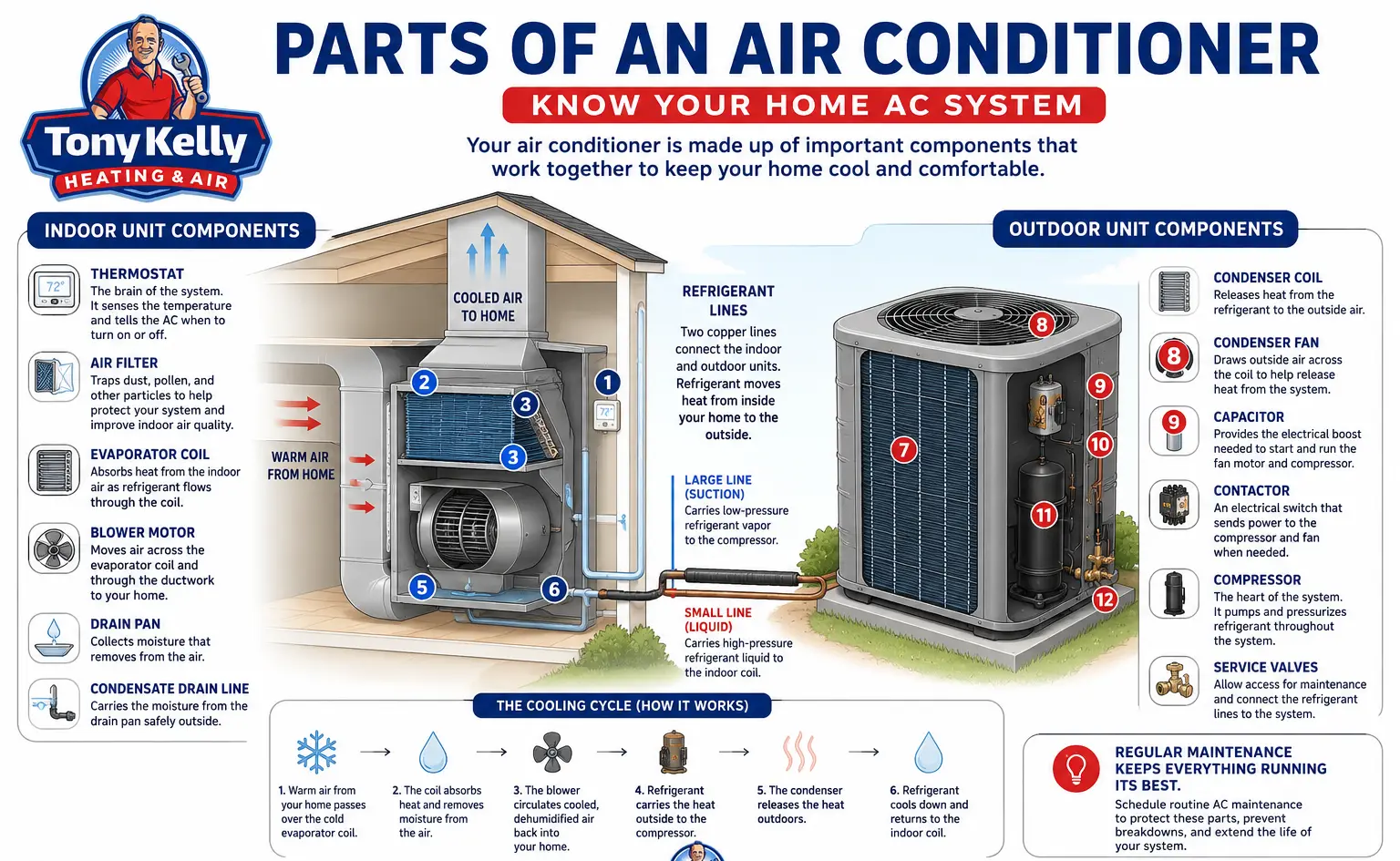
Understanding individual air conditioner parts is useful, but the system makes more sense when you see how those parts work as a sequence.
This continuous interaction is why diagnosing an air conditioner often means looking at the system as a whole. A symptom in one area may be caused by a problem somewhere else.
Learning the names of AC unit parts does not mean homeowners need to diagnose or repair every component themselves. Many symptoms overlap, and electrical or refrigerant work requires specialized equipment and training.
Still, knowing which parts are associated with certain symptoms can help you communicate clearly when something changes.
Warm or room-temperature air can involve thermostat settings, refrigerant issues, airflow restrictions, compressor trouble, frozen coils, electrical problems, or outdoor-unit failures.
Our article explaining why an AC may blow warm air in Florida covers this symptom in more detail.
Weak airflow may involve the air filter, blower motor, evaporator coil, return-air pathway, ductwork, dampers, or other restrictions.
A system can sometimes produce cold air at the equipment while still struggling to distribute enough of that air through the home.
Ice is not a sign that an air conditioner is cooling especially well. A frozen evaporator coil can interfere with heat transfer and airflow.
Restricted airflow and refrigerant-system problems are among the possible causes. The system generally needs to be allowed to thaw before meaningful diagnosis can occur.
Water around the air handler may point to a clogged drain, damaged drain pan, frozen evaporator coil, drainage problem, or condensate pump issue where one is installed.
Because Tallahassee homes can experience significant condensate production during humid cooling weather, drainage components deserve regular attention.
Rattling, grinding, squealing, buzzing, clicking, or banging can involve fan blades, motors, bearings, loose hardware, electrical components, the blower assembly, or the compressor.
A new noise does not identify one specific failed part, but it does provide useful diagnostic information.
A system that runs for long periods may simply be responding to high outdoor temperatures, but continuous operation can also involve thermostat problems, airflow restrictions, dirty coils, sizing issues, refrigerant problems, duct losses, or declining equipment performance.
Our guide to an AC running constantly in Tallahassee explores how to distinguish heavy normal operation from a potential problem.
A system that does not start may have a thermostat or power issue, failed capacitor, damaged contactor, control-board problem, safety-switch activation, wiring issue, or another electrical or mechanical failure.
Homeowners can safely check basic items such as thermostat settings and the electrical breaker, but repeatedly resetting a tripping breaker or opening electrical cabinets is not recommended.
Most internal AC components should be inspected or serviced by an HVAC professional, but homeowners can take several basic steps that support the system as a whole.
Checking the filter regularly is one of the simplest ways to help maintain proper airflow. Follow the filter manufacturer’s recommendations and pay attention to household conditions that may cause a filter to load more quickly.
Vegetation, leaves, grass clippings, and other debris should not block airflow around the condenser. Avoid piling items against the outdoor cabinet or covering the sides of the unit during operation.
Furniture, curtains, rugs, or stored items can block registers and returns. Good circulation helps the blower move air through the system as designed.
Water around the indoor equipment deserves attention. A small drainage problem can become more disruptive if moisture begins affecting surrounding materials.
A sudden change in sound, cycle length, airflow, temperature, humidity, or electrical behavior can be more informative than waiting for complete system failure.
For a deeper look at what homeowners can reasonably handle versus what belongs in a professional visit, see our comparison of DIY and professional HVAC maintenance.
Routine maintenance gives a technician an opportunity to evaluate the individual air conditioner components as part of a complete system.
Depending on the equipment and service being performed, maintenance may involve inspecting coils, measuring system operation, checking thermostat performance, evaluating airflow, inspecting electrical components, looking at refrigerant-system conditions, checking condensate drainage, and testing startup and shutdown cycles.
The value is not simply cleaning one part. It is seeing how the AC components are working together.
For example, a dirty filter can affect airflow. Poor airflow can affect evaporator coil temperature. Coil conditions can affect cooling performance. Longer run times can then place more demand on the blower, compressor, and electrical components.
This is why preventative service is best understood as system maintenance rather than a checklist of isolated parts.
Our detailed article on the components checked during AC maintenance explains what homeowners can typically expect during a professional cooling-system visit.
The basic parts of an air conditioner are the same throughout much of the country, but the conditions those parts operate under can vary significantly.
North Florida’s climate creates several practical considerations.
Air conditioners in Tallahassee can spend much of the year operating in cooling mode. Longer seasonal runtime means components such as the compressor, fan motors, blower, capacitor, contactor, and bearings may accumulate operating hours quickly.
Heavy runtime does not automatically mean the equipment is failing, but it makes consistent system condition and airflow especially important.
The evaporator coil does double duty in humid weather: it absorbs sensible heat while also removing moisture from the air.
That moisture becomes condensate, which means the drain pan and condensate line can be particularly important during North Florida’s humid months.
Persistent humidity issues can involve equipment operation, system sizing, airflow, duct conditions, thermostat settings, or the home’s overall moisture load.
Pollen, leaves, pine needles, dirt, grass clippings, and storm debris can affect both filters and outdoor condenser airflow.
Homeowners do not need to disassemble equipment, but keeping the area around the outdoor unit clear can help preserve airflow through the condenser coil.
Thunderstorms and power outages are common considerations in North Florida. After a power interruption, an HVAC system may need time before restarting, and electrical surges or storm-related debris can sometimes affect equipment.
Our homeowner guide explaining how to restart an air conditioner after a power outage covers the basic steps to take before assuming a component has failed.
A failed AC part does not automatically mean the entire air conditioning system needs replacement.
Components such as capacitors, contactors, thermostats, motors, sensors, and drain components can often be addressed individually when the rest of the system remains in good condition.
The decision becomes more complicated when a major component such as the compressor or coil fails, especially in an older system.
Factors that can influence the repair-versus-replacement decision include:
Instead of relying on one age cutoff, it is usually more useful to consider equipment condition as a whole. Our guide to AC lifespan in Florida’s climate explains some of the factors that can shorten or extend useful service life.
Homeowners weighing a major repair can also review our comparison of AC repair versus replacement for additional decision-making factors.
You do not need to become an HVAC technician to benefit from knowing the parts of an air conditioner.
Understanding the system can help you describe what you are seeing more clearly:
Those observations provide more useful information than simply saying “the AC is broken.”
They still do not replace diagnosis. Different AC components can create similar symptoms, and some problems involve several parts at once.
For a broader homeowner troubleshooting overview, see our HVAC troubleshooting tips.
The main parts of a central air conditioner include the evaporator coil, compressor, condenser coil, expansion or metering device, blower motor, thermostat, air filter, condenser fan, refrigerant lines, condensate drain, and electrical controls. Central systems also rely on ductwork to distribute conditioned air throughout the home.
Indoor AC unit parts commonly include the evaporator coil, air handler, blower motor, air filter, thermostat, condensate drain pan, drain line, and some electrical controls. Supply and return ductwork connect the indoor equipment to the living areas of the home.
Outdoor AC unit components typically include the compressor, condenser coil, condenser fan and motor, capacitor, contactor, service valves, wiring, and refrigerant-line connections. These parts primarily handle refrigerant circulation and releasing indoor heat to the outdoors.
No single component works independently, but the compressor, condenser, evaporator coil, and metering device are fundamental to the refrigeration cycle. The blower, thermostat, electrical controls, and airflow system are also necessary for the air conditioner to cool the home properly.
The copper lines carry refrigerant between the indoor evaporator coil and outdoor unit. The larger insulated line typically carries low-pressure refrigerant vapor toward the compressor, while the smaller line carries higher-pressure liquid refrigerant toward the indoor metering device.
Basic homeowner tasks such as changing an accessible air filter or keeping debris away from the outdoor cabinet are generally different from internal AC repairs. Electrical components, motors, refrigerant circuits, compressors, coils, and control systems should be evaluated and serviced by trained HVAC professionals because they can involve high voltage, pressurized refrigerant, specialized tools, and system-specific procedures.
A central air conditioner is more than an outdoor condenser sitting beside the house. It is a connected system of indoor and outdoor components moving air, refrigerant, heat, moisture, and electricity in a carefully controlled cycle.
The evaporator coil absorbs heat. The compressor keeps refrigerant moving. The condenser releases heat outdoors. The blower circulates air. The filter helps protect airflow and equipment. The thermostat coordinates operation. The condensate system removes moisture, while ductwork distributes cooled air throughout the home.
Understanding these air conditioner parts and functions can help homeowners recognize changes in system performance, ask better questions, and better understand why an HVAC technician may recommend a particular inspection or repair.
For active cooling-system problems involving warm air, unusual noises, weak airflow, frozen equipment, water leaks, or complete loss of cooling, Tony Kelly Heating & Air Conditioning provides air conditioning repair for Tallahassee homes. Homeowners focused on keeping these components operating reliably can also learn about our air conditioning maintenance services.
Address:
870 Blountstown Hwy. Unit # 9
Tallahassee, FL 32303
Phone: 850-385-3774
License #: CMC1249702
Open Monday Through Friday
8:00 am to 8:00 pm

