CALL US 850-385-3774
Smart thermostats have become one of the most talked-about HVAC upgrades for homeowners in Tallahassee and throughout North Florida. Between mobile app controls, energy reports, automatic schedules, and smart home integrations, many homeowners wonder just how powerful these devices really are.
One of the most common questions people ask is:
Can a Nest Thermostat Replace Heat and Air Conditioning?
The short answer is no.
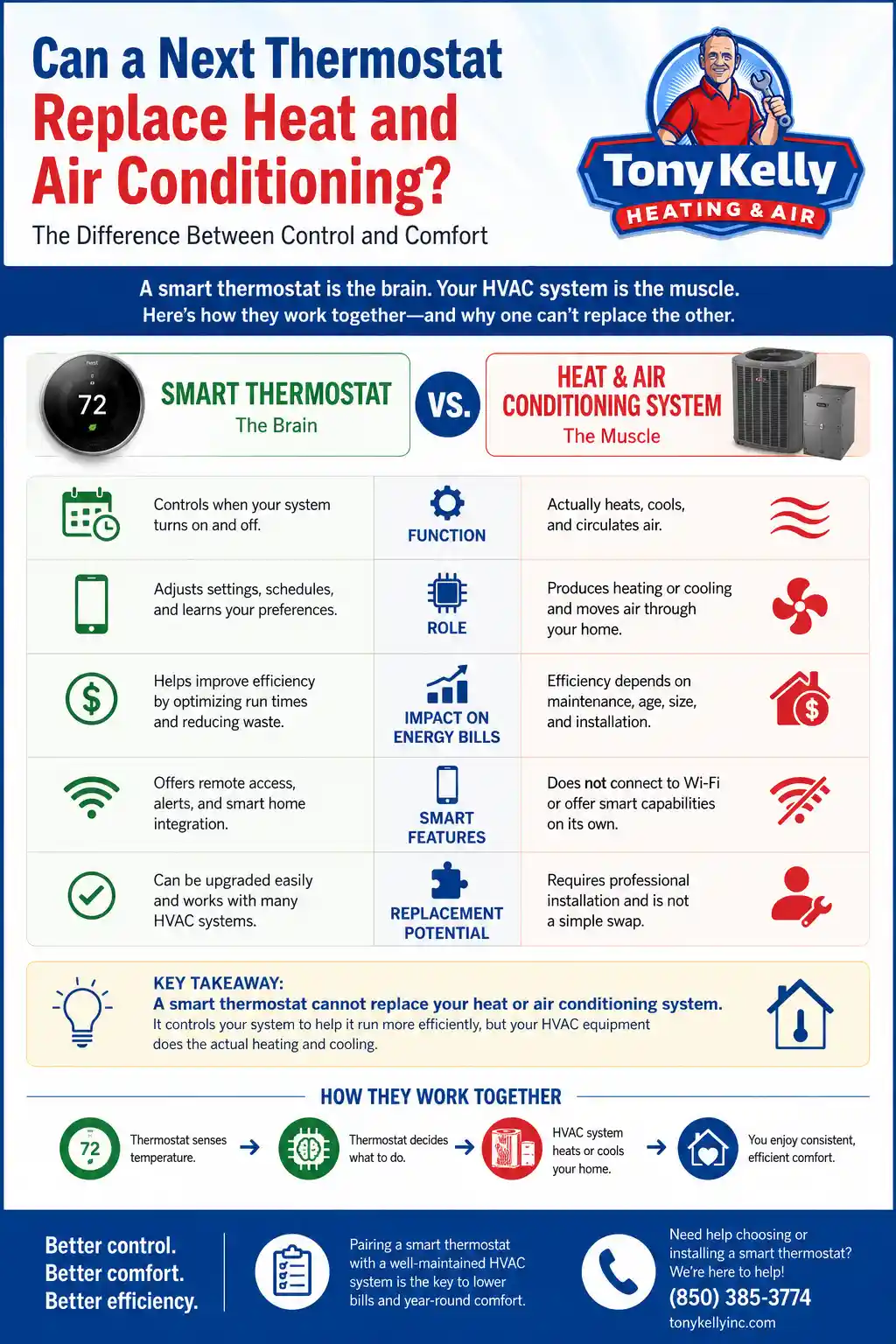
A smart thermostat — including devices like Nest, ecobee, Honeywell Home, Emerson Sensi, and Amazon Smart Thermostat — cannot replace your actual heating and cooling equipment. A thermostat controls your HVAC system, but it does not create heating or cooling on its own.
Think of your thermostat like the brain of the system. Your air conditioner, heat pump, furnace, ductwork, and air handler are the equipment that actually heats and cools your home.
Still, smart thermostats can dramatically improve comfort, efficiency, airflow management, humidity control, and HVAC performance when paired with the right system.
For many North Florida homeowners dealing with long cooling seasons, high humidity, and rising energy bills, smart thermostats can be one of the best HVAC upgrades available. This is one reason why more homeowners are exploring smart thermostat installation as part of broader HVAC improvements.
A smart thermostat is a low-voltage control device that communicates with your HVAC system.
It tells your system:
Unlike older manual thermostats, smart thermostats use sensors, Wi-Fi connectivity, occupancy tracking, and learning algorithms to automatically adjust your home’s comfort settings.
Many newer thermostats can also:
But no matter how advanced the thermostat becomes, it still depends on the HVAC equipment itself to physically heat or cool the home.
If your air conditioner stops working, replacing the thermostat alone will not restore cooling. In many cases, issues like refrigerant leaks, frozen coils, airflow restrictions, or compressor failures are the real cause, which is why understanding common summer HVAC problems can help homeowners identify what’s actually happening.
If your heat pump fails, the thermostat cannot generate heat by itself.
The thermostat is the controller — not the heating or cooling equipment.
Smart thermostat marketing often focuses heavily on comfort, automation, and energy savings.
Because these devices can make such a noticeable difference in how your HVAC system behaves, some homeowners mistakenly believe the thermostat itself is doing the heating and cooling.
In reality, the thermostat is optimizing how your existing HVAC equipment operates.
That optimization can absolutely make your home:
But those improvements come from better management of the HVAC system — not from replacing it.
This is similar to how homeowners sometimes assume HVAC maintenance itself “fixes” airflow or efficiency problems permanently. In reality, long-term performance depends on the condition of the full HVAC system, including ductwork, airflow balance, insulation, and equipment sizing. That’s why routine HVAC maintenance in Tallahassee remains important even with advanced thermostat technology.
While a smart thermostat cannot replace heating and air conditioning equipment, it can replace:
Many older homes around Tallahassee still use basic thermostats that only allow simple temperature adjustments.
These older thermostats often:
Replacing those outdated controls with a properly configured smart thermostat can significantly improve overall HVAC performance. Homeowners who already struggle with systems constantly running often notice immediate differences in runtime behavior after upgrading controls, especially in situations similar to those discussed in why an AC keeps running constantly in Tallahassee.
Yes — substantially.
According to ENERGY STAR, certified smart thermostats are designed to reduce heating and cooling energy usage by automatically optimizing system runtime and temperature setbacks.
https://www.energystar.gov/products/smart_thermostats
For North Florida homeowners, this is especially important because air conditioning systems run for much of the year.
Long cooling seasons in Tallahassee create constant strain on HVAC systems.
Smart thermostats help by:
Many homeowners notice lower utility bills within the first few months after installation.
However, the biggest improvements usually happen when the thermostat is paired with:
That’s why homeowners considering a thermostat upgrade are often also evaluating broader HVAC improvements like HVAC installation in Tallahassee or replacing aging systems that struggle with Florida’s humidity and long cooling season.
No.
This is another extremely common misconception.
A heat pump is the actual equipment that moves heat into or out of your home.
The thermostat only tells the heat pump when to operate.
Heat pumps are especially common throughout Florida because they provide both heating and cooling using the same system.
Your thermostat communicates with:
If the heat pump itself fails mechanically, a thermostat replacement will not solve the issue.
However, improper thermostat setup can absolutely create heat pump problems.
Incorrect programming may:
Many Florida homeowners dealing with cold air from their heat pump during winter are actually experiencing system configuration or operational issues rather than thermostat failure. This is discussed further in why your heat pump blows cold air in winter.
Yes — but indirectly.
Humidity control is one of the biggest HVAC challenges in North Florida.
High outdoor moisture levels force air conditioners to work constantly during spring and summer.
Smart thermostats help humidity control by managing:
Some advanced smart thermostats include dedicated humidity sensors and dehumidification controls.
However, the thermostat itself is not removing humidity from the air.
Your HVAC equipment still performs the actual moisture removal process.
Homes with oversized systems often struggle with humidity because the system cools too quickly without running long enough to remove moisture.
Smart thermostats can help improve runtime behavior, but they cannot fully solve humidity problems caused by poor HVAC sizing.
For homeowners struggling with persistent moisture, mold concerns, or indoor discomfort, pairing thermostat upgrades with solutions like whole-home dehumidifier installation often creates significantly better indoor comfort.
Sometimes.
Compatibility depends on:
Many older homes throughout Tallahassee and surrounding communities still have outdated thermostat wiring.
The most common issue is a missing C-wire.
Most smart thermostats require a common wire for constant power.
If the system lacks a C-wire, additional installation work may be necessary.
Some systems may require:
This is why professional installation is usually recommended, especially in older homes where HVAC systems may already be dealing with aging ductwork, airflow restrictions, or inconsistent cooling performance.
Yes.
One major benefit of smart thermostat technology is reducing unnecessary HVAC strain.
Older thermostats often cause systems to:
Smart thermostats improve runtime behavior by using:
This can help extend the lifespan of:
In Florida’s climate, reducing unnecessary runtime can make a significant difference over time, especially for homeowners already concerned about whether their system is nearing replacement age after reading about how long an AC unit lasts in Florida’s climate.
Sometimes — but not always.
Temperature inconsistencies usually come from:
A smart thermostat can help reduce temperature swings through improved scheduling and runtime control.
However, it cannot fully correct mechanical airflow issues.
If certain rooms remain hot or cold regardless of thermostat settings, the problem may involve:
Homes experiencing these issues sometimes benefit from solutions like HVAC zoning system installation, which allows different areas of the home to be controlled independently.
While smart thermostats do not directly clean indoor air, they can help HVAC systems manage airflow more effectively.
Some models integrate with:
This helps maintain more consistent airflow and humidity levels throughout the home.
For Florida homeowners dealing with dust, pollen, humidity, or mold concerns, thermostat optimization can complement broader indoor air quality improvements. Many homeowners exploring these upgrades also look into whether air duct cleaning reduces dust in Florida homes as part of improving indoor comfort.
The EPA also explains how indoor humidity and ventilation impact overall indoor air quality:
https://www.epa.gov/indoor-air-quality-iaq
No.
Even the best thermostat cannot replace:
Routine maintenance remains critical in Florida because HVAC systems operate so frequently.
Without maintenance, homeowners still risk:
A smart thermostat improves control efficiency — but maintenance protects the actual equipment.
Many homeowners discover this after dealing with problems like frozen systems, airflow restrictions, or warm air issues similar to those discussed in why an AC blows warm air in Florida.
So, can a Nest Thermostat replace heat and air conditioning?
No.
A smart thermostat controls your HVAC system — it does not replace it.
Your heating and cooling equipment still performs the actual work of:
However, smart thermostats can dramatically improve how efficiently and effectively your HVAC system operates.
For North Florida homeowners dealing with long summers, high humidity, and rising utility costs, upgrading to a properly installed smart thermostat can improve:
When paired with proper HVAC installation, maintenance, and airflow management, smart thermostats become an extremely valuable part of a modern home comfort system.
No. A smart thermostat only controls the air conditioner. The AC equipment still performs the actual cooling.
No. The furnace or heat pump still creates heat. The thermostat only controls operation timing and temperature settings.
Yes. Smart thermostats can reduce energy usage by optimizing HVAC runtime, scheduling, and temperature setbacks.
Yes. Smart thermostats can improve humidity management by optimizing cooling cycles and runtime behavior.
Not during the outage itself. After power returns, most reconnect automatically once Wi-Fi and HVAC power are restored.
Indirectly. Some smart thermostats integrate with air purification and dehumidification systems to help maintain healthier indoor conditions.
Many do, but some require wiring upgrades or adapter kits due to missing C-wires or older HVAC systems.
Popular choices include Google Nest, ecobee, Honeywell Home, Emerson Sensi, and Amazon Smart Thermostat. The best option depends on your HVAC system and home layout.
Address:
870 Blountstown Hwy. Unit # 9
Tallahassee, FL 32303
Phone: 850-385-3774
License #: CMC1249702
Open Monday Through Friday
8:00 am to 8:00 pm

