CALL US 850-385-3774
If your AC is blowing warm air instead of cooling your home, it can be confusing—especially when the system seems to be running like normal. In North Florida, where air conditioners work long hours through heat and humidity, even small issues can quickly show up as noticeable comfort problems.
This guide walks through what it means when your AC is blowing warm air, the most common causes behind it, what you can safely check on your own, and how to think through the next steps.
Many homeowners notice this issue after experiencing other symptoms like those discussed in why your AC isn’t cooling or in broader system breakdowns like common HVAC problems. Warm air is often one of the clearest signals that something in the cooling cycle isn’t functioning properly.
Your air conditioner doesn’t actually “create” cold air. Instead, it removes heat from inside your home and transfers it outdoors. When everything is working correctly, the air coming out of your vents feels cool and consistent.
If your AC is blowing warm air, it typically means one of the following:
This is why the issue is often connected to performance-related topics like AC efficiency. A system can still run, but not actually cool.
One of the simplest explanations is that the thermostat isn’t set correctly. If it’s on “fan” mode instead of “cool,” the system will circulate air without cooling it.
In other cases, the thermostat may not be communicating properly with your system. This can happen if batteries are low or if the thermostat isn’t accurately reading the room temperature.
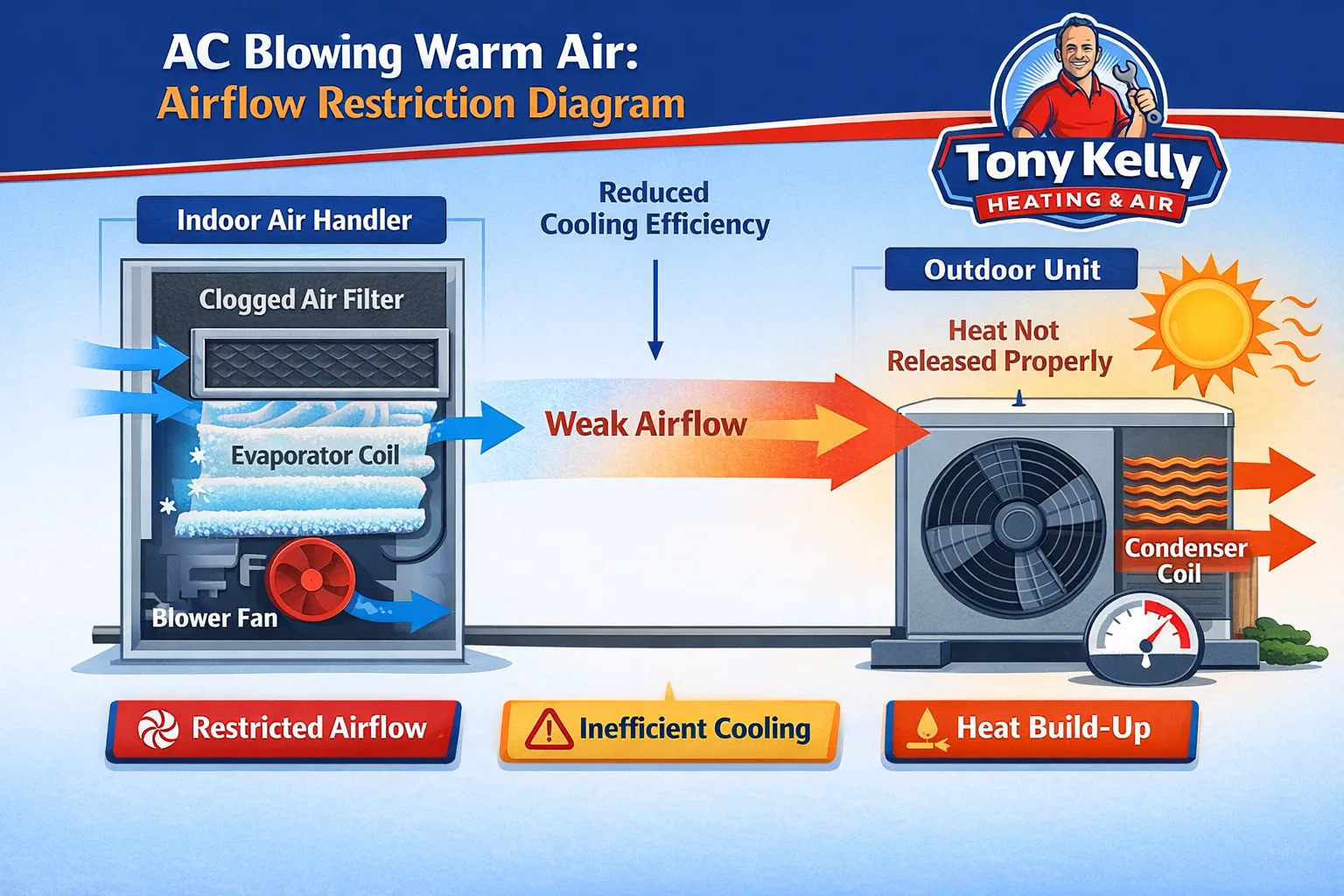
Airflow is essential to the cooling process. When your air filter becomes clogged, it restricts how much air can pass through the system.
This can lead to:
This is one of the most common issues covered in basic HVAC troubleshooting, and it’s often the first thing to check.
Refrigerant is what allows your system to absorb heat from inside your home. If levels are low, the system can’t complete the cooling cycle effectively.
This can happen due to leaks or system wear over time. Unlike filters or thermostat settings, this is not something that can be resolved without specialized tools.
Your outdoor unit plays a critical role in releasing heat from your home. If it’s blocked, dirty, or not running at all, heat remains trapped in the system.
Common issues include:
These types of problems often become more noticeable during peak summer conditions discussed in summer HVAC preparation.
Air conditioning systems rely on multiple electrical components working together. If parts like capacitors or compressors fail, the system may run but not cool.
This is often part of larger system issues explained in why HVAC systems break down.
Homes in Tallahassee and surrounding areas face unique conditions that can make cooling issues more noticeable:
Humidity, in particular, plays a major role. Systems that struggle to manage moisture may also struggle to cool effectively. This is why many homeowners explore options like whole-home dehumidifiers.
Power interruptions can cause systems to reset or behave differently when restarted. If your AC starts blowing warm air after an outage, it may need a simple reset or inspection.
For guidance, see how to restart your AC safely.
If your indoor system is running but the outdoor unit is not, the system won’t be able to remove heat. This often results in warm air coming through vents.
If your AC runs continuously but never cools the home, it may be struggling with airflow, refrigerant, or efficiency issues similar to those discussed in reducing HVAC strain.
These steps can help rule out simple issues before moving on to more in-depth diagnosis.
If the issue continues after basic checks, it’s often related to:
These situations often align with early warning signs discussed in AC failure indicators.
Routine maintenance is one of the most effective ways to avoid unexpected issues. Learn more in preventative HVAC maintenance.
If your AC continues to blow warm air, it may require professional inspection to identify the exact cause. In many cases, resolving the issue involves targeted repairs that restore proper cooling function.
For homeowners in the Tallahassee area and surrounding communities, this often relates to services like AC repair in Tallahassee, as well as similar services in Quincy, Midway, and Crawfordville.
This usually means the system cannot remove heat properly due to airflow issues, refrigerant levels, or component problems.
Yes. Incorrect settings or communication issues can prevent the system from entering cooling mode.
Not always. Sometimes it’s as simple as a clogged filter or incorrect setting. Other times, it may require further inspection.
High humidity and long cooling seasons put additional strain on HVAC systems, making performance issues more noticeable.
If basic troubleshooting doesn’t resolve the issue, it may be helpful to pause use until the system can be evaluated to avoid additional strain.
Address:
870 Blountstown Hwy. Unit # 9
Tallahassee, FL 32303
Phone: 850-385-3774
License #: CMC1249702
Open Monday Through Friday
8:00 am to 8:00 pm

