CALL US 850-385-3774
Air conditioning maintenance is important almost anywhere, but it takes on added importance in Tallahassee and across North Florida. Local cooling systems operate through long stretches of heat, high humidity, afternoon thunderstorms, heavy rainfall, pollen, airborne debris, and periods of near-continuous summer use. An air conditioner that might receive moderate seasonal use in another part of the country may spend much of the year managing both temperature and moisture in a North Florida home.
Regular maintenance helps keep that workload from gradually reducing airflow, cooling performance, humidity control, and energy efficiency. It also gives an HVAC technician an opportunity to inspect the system before a dirty coil, restricted filter, clogged drain, loose electrical connection, or worn component begins affecting comfort.
For most homeowners, professional air conditioning maintenance includes much more than changing a filter or briefly checking whether cold air comes from the vents. A complete visit may involve inspecting, cleaning, testing, measuring, and adjusting several parts of the cooling system. The exact checklist depends on the equipment, its age, its condition, and the way it is installed.
This guide explains what AC system maintenance commonly includes, how often Tallahassee homeowners should schedule it, what affects the average cost of AC maintenance, which tasks can be handled by a homeowner, and when a more detailed HVAC system inspection may be needed.
Air conditioning maintenance is the routine inspection and care of the equipment responsible for cooling and dehumidifying a home. The goal is to confirm that the system is clean, operating correctly, receiving adequate airflow, draining moisture properly, and responding to the thermostat as expected.
Maintenance is preventive rather than reactive. A repair visit generally begins because the system is already blowing warm air, leaking water, making noise, tripping a breaker, freezing up, or failing to start. Air conditioning preventive maintenance is scheduled before a known failure so that the technician can evaluate the equipment under normal operating conditions.
That distinction matters because many HVAC problems develop gradually. A condenser coil may collect dirt over several months. A filter may become increasingly restrictive. A condensate line may slowly accumulate biological growth or debris. An electrical connection may loosen as the equipment cycles repeatedly. Refrigerant performance may decline because of a leak that is not yet large enough to stop the system from cooling.
The AC may continue to run through these conditions, but it may need longer cycles to reach the thermostat setting. Rooms may become less even, indoor humidity may rise, and electricity use may increase. Routine maintenance can reveal these changes before the homeowner assumes that reduced performance is simply a normal result of Florida heat.
Homeowners looking for service-specific information can review what is included in professional AC maintenance for Tallahassee homes. This blog focuses on the broader planning questions: what technicians inspect, how frequently service makes sense in North Florida, and how maintenance costs are determined.
Tallahassee air conditioners face operating conditions that differ from those in areas with shorter or milder cooling seasons. Local systems commonly begin running regularly during spring and remain heavily used through much of fall. Even during milder periods, indoor humidity may make occasional cooling or dehumidification necessary.
National Weather Service climate reporting for Tallahassee regularly documents summer daytime temperatures around the 90s along with high relative humidity. Those conditions increase cooling demand while also creating a substantial moisture load inside the HVAC system. When warm, humid air passes across a cold evaporator coil, water condenses and moves into the drain pan and condensate line. That moisture must drain correctly every time the system operates.
This is one reason drain maintenance is especially relevant in North Florida. A partially restricted condensate line may not cause an immediate cooling failure, but it can lead to standing water, overflow, a triggered float switch, increased moisture near the air handler, or water damage around the equipment. The U.S. Department of Energy notes that hot, humid areas in the Southeast can produce a considerable amount of air-conditioning condensate, making proper drainage an important part of system operation.
Local outdoor equipment is also exposed to pine straw, leaves, grass clippings, pollen, dirt, insects, and storm debris. Material that collects against the condenser can restrict the movement of outdoor air through the coil. Because the condenser releases heat removed from the home, reduced airflow around it can make the cooling process less effective.
Other North Florida conditions that can affect maintenance needs include:
These conditions do not mean every Tallahassee air conditioner will develop the same problems. They do mean that a generic maintenance schedule created for a mild climate may not fully reflect the amount of work a North Florida system performs.
Homeowners preparing for peak cooling season may also find it useful to review how to prepare an HVAC system for Tallahassee summer heat. Seasonal preparation and professional maintenance overlap, but preparation also includes homeowner steps such as checking thermostat settings, clearing vents, and watching for changes in cooling performance.
A professional maintenance visit should evaluate the cooling system as a connected system rather than treating the outdoor unit, indoor air handler, thermostat, and ductwork as unrelated parts. The precise procedure will vary by equipment and technician, but a thorough visit commonly covers the following areas.
The thermostat tells the HVAC system when to start, how long to operate, and when to stop. During maintenance, the technician may confirm that the thermostat responds correctly, reads the indoor temperature accurately, communicates properly with the equipment, and is configured for the type of HVAC system in the home.
A thermostat problem can sometimes resemble an equipment problem. Incorrect settings, a weak battery, poor placement, damaged wiring, or a calibration issue may cause short cycling, long run times, inconsistent temperatures, or a system that does not start when expected.
Programmable and smart thermostats may also be reviewed for schedules that conflict with the household’s routine. A system can appear inefficient when the actual problem is an aggressive schedule, frequent manual changes, or a thermostat located where sunlight or another heat source affects its reading.
The filter protects the HVAC system from airborne debris while helping reduce the amount of material recirculated through the home. A technician will normally inspect the filter and determine whether it is clean, correctly sized, properly installed, and appropriate for the system.
A dirty filter restricts airflow. As airflow declines, the system may operate longer, provide weaker cooling at the vents, struggle with temperature balance, or place additional strain on the blower. In some cases, severe airflow restriction can contribute to an evaporator coil becoming too cold and freezing.
Filter selection also matters. A very restrictive filter is not automatically better for every system. The filter must balance particle capture with the airflow requirements of the equipment and duct design. Homeowners dealing with recurring dust or filtration concerns may need a broader review of the duct system, humidity, return-air capacity, or indoor air quality options for North Florida homes.
Air conditioners depend on multiple electrical parts to start, run, and shut down correctly. A maintenance visit may include inspecting wiring, tightening accessible connections, checking contactors, testing capacitors, measuring voltage and current, and looking for heat damage, corrosion, or other signs of wear.
Electrical problems are not always visible to a homeowner. A system may continue running with a weakened capacitor or worn contactor until the component can no longer support startup or operation. Testing these parts during an HVAC inspection can provide a clearer picture of their condition.
Storms and power interruptions also make electrical checks relevant in Tallahassee. Maintenance cannot prevent every issue associated with an outage or power fluctuation, but it can identify damaged or deteriorating components that may have become less reliable.
The evaporator coil is located indoors and absorbs heat from the air moving through the system. The coil also removes moisture as humid air passes across its cold surface.
Dust, biological buildup, and debris on the coil can interfere with airflow and heat transfer. Because the coil is often located inside a cabinet, homeowners may not be able to see its condition without removing panels. A technician can inspect accessible portions of the coil and determine whether cleaning or further evaluation is appropriate.
A dirty evaporator coil can contribute to long cooling cycles, weak airflow, poor humidity removal, freezing, and reduced comfort. However, these symptoms can also have other causes. A proper diagnosis should consider the filter, blower, ductwork, refrigerant performance, thermostat operation, and system sizing rather than assuming the coil is the only issue.
The outdoor condenser coil releases heat carried from inside the home. It needs adequate airflow through the coil surface and around the cabinet.
During maintenance, the technician may remove leaves, grass, dirt, pine straw, or other material from around the unit and clean the coil when needed. The surrounding area should also be checked for shrubs, fencing, stored items, or landscaping that restricts ventilation or makes the equipment difficult to service.
Coil cleaning should be performed using methods appropriate for the equipment. High-pressure spraying, harsh chemicals, or bent fins can damage the coil. Homeowners can generally keep the area clear and remove loose surface debris, but deeper cleaning is better handled as part of professional central air conditioning maintenance.
Refrigerant moves heat through the air-conditioning system. Contrary to a common misconception, an AC system does not normally consume refrigerant as it runs. Low refrigerant generally suggests that refrigerant has escaped somewhere in the system.
A maintenance check may include evaluating temperatures, pressures, or other operating data to determine whether the refrigeration circuit appears to be functioning correctly. Refrigerant should not simply be added without considering why the level is low.
Symptoms associated with a refrigerant problem can include weak cooling, long run times, ice on the refrigerant line or evaporator coil, unusual operating pressures, or higher electricity use. Those symptoms can overlap with dirty coils, poor airflow, duct leakage, and other problems, which is why professional testing matters.
The condensate drain removes water collected as the AC dehumidifies indoor air. In Tallahassee’s humid climate, this part of the system may handle substantial moisture during long cooling cycles.
Maintenance may include inspecting the drain pan, checking the drain line for restriction, confirming that water flows in the intended direction, and evaluating accessible safety switches. The technician may also clear or flush the line depending on its condition and the maintenance procedure.
A clogged drain can cause more than a small water leak. Depending on the installation, it may shut the system down through a float switch, allow water to overflow near the air handler, damage surrounding materials, or contribute to unwanted moisture.
The blower moves conditioned air through the duct system and back into the rooms. A technician may inspect the blower assembly, evaluate cleanliness, listen for bearing or motor noise, and confirm that airflow appears appropriate.
Airflow problems can originate in several places, including a dirty filter, dirty coil, blower issue, undersized return duct, closed damper, crushed flex duct, disconnected duct, blocked register, or poorly designed duct system. That means a complete HVAC system inspection may go beyond the equipment cabinet when weak or uneven airflow is reported.
ENERGY STAR recommends that contractors clean and adjust blower components and notes that airflow problems can significantly reduce system efficiency. It also recommends evaluating duct systems when comfort or performance problems may be connected to leakage, damage, or inadequate air balance.
The compressor circulates refrigerant and is one of the most important components in the cooling system. Maintenance may include monitoring compressor startup and operation, checking electrical measurements, listening for unusual sounds, and reviewing system performance.
The outdoor fan motor, indoor blower motor, and other moving components may also be inspected. Depending on the equipment, the technician may check bearings, belts, lubrication points, mounting hardware, and general operation.
After inspecting and servicing the system, the technician should confirm that it starts, runs, and shuts down correctly. This may include measuring temperatures, reviewing airflow, checking the thermostat response, and evaluating whether the system is producing an appropriate cooling result under current conditions.
A temperature measurement by itself does not explain every comfort problem. Outdoor temperature, indoor humidity, airflow, system runtime, equipment capacity, duct conditions, and the location of the readings all matter. Still, performance testing helps connect the individual maintenance findings to the way the complete system operates.
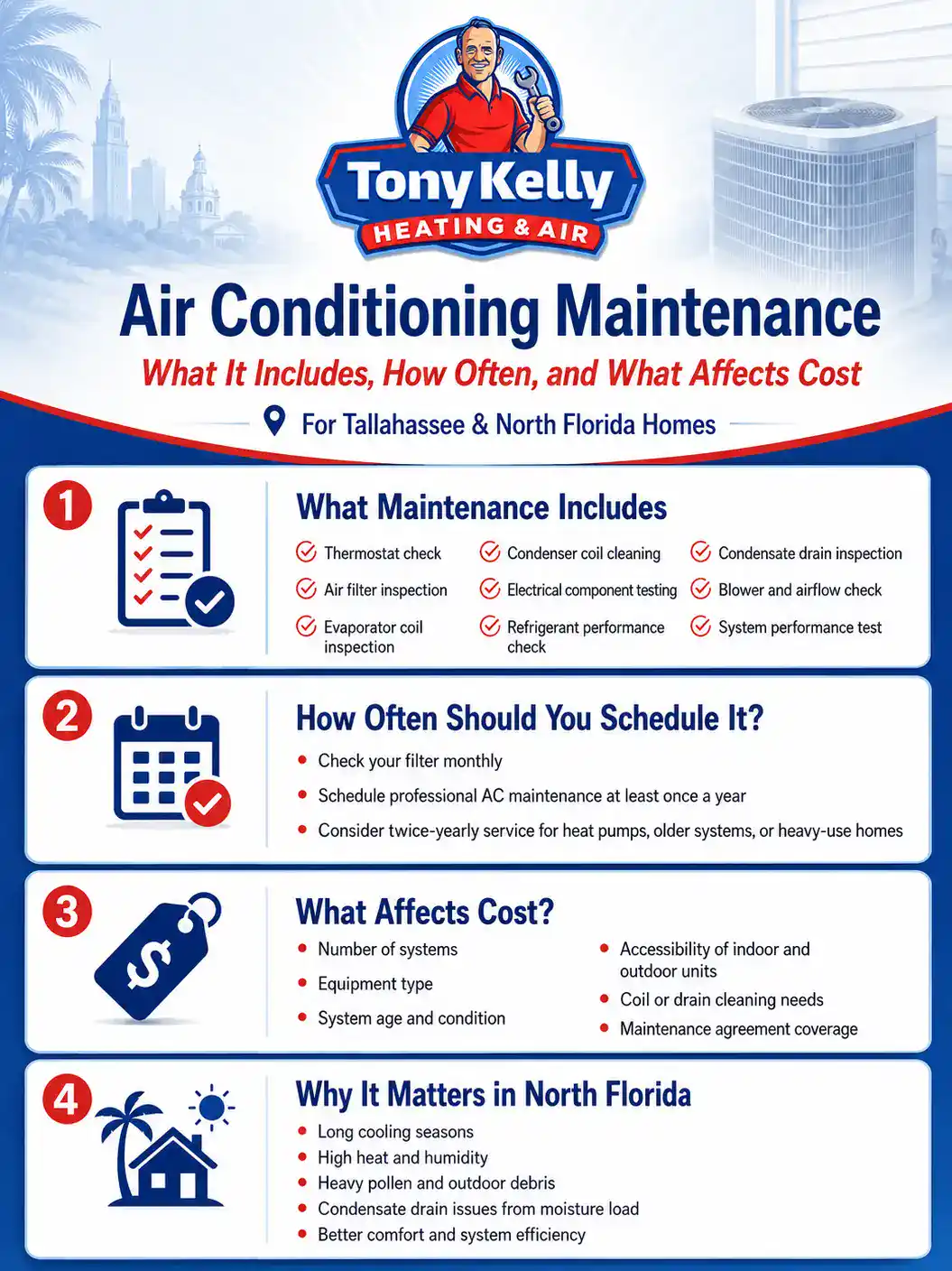
The following AC maintenance checklist separates routine homeowner care from work that normally belongs in a professional service visit.
Homeowners who prefer a seasonal overview can also use this spring HVAC maintenance checklist to organize basic preparation before the most demanding part of Tallahassee’s cooling season.
Most air-conditioning systems should receive professional maintenance at least once each year. ENERGY STAR recommends an annual preseason checkup and suggests scheduling cooling maintenance in spring before contractors become busiest and before sustained summer use begins.
In Tallahassee and across North Florida, many homes may benefit from two HVAC visits per year: a cooling-focused visit before peak summer and another system check before the heating season. This schedule is particularly useful for heat pumps because the same equipment provides both cooling and heating.
Twice-yearly service may also make sense when:
The answer to “how often should you service your AC?” should therefore consider both a minimum schedule and the actual operating conditions. Annual service is a practical baseline, while twice-yearly inspection may better reflect the workload of equipment used for long North Florida cooling seasons.
Maintenance frequency is different from filter frequency. A system that receives professional maintenance once or twice a year may still need its filter checked monthly and replaced several times between visits. ENERGY STAR recommends inspecting filters each month during heavy-use periods and replacing them at least every three months, or sooner when they become dirty.
For a closer look at service-plan scheduling, visit the guide to HVAC maintenance plans in Tallahassee. That resource explains how structured plans differ from booking individual maintenance visits when needed.
Late winter or spring is generally the best time for annual AC maintenance in Tallahassee. The purpose of preseason service is to inspect the system before it enters the longest and most demanding portion of the cooling season.
However, maintenance remains useful outside spring. Homeowners should not postpone service for many months simply because the preferred preseason period has passed. A system that has not been maintained recently can still be inspected during summer, fall, or winter.
The best timing depends partly on the equipment:
Spring maintenance is also a good opportunity to discuss any comfort problem noticed during the previous summer, such as a bedroom that stayed warm, an AC that ran almost continuously, or humidity that remained high even when the thermostat setting was reached.
The average cost of AC maintenance varies because contractors do not all include the same inspection, cleaning, testing, documentation, or follow-up. National estimates can provide broad context, but they should not be treated as a guaranteed Tallahassee price.
A basic visit may be priced differently from a comprehensive tune-up that includes electrical measurements, coil cleaning, drain service, refrigerant performance testing, airflow evaluation, and a written report. The final amount may also depend on how many systems are present and whether the equipment is readily accessible.
Factors that commonly affect AC maintenance cost include:
It is also important to distinguish maintenance from repairs. A maintenance visit covers routine inspection, cleaning, and adjustment within the stated service scope. A failed capacitor, refrigerant leak, damaged motor, broken drain component, faulty thermostat, or damaged duct is generally a repair rather than routine maintenance.
A low advertised price may therefore represent a limited inspection rather than the full cost of correcting every issue found. Homeowners comparing providers should ask what is included, how additional work is presented, and whether the maintenance price applies to one system or the entire property.
Some Tallahassee homes have separate HVAC systems for different floors, additions, guest spaces, or sections of the house. Each system has its own filters, electrical components, coils, drain components, refrigerant circuit, thermostat, blower, and outdoor equipment.
Maintaining two systems requires more time than maintaining one. The same principle applies to a ductless system with several indoor heads. Although the system may share an outdoor unit, each indoor unit has filters, coils, fans, drains, and operating controls that may need attention.
A maintenance agreement may bundle scheduled visits and other defined benefits into an annual arrangement. The value depends on how often the system will be serviced, what each visit includes, whether multiple systems are covered, and which additional benefits are important to the homeowner.
Tony Kelly HVAC’s Ultimate Savings Agreement provides information about its included tune-ups and plan features. Homeowners should compare the agreement details with the expected cost and scope of booking individual visits.
A plan should not be evaluated only by its advertised annual price. Consider the number of included visits, inspection depth, scheduling process, repair-related terms, equipment coverage, and whether unused benefits have value for your household.
The terms maintenance, tune-up, diagnostic, and HVAC inspection are sometimes used interchangeably, but they can refer to different levels of service.
An annual maintenance visit focuses on routine preventive care. The technician inspects and services operating equipment, tests important components, cleans designated areas, and looks for developing problems.
A diagnostic visit focuses on a specific symptom. The technician may perform targeted testing to determine why the system is not cooling, leaking, freezing, making noise, or failing to start.
A broader HVAC system inspection may be appropriate when the concern involves more than routine equipment care. Examples include:
An HVAC inspection may include deeper evaluation of duct design, static pressure, return-air capacity, insulation, air leakage, equipment sizing, drainage configuration, or overall home performance. These items may not be included in every standard tune-up.
For example, a maintenance technician may confirm that the blower operates, the filter is clean, and the coil is in acceptable condition. If several bedrooms still receive weak airflow, further duct and pressure testing may be needed to identify crushed ductwork, leaks, closed dampers, or design limitations.
Homeowners can perform several useful maintenance tasks, but a do-it-yourself checklist should not be treated as a replacement for professional inspection.
Safe homeowner tasks typically include checking the filter, keeping the outdoor unit clear, cleaning accessible vent covers, monitoring the condensate outlet, reviewing thermostat settings, and paying attention to changes in operation.
Work involving refrigerant, live electrical components, internal equipment panels, motor testing, capacitor testing, chemical coil cleaners, or major drain disassembly should be left to a trained HVAC technician. Turning off the thermostat does not necessarily remove electrical power from every part of the system.
Homeowners should also avoid adding refrigerant, bypassing a float switch, repeatedly resetting a tripped breaker, forcing ice from a frozen coil, or using high-pressure water on the condenser. These actions may damage equipment or hide the cause of the problem.
For a detailed comparison, review DIY and professional HVAC maintenance in Tallahassee. The most effective approach is usually a combination of simple homeowner upkeep and periodic professional testing.
Maintenance should be scheduled regularly, but homeowners should not wait for the next annual appointment when the system begins showing a clear change in operation.
Arrange an HVAC evaluation when you notice:
Some of these symptoms can be related to routine maintenance issues, but others indicate a repair need. An air conditioner that is already malfunctioning should receive diagnostic service rather than being treated as a normal tune-up.
Homeowners experiencing reduced cooling can review common reasons an air conditioner stops cooling during a North Florida summer. For warm airflow specifically, the guide to an AC blowing warm air in Florida explains several possible causes.
Air-conditioning maintenance can support humidity control when moisture problems are connected to dirty coils, poor airflow, drainage issues, thermostat operation, or reduced cooling performance. A clean, properly operating system is generally better able to cool and dehumidify the air than a neglected one.
However, maintenance does not solve every humidity problem. High indoor moisture may also involve:
If a Tallahassee home feels humid even while the AC is cooling, the technician should evaluate the concern rather than assuming that a lower thermostat setting is the best solution. In some homes, a whole-home dehumidifier for Florida’s humid climate may be part of a broader moisture-control approach.
Maintenance can help restore performance lost to dirt, restricted airflow, improper controls, and other correctable conditions. ENERGY STAR notes that dirty coils can reduce cooling ability and increase run time, while airflow problems can reduce efficiency considerably.
That does not mean every maintenance visit will produce a dramatic or identical reduction in the electric bill. Energy use is also affected by outdoor weather, thermostat settings, insulation, duct leakage, home size, window exposure, occupancy, equipment efficiency, and system sizing.
The most realistic expectation is that maintenance helps the system operate closer to its intended condition. A clean coil, clean filter, correct airflow, properly functioning controls, and unobstructed condenser allow the equipment to do its job without avoidable restrictions.
Homeowners can also review how to tell whether an AC is running efficiently. Looking at run time, airflow, humidity, temperature consistency, and electricity use together provides a better picture than relying on one symptom.
Commercial air conditioning maintenance follows many of the same principles as residential maintenance, but the systems, schedules, controls, operating hours, and consequences of downtime may be different.
A small North Florida office may use equipment similar to residential split systems. A larger property may have rooftop units, packaged equipment, multiple zones, complex controls, larger motors, greater ventilation requirements, and several thermostats or building-control points.
Commercial maintenance may require more frequent filter changes and inspections because the equipment operates for longer hours or serves more occupants. Restaurants, medical offices, retail spaces, warehouses, and professional buildings can also have very different ventilation and temperature requirements.
A commercial air conditioning maintenance schedule may consider:
Commercial properties often benefit from a documented preventive schedule rather than relying on one general annual visit. Filters, belts, drain components, coils, electrical systems, and controls may need attention at different intervals.
Maintenance recommendations should be matched to the specific building and equipment. A schedule appropriate for a small office may not be sufficient for a property with multiple rooftop systems operating through extended hours.
A maintenance appointment is also an opportunity for the homeowner to understand the condition of the system. Useful questions include:
A clear maintenance report helps the homeowner distinguish current problems from future planning considerations. It can also provide a useful history when the system is serviced again.
Most Tallahassee homeowners should schedule professional AC maintenance at least once a year, ideally before sustained summer use. Homes with heat pumps, older equipment, multiple systems, heavy usage, or recurring airflow and humidity concerns may benefit from twice-yearly service.
A typical visit may include thermostat testing, filter inspection, electrical checks, evaporator and condenser coil inspection, condensate drain service, refrigerant performance evaluation, blower and airflow checks, motor and compressor testing, and confirmation that the system starts, cools, and shuts down correctly.
Check the filter monthly during periods of heavy cooling use. Many filters need replacement every one to three months, but the right interval depends on the filter, equipment, pets, household activity, indoor air conditions, and how quickly visible buildup develops.
Not always. Maintenance focuses on preventive cleaning, testing, and adjustment. A broader HVAC inspection may evaluate duct leakage, airflow balance, equipment sizing, insulation, humidity, or other whole-home issues. A diagnostic visit is used when the system already has a specific malfunction.
North Florida air conditioners remove substantial moisture from humid indoor air. That water must pass through the drain pan and condensate line. Debris or biological buildup can restrict the line, resulting in overflow, system shutdown, or unwanted moisture near the air handler.
Routine maintenance generally covers inspection, cleaning, testing, and adjustments included in the scheduled service. Replacing failed electrical parts, repairing refrigerant leaks, replacing motors, correcting damaged ductwork, or completing other corrective work is normally considered repair service.
Maintenance can identify many developing problems and reduce avoidable strain, but it cannot guarantee that equipment will never fail. Components can still break because of age, manufacturing issues, electrical events, corrosion, or other causes. The value of maintenance is better operation, earlier information, and a more consistent service history.
Newer equipment still needs clean filters, proper airflow, clear drainage, clean coils, reliable electrical components, and correct operation. Maintenance may also help document that the system has received regular professional care. Homeowners should follow the manufacturer’s instructions for their specific equipment.
A practical maintenance plan begins with the type of system, the way the home is used, and the demands of North Florida’s climate. At minimum, homeowners should inspect filters regularly, keep the outdoor condenser clear, watch for drainage problems, and schedule professional service each year.
Homes with heat pumps, multiple systems, long operating hours, older equipment, heavy pollen exposure, or ongoing humidity concerns may need a more frequent schedule. Maintenance should also be adjusted when the manufacturer specifies particular inspection or cleaning intervals.
The most useful maintenance visit is one that evaluates the system carefully, documents the findings, and clearly separates routine care from necessary repairs. It should help the homeowner understand how the equipment is operating rather than simply provide a pass-or-fail statement.
Tallahassee homeowners who are ready to arrange a system visit can use the Tony Kelly HVAC contact page to provide information about their equipment and maintenance needs.
For additional independent guidance, review the ENERGY STAR HVAC maintenance checklist. Local temperature and humidity observations are also available through the National Weather Service office serving Tallahassee and North Florida.
Address:
870 Blountstown Hwy. Unit # 9
Tallahassee, FL 32303
Phone: 850-385-3774
License #: CMC1249702
Open Monday Through Friday
8:00 am to 8:00 pm

