Florida humidity doesn’t play by the usual rules. Some days are blazing hot and sticky. Other days are cooler, rainy, and still feel damp inside — even when your thermostat says everything is “fine.”
If you’ve ever said:
- “The AC is running, but the house still feels clammy.”
- “It smells musty in the closets.”
- “My indoor humidity stays above 60% no matter what I do.”
You’re not imagining it. You’re seeing a common Florida pattern: temperature control and moisture control are not the same thing. In fact, this same climate pattern is one reason HVAC breakdowns and recurring system issues are more common in North Florida homes.
A whole-home dehumidifier is designed to handle the part your air conditioner often can’t — especially during North Florida’s mild-but-humid stretches when the AC doesn’t run long enough to pull moisture out of the air.
Want a quick companion read first? See: How winter humidity impacts indoor air in North Florida.
Why Florida Humidity Feels Worse Than You Expect
A lot of humidity advice online is written for places where humid days are occasional. Florida is different. It’s a warm-humid climate with frequent moisture in the air — and the thing that matters most isn’t just “relative humidity.”
It’s dew point (how much moisture the air actually holds).
When dew points are high, the air carries more moisture into your home through everyday infiltration: doors opening, duct leaks, attic gaps, and ventilation that isn’t balanced correctly.
North Florida’s sneaky humidity problem is that some of the most uncomfortable days happen when it’s mild outside:
- Rainy days in the 60s and 70s
- Cool nights with damp air
- Shoulder seasons
- Post-storm weeks when the home takes longer to dry out
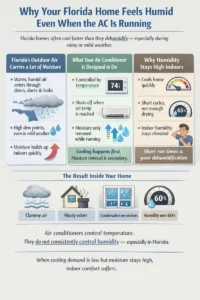
Those are the exact conditions where your air conditioner may not run long enough to dehumidify properly — even if it cools the home just fine.
Click to Enlarge
What People Are Saying Online (Real Homeowner + HVAC Forum Themes)
Across homeowner threads and HVAC advice forums, a few themes show up repeatedly:
1) “My AC reaches temperature but humidity stays high.”
This is the most common Florida-style complaint. Homeowners report indoor relative humidity (RH) readings climbing into the 60–75% range even though the thermostat setpoint is being met.
2) “It got worse after insulation or making the home tighter.”
Some homeowners notice more humidity after upgrades like spray foam or major air sealing. The home cools faster (less heat gain), but the AC runs less — which can reduce moisture removal if the system wasn’t designed around the new conditions.
3) “Portable dehumidifiers help… but they add heat and don’t fix the whole house.”
Portable units can provide relief, but many people get frustrated by noise, maintenance, and the “one room at a time” limitation — plus added heat in the space.
4) “What humidity should I aim for?”
Advice varies, but the most consistent guidance from credible sources is to keep indoor humidity below 60% and ideally closer to 30–50% when possible, especially to reduce mold risk.
If indoor air quality is your bigger goal, this page is a helpful overview: Indoor Air Quality Services.
The HVAC Reality: Air Conditioners Aren’t “Humidity Machines”
Your AC removes moisture as a side effect of cooling.
That matters because your thermostat only controls temperature. When your home hits the setpoint, the system cycles off — even if indoor humidity is still high.
Sensible vs Latent Load (Simple Explanation)
- Sensible load = heat that changes temperature
- Latent load = moisture in the air (humidity)
Air conditioners can address both, but they’re usually controlled by temperature alone. In Florida, that’s where humidity trouble starts.
The #1 Humidity Culprit in Florida Homes: Short Run Times
Moisture removal takes time. If your AC cools the house quickly and shuts off, it may not run long enough to remove much moisture.
Short cycling is often linked to:
- Oversized equipment
- Airflow settings that favor cooling over dehumidification
- Insulation/air sealing upgrades that reduced cooling demand
- Thermostat patterns that lead to short cycles
If your system seems like it’s struggling in more ways than one, this quick checklist helps: Top 5 signs your HVAC system needs immediate attention.
So What Does a Whole-Home Dehumidifier Do Differently?
A whole-home dehumidifier is designed to do one thing well: remove moisture from indoor air — even when you don’t need more cooling.
Instead of waiting for the AC to run, the dehumidifier runs based on humidity demand (a humidistat or integrated control). That means:
- On mild but humid days, it can control RH without freezing you out.
- After storms, it can help dry the home more consistently.
- In cooler months, it can still manage moisture when the AC barely runs.
If you want the service-level overview, see: Whole-Home Dehumidifier Installation in Tallahassee.
How Whole-Home Dehumidifiers Work (Step-by-Step)
Most residential whole-home dehumidifiers use a refrigeration process (similar concept to AC) but optimized for moisture control.
Step 1: Humid Air Is Pulled Into the Unit
Depending on the design, air comes from a dedicated return grille in a central area or ties into return ductwork.
Step 2: Moisture Condenses on a Cold Coil
Warm, humid air passes over a cold coil. Water vapor condenses into liquid — like a cold drink “sweating” on a summer day.
Step 3: Water Drains Away
Condensed water flows into a drain line (gravity drain or pump). Drain design matters in Florida because the unit can remove a meaningful amount of water over time.
Step 4: Drier Air Returns to the Home
The unit supplies drier air back into the home, typically through ductwork, which helps distribute humidity control evenly instead of room-by-room.
Step 5: Humidity Control Decides When It Runs
A humidistat monitors indoor RH. When humidity rises above the setpoint, it turns on and removes moisture until you’re back in range.
Visual Mental Model: Why Your Home Can Feel “Sticky” at 74°F
Here’s the simple comfort equation homeowners notice:
- High humidity makes the same temperature feel warmer.
- Your body can’t cool itself as well because sweat evaporates slower.
- You feel “clammy” even though the thermostat reads normal.
That’s why many Florida homeowners start dropping the thermostat lower — because it’s the only tool they think they have.
But overcooling is expensive, and it still doesn’t always solve humidity during mild damp conditions.
Whole-Home Dehumidifier vs AC Dehumidification: When Each One Wins
When Your AC Might Be Enough
If your system is correctly sized and runs long cycles during hot weather, humidity may stay controlled most of the summer.
When Your AC Usually Isn’t Enough (Common Florida Cases)
- You feel humid when it’s not that hot outside
- Your system runs short cycles
- Indoor RH stays above 55–60%
- You get musty smells and mildew even when the house is “cool”
This is where a whole-home dehumidifier can take over moisture control so your AC can focus on temperature.
If you’re comparing equipment types (which can affect humidity control), read: Mini-split vs central AC in Tallahassee.
Florida Scenario Examples (The “This Is My House” Section)
Scenario 1: “It’s 72°F and raining — why is my house at 65% RH?”
There’s not much temperature load, so the AC barely runs. But the outdoor air is still loaded with moisture, and infiltration brings that moisture inside. A whole-home dehumidifier can maintain RH during these conditions without pushing the house colder.
Scenario 2: “We upgraded insulation and now humidity is worse.”
A tighter home can cool faster and stop the AC sooner. If the system was already on the larger side, short cycling becomes more likely — and indoor humidity can climb.
Scenario 3: “After a storm, the house smells musty for days.”
When materials stay damp, odors linger. Post-storm humidity spikes can also increase microbial growth risk inside ductwork and on interior surfaces.
Related reading: Why you need your air ducts cleaned after a storm in Tallahassee.
Service page: Air Duct Cleaning in Tallahassee.
Crawl Spaces, Attics, and Duct Leaks: The Hidden Humidity Pipeline
Florida humidity problems often start outside your living space.
Crawl Spaces
If you have a crawl space, moisture below the home can migrate upward. In North Florida, crawl space humidity is a common contributor to musty odors and indoor humidity swings.
Recommended internal reading:
Attics + Duct Leaks
If return ductwork leaks in the attic, it can pull in hot, humid attic air — raising indoor moisture and making humidity control harder. Even strong equipment can feel “weak” if your home is constantly taking on damp air from unconditioned spaces.
What Humidity Level Should You Target in Florida?
Homeowners get mixed advice, so here’s the practical framing:
- Many credible resources recommend keeping indoor humidity below 60%, and ideally closer to 30–50% when possible (especially for mold risk reduction).
- In Florida homes, a comfortable target is often around 50% RH, sometimes adjusted slightly based on comfort, condensation, and how the home behaves.
If you’re consistently reading 60%+ inside, that’s when you’ll commonly see musty smells, condensation, mildew, and comfort complaints even at normal thermostat settings.
Benefits of Whole-Home Dehumidifiers in Florida Homes
More consistent comfort
Lower RH makes your home feel less sticky. Many homeowners find they can keep the thermostat slightly higher while still feeling comfortable.
Reduced musty odors and moisture-driven issues
Moisture control is foundational to indoor air quality. For additional IAQ steps, see: 7 tips to improve indoor air quality.
Less strain from “band-aid” behaviors
When humidity is uncontrolled, homeowners often drop the thermostat too low, run fans constantly, or rely on multiple portable units. Whole-home humidity control reduces the need for workarounds.
Cost and ROI Context (Without Making Promises)
Most homeowners want to know: “Is this a small upgrade or a major project?”
In many cases, whole-home dehumidification is a mid-level comfort investment — more than a portable unit, but typically far less than repeated humidity damage, ongoing comfort problems, or major mold remediation work driven by chronic moisture.
The ROI usually shows up as:
- Fewer humidity-driven comfort complaints
- Less overcooling (and less wasted energy)
- Reduced musty odor and mildew recurrence
- Better consistency for indoor air quality
Related internal reading:
Who a Whole-Home Dehumidifier Is For (And Who It’s Not For)
Usually a great fit if:
- Indoor RH stays above 55–60% regularly
- The home feels clammy even when cool
- You notice musty odors in closets or bathrooms
- You have a crawl space or attic duct leakage concerns
- Your AC short cycles during humid weather
- Portable dehumidifiers help but don’t solve the whole-home problem
Might not be necessary if:
- Humidity is rare and tied to a specific event (like a temporary leak)
- Your AC runs long cycles and indoor RH stays stable under 55%
- The moisture issue is isolated (one bathroom fan problem, one room with a known leak)
Portable Dehumidifier vs Whole-Home Dehumidifier (Florida-Specific Truth)
Portable units can work, but they come with tradeoffs Florida homeowners often run into:
- They add heat to the room (so the AC may run more)
- They’re noisy
- They treat one area at a time
- They require tank emptying or drain/pump setups
- They can’t fix duct leakage or whole-home infiltration
Whole-home units are designed for even coverage, consistent control, and proper drainage integration.
Frequently Asked Questions Florida Homeowners Search
Do whole-home dehumidifiers run all the time?
No — they run based on humidity demand. On very humid stretches they may run more often. When humidity is stable, they cycle less.
Will a whole-home dehumidifier increase my electric bill?
It can add energy use, but it can also reduce the “hidden cost” of overcooling. Many Florida homeowners crank the thermostat down just to feel comfortable. Humidity control often reduces the urge to do that.
Can a whole-home dehumidifier replace air conditioning?
No. It controls moisture, not cooling. It’s a partner system, not a replacement.
Is a whole-home dehumidifier worth it in North Florida?
If your indoor RH stays elevated during mild, rainy periods — or you’re battling musty odors and humidity-driven discomfort — it’s one of the most direct solutions available.
The Most Common “Missing Piece” Homeowners Overlook: Measurement
If you haven’t measured indoor humidity, start there. A simple hygrometer can tell you a lot quickly. Check RH in:
- Living room
- Main bedroom
- A closet
- Near supply vents
- Crawl space (if applicable)
If readings are consistently high, that’s your signal to move from guessing to fixing.
A Straightforward Next Step That Doesn’t Feel Salesy
If your home stays humid even when cooling seems normal, that’s usually a sign that moisture control is the missing system, not “more cooling.”
A professional evaluation can help determine:
- Whether the AC is short cycling
- Whether duct leakage or infiltration is feeding humidity
- Whether a whole-home dehumidifier is the right fit
- Or whether your home needs a different moisture strategy first
If you want the practical service overview next, start here: Whole-Home Dehumidifier Installation in Tallahassee.
If your concerns include odors, dust, or post-storm issues, this cluster supports the full story:
Helpful Outbound Resources
published on Tuesday, December 16th, 2025


